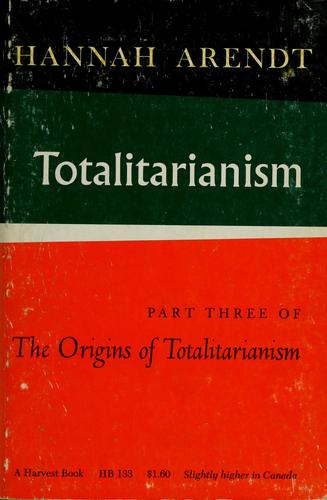

Matthew Royal reviewed Totalitarianism by Hannah Arendt
Review of 'Totalitarianism' on 'Goodreads'
4 stars
The two examples of totalitarianism Earth has on record are the only ones from which we can generalize. While I'm wary of the accuracy of a 2-data point trend line, Hannah Arendt has some interesting observations that serve as warning signs for our society today. Rather than fixating on words labeling ideas, such as "socialism" or "nationalist," Arendt analyzes societal trends that seem to incubate totalitarianism: racism, absolutism, single-party political environments.
Interestingly, totalitarianism doesn't formally replace the previous system in which it metastasized. This book makes me simultaneously realize I need to read more fundamental political theory (Hobbes, Marx) and grow skeptical that any ideologically driven system has all the answers.
Nazi leadership believed: "The more accurately we recognize and observe the laws of nature and life, ... so much the more do we conform to the will of the Almighty. The more insight we have into the will of …
The two examples of totalitarianism Earth has on record are the only ones from which we can generalize. While I'm wary of the accuracy of a 2-data point trend line, Hannah Arendt has some interesting observations that serve as warning signs for our society today. Rather than fixating on words labeling ideas, such as "socialism" or "nationalist," Arendt analyzes societal trends that seem to incubate totalitarianism: racism, absolutism, single-party political environments.
Interestingly, totalitarianism doesn't formally replace the previous system in which it metastasized. This book makes me simultaneously realize I need to read more fundamental political theory (Hobbes, Marx) and grow skeptical that any ideologically driven system has all the answers.
Nazi leadership believed: "The more accurately we recognize and observe the laws of nature and life, ... so much the more do we conform to the will of the Almighty. The more insight we have into the will of the Almighty, the greater will be our successes." The idea was adapted by Stalin in support of dialectical materialism, and the regime practiced the theory that the masses ignore the facts before their eyes, and follow only their imaginations, the best of which are the most consistent. So consistency of ideology wins out over facts. This sounds disturbingly familiar to me, living in the USA today, with the perceived tension between evidence-based approaches and "it will all work out if we just double down on this idea."
Finally, totalitarianism was only possible after the people were insulated from non-sympathizers by the complete politicization of every area of live. Things previously not considered "political" became arms of the ruling party. The party explicitly duplicated Civic and Professional groups in order to undermine and replace the originals, then pushed the idea that "Everything outside the movement is dying," and the only way forward is through the party. All of this is easily attained through Facebook and our filter bubbles now.
While we're still missing a single party system, the US is not far removed from the ideal growth requirements for totalitarianism. It's a reminder to stay vigilant:
- seek out friends with viewpoints different from my own, and engage thoughtfully with them,
- consume information with an active attention to how it can be manipulated and skewed, and
- evaluate the actions that seem necessary from my most solidly held ideals in the light of whether they dehumanize others.