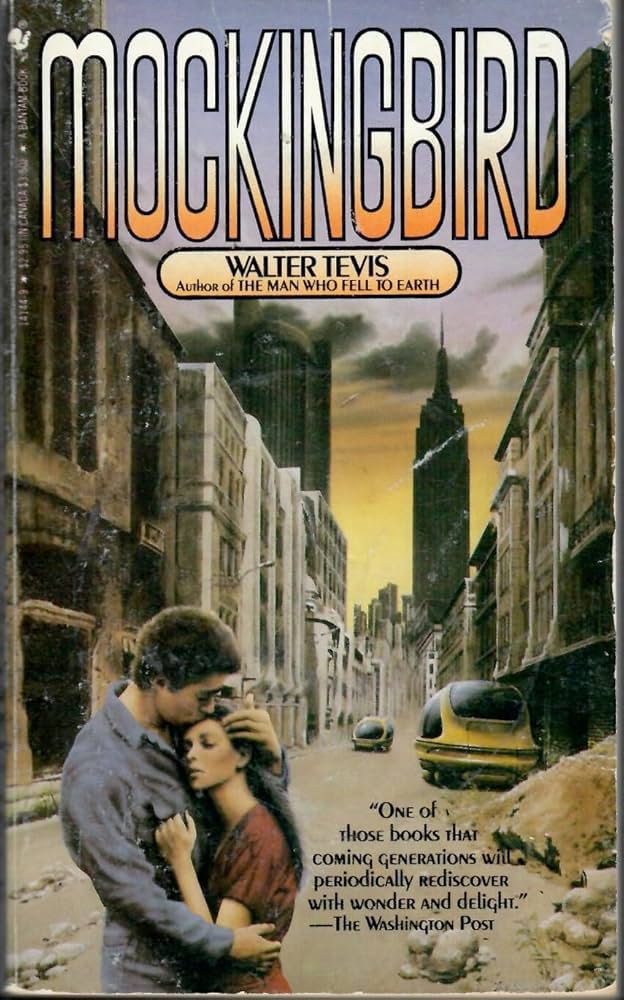

4thace reviewed Mockingbirdii by Walter Tevis
A decent post-apocalyptic story
3 stars
(Copied from Goodreads) There was an interesting setup - a superintelligent android, the man who rediscovered reading, a woman who refused to take the mind-control drugs - but there wasn't the payoff in the end that I was hoping for. The long stretches of diary entries by Paul felt like filler in places, not really fitting in to the rest of the story in any way that led somewhere. I think you are supposed to admire the way he reinvents the emotions of love and compassion for himself, but too much of it comes of as kind of obtuse. Probably for its time the way love and sex were depicted in the book were provocative although it's hard to see them that way now. For a dystopian novel there was a lot less of the atmosphere of doom around our characters than most because of the general breakdown in systems …
(Copied from Goodreads) There was an interesting setup - a superintelligent android, the man who rediscovered reading, a woman who refused to take the mind-control drugs - but there wasn't the payoff in the end that I was hoping for. The long stretches of diary entries by Paul felt like filler in places, not really fitting in to the rest of the story in any way that led somewhere. I think you are supposed to admire the way he reinvents the emotions of love and compassion for himself, but too much of it comes of as kind of obtuse. Probably for its time the way love and sex were depicted in the book were provocative although it's hard to see them that way now. For a dystopian novel there was a lot less of the atmosphere of doom around our characters than most because of the general breakdown in systems that felt to me like it didn't gibe with the idea of a superintelligent being. Perhaps it was the suicidal tendencies that Spofford harbored that ended up being expressed in the world he was supposed to take care of.
(Added 2025-12-06) I listened to the audiobook of this and discovered that I remembered exactly nothing from having read it ten years ago, characters, scenes, the way it ended. I think it was a little hard to believe the account of how Paul taught himself to read when he was young, but it was offset by making him pretty unremarkable in mostother respects. I recognize the section where he is living with the xenophobic Christian community as a critique of evangelical churches in America, which is more poignant at the present moment. it was still hard to get into the mind of Spofford the robot who turns out to have been personally responsible for many of the worst things of the world the dwindling humans were suffering. I liked the character of Mary Lou better in this re-read and the way she gets to make choices for herself in the middle part of the book. When Paul shows back up, however, it felt like she had to put up with a lot of his baggage without being able to express anything she wanted for herself and her child.