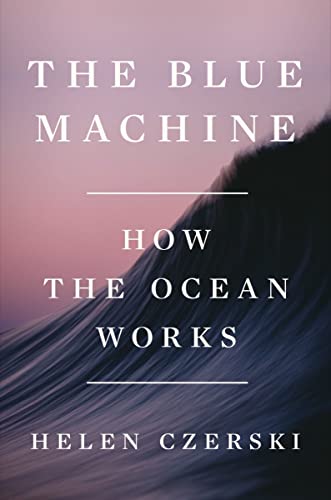
All of Earth's ocean, from the equator to the poles, is a single engine powered by sunlight - a blue machine.
Human history has been dictated by the ocean; the location of cities, access to resources, and the gateway to new lands have all revolved around water. We live inside the weather the ocean generates and breathe in what it breathes out. Yet despite our dependence, our awareness of its totality is minimal.
In a book that will re-calibrate our view of this defining feature of our planet, physicist Helen Czerski dives deep to illuminate the murky depths of the ocean engine, examining the messengers, passengers and voyagers that live in it, travel over it, and survive because of it. From the Ancient Polynesians who navigated the Pacific by reading the waves, to permanent residents of the deep like the Greenland shark that can live for hundreds of …
All of Earth's ocean, from the equator to the poles, is a single engine powered by sunlight - a blue machine.
Human history has been dictated by the ocean; the location of cities, access to resources, and the gateway to new lands have all revolved around water. We live inside the weather the ocean generates and breathe in what it breathes out. Yet despite our dependence, our awareness of its totality is minimal.
In a book that will re-calibrate our view of this defining feature of our planet, physicist Helen Czerski dives deep to illuminate the murky depths of the ocean engine, examining the messengers, passengers and voyagers that live in it, travel over it, and survive because of it. From the Ancient Polynesians who navigated the Pacific by reading the waves, to permanent residents of the deep like the Greenland shark that can live for hundreds of years, she explains by way of vast currents, invisible ocean walls and underwater waterfalls how all have their place in the oceans' complex interlinked system.
Timely, elegant, and passionately argued, The Blue Machine is one of the biggest stories ever told. Its understanding crucial to our future. Drawing on years at the forefront of marine science, Helen Czerski captures the magnitude and subtlety of this complex force, showing us the thrilling extent to which we are at the mercy of this great engine.
The science of oceans with a primary focus on ocean physics. Temperature, salinity, heat, light, sound, mass, pressure. The last third of the book gets more into biology and ecology, though not losing all connection to discussion of physics. All of it fascinating.
The science of oceans with a primary focus on ocean physics. Temperature, salinity, heat, light, sound, mass, pressure. The last third of the book gets more into biology and ecology, though not losing all connection to discussion of physics. All of it fascinating.
A wonderful book about the machine the is the world's oceans.
5 stars
An excellent book about a global machine that people don't often think about: the global ocean. A machine takes in energy and does work, and the author shows how the ocean does that. The ocean takes in the energy of the sun, stores it mainly as heat, and uses it to move water in great currents all over the world. This affects how organisms live, for those at the surface to those living in the depths.
The book starts with showing how the machine works physically. Light from the sun heats the surface, causing evaporation and currents to form as cold water moves in to replace the lost water. The earth's rotation swirls the currents as they move north or south, which are further affected by land masses in their path. The author goes from the equator to the poles, showing how the workings of the machine affect the …
An excellent book about a global machine that people don't often think about: the global ocean. A machine takes in energy and does work, and the author shows how the ocean does that. The ocean takes in the energy of the sun, stores it mainly as heat, and uses it to move water in great currents all over the world. This affects how organisms live, for those at the surface to those living in the depths.
The book starts with showing how the machine works physically. Light from the sun heats the surface, causing evaporation and currents to form as cold water moves in to replace the lost water. The earth's rotation swirls the currents as they move north or south, which are further affected by land masses in their path. The author goes from the equator to the poles, showing how the workings of the machine affect the local conditions in areas.
All of this, of course, affects how organisms will live, by taking advantage of the conditions caused by the machine, whether to move about, eat or to breed. Humans are not exempted, as sailing ships and other early vessels also took advantage of the currents. Reading the currents also allows humans to predict where good fishing ground might be located.
All this human activity has lead to disruptions in the global ecosystem, for marine organisms depend on a predictable machine in order to survive. As an example, whaling lead to a collapse in marine microorganisms because the microorganisms depend on iron to grow, and a major source of iron was whale poop, which is now in short supply. The changing climate has also led to warmer water temperatures and changing currents, which are disrupting the lives of organisms.
In closing, the author offers some thoughts on how to reduce such disruptions. But the major point of the book is to make people more aware of the ocean and the machine that is running in it, and not to treat the oceans as a 'blank spot' that we can all throw our troubles (and refuse) into and not consider the consequences.