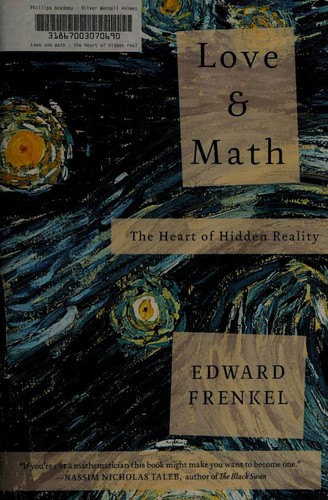

4thace reviewed Love and Math by Edward Frenkel
Review of 'Love and Math' on 'Goodreads'
3 stars
I picked this book up at the library because I have been interested in pure and applied math for a long time now, although I was unacquainted with the author. He has two main subjects he wanted to convey in the book. The first one the story of how hard he had to struggle in the old Soviet system with its semi-official anti-semitism when it came to career advancement and which ended up forcing him to leave just at the time when the country was opening up to the West under Gorbachev. He had some references to mathematical ideas in this section, to provide background on the kinds of problems he was trying to solve, but at a relatively popular level. The second subject begins when he starts to work as a professional full-time mathematician in the West pursuing the Langlands program of unifying three far-flung fields in math along …
I picked this book up at the library because I have been interested in pure and applied math for a long time now, although I was unacquainted with the author. He has two main subjects he wanted to convey in the book. The first one the story of how hard he had to struggle in the old Soviet system with its semi-official anti-semitism when it came to career advancement and which ended up forcing him to leave just at the time when the country was opening up to the West under Gorbachev. He had some references to mathematical ideas in this section, to provide background on the kinds of problems he was trying to solve, but at a relatively popular level. The second subject begins when he starts to work as a professional full-time mathematician in the West pursuing the Langlands program of unifying three far-flung fields in math along with the allied field of quantum physics. This was quite a bit more technical. At the very end, he talks about a couple of collaborative art projects he has been involved with. He wrote for a film project giving the proper context for the word "Love" in title of the book: which refers not to the ordinary emotion between people but the feeling a mathematician has for the beauty of mathematical truths.
I thought the book was interesting, though it seemed odd to think that it would be of widespread appeal with the rather lengthy technical sections with many pages of footnotes. He steers well clear from talking much about his domestic life with his parents and at home during his marriage, preferring to concentrate on what he did professionally. I didn't really know anything about the Langlands program as such before I read this book but had read with interest something about recent theorems connecting number theory, harmonic analysis, and Riemannian surfaces, so this was a good introduction.