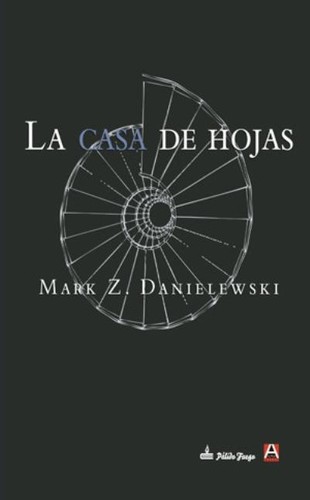
Esta novela —coeditada entre Alpha Decay y Pálido Fuego— es, además de una obra literaria de un valor incalculable, un claro ejemplo de hasta dónde puede llevarnos la imaginación y la creatividad humanas aplicadas a un fin concreto.
Obra maestra de Mark Z. Danielewski, La casa de hojas se compone de dos historias paralelas: la del joven Johnny Truant y su frenética existencia en Los Angeles a principios de los años noventa; y la que se inicia cuando Truant encuentra un manuscrito en la casa de un anciano que acaba de fallecer. Ese manuscrito narra la historia de un matrimonio que se traslada a una casa en el campo. Al poco tiempo, esta familia norteamericana de clase media-alta hace un descubrimiento escalofriante: la casa que habitan es más grande en el interior que en el exterior. Este descubrimiento desencadenará una serie de tramas en las que las mismas unidad …
Esta novela —coeditada entre Alpha Decay y Pálido Fuego— es, además de una obra literaria de un valor incalculable, un claro ejemplo de hasta dónde puede llevarnos la imaginación y la creatividad humanas aplicadas a un fin concreto.
Obra maestra de Mark Z. Danielewski, La casa de hojas se compone de dos historias paralelas: la del joven Johnny Truant y su frenética existencia en Los Angeles a principios de los años noventa; y la que se inicia cuando Truant encuentra un manuscrito en la casa de un anciano que acaba de fallecer. Ese manuscrito narra la historia de un matrimonio que se traslada a una casa en el campo. Al poco tiempo, esta familia norteamericana de clase media-alta hace un descubrimiento escalofriante: la casa que habitan es más grande en el interior que en el exterior. Este descubrimiento desencadenará una serie de tramas en las que las mismas unidad y armonía familiar se verán sometidas a esa arquitectura de pesadilla.
I will open by saying that my estimation of this book may have suffered from its reputation. I generally try not to expose myself to a lot of hype around books I'm interested in, but that was how this one even ended up on my radar. I will also say that it may appeal more to fans of horror (which is not a description I would apply to myself). That is not to say that this is strictly a horror story, but I think it overlaps more with horror than anything else. I was mostly interested because I like weird stuff, and the way this was described made it sound like it qualified there. I suppose it does a bit, but I expected more.
That said, I will give the author some credit, as I imagine this took some thought and effort to put together. I think the presentation …
I will open by saying that my estimation of this book may have suffered from its reputation. I generally try not to expose myself to a lot of hype around books I'm interested in, but that was how this one even ended up on my radar. I will also say that it may appeal more to fans of horror (which is not a description I would apply to myself). That is not to say that this is strictly a horror story, but I think it overlaps more with horror than anything else. I was mostly interested because I like weird stuff, and the way this was described made it sound like it qualified there. I suppose it does a bit, but I expected more.
That said, I will give the author some credit, as I imagine this took some thought and effort to put together. I think the presentation does add another layer of enjoyment, and I like that there are a few little tidbits that open up possibilities for interpretation. However, in my opinion, none of that was enough to overcome the fact that most of the actual contents are fluff wrapped around what amounts to a pretty short story. It's not exactly pointless fluff, because it does play a role, but it is fluff nonetheless. This is where my comment in the title line comes from. A lot of it I didn't even find to be enjoyable fluff, and some of it outright annoyed me.
Despite not loving it, I don't regret reading it, because I would have been forever curious. Clearly there are people who do love it, so if you're curious I'd say it might be worth a shot.
Content warning
Spoilers for some of the unusual features of this book and minor plot details. No major plot details are included.
Mark Z. Danielewski presents a haunted book by Zampanó with haunted commentary by Johnny Truant about a haunted movie about a haunted house that appears to be sentient, full of sprawling corridors that expand and contract. The surreal journeys through the house are amplified by experimental text layouts which describe experimental filmmaking choices, and with an unbelievable number of detailed fake citations, scattered throughout footnote mazes with three different authors, crossed-out paragraphs, text that changes color and orientation, the whole nine yards.
Throughout all of that, House of Leaves never feels gimmicky. Everything is purposeful. The biggest problem is the long-windedness of the passages attributed to Johnny Truant, and their rather un-sexy sex scenes. Those can be skipped, but they are worth reading as they contain a whole other layer of madness to this web of a story.
This was a complicated one. The two star review is based off my immediate gut feeling after I finished it. It's certainly well written and tons of effort went into its creation, which I can dig. But I kinda hated Johnny Truant. His endless boring stories of banging everyone and doing drugs were kind of torturous. Plus, the purple prose and spiraling wordiness of his entries were a drag. I was also frustrated by all the fake scholarship and constant footnotes. Every time I started to get into the story of the house, I had to wade through a few chapters worth of stupid theorizing and microscopic detail analysis of the color of the wife's eyeshadow.
Plus all the typographical clownery. Just because a character is walking down stairs doesn't make it clever to have entire pages resemble them. Come on.
All in all, a very frustrating experience. Also, it …
This was a complicated one. The two star review is based off my immediate gut feeling after I finished it. It's certainly well written and tons of effort went into its creation, which I can dig. But I kinda hated Johnny Truant. His endless boring stories of banging everyone and doing drugs were kind of torturous. Plus, the purple prose and spiraling wordiness of his entries were a drag. I was also frustrated by all the fake scholarship and constant footnotes. Every time I started to get into the story of the house, I had to wade through a few chapters worth of stupid theorizing and microscopic detail analysis of the color of the wife's eyeshadow.
Plus all the typographical clownery. Just because a character is walking down stairs doesn't make it clever to have entire pages resemble them. Come on.
All in all, a very frustrating experience. Also, it was sold to me as one of the great horror stories of the modern age, which had my hopes pretty high. Maybe I just wasn't the target audience for this one. It has been recommended that since I read it in full once, it might be a good idea to revisit and just read the core story, and that it would be much more enjoyable. I may do so.