
4thace started reading An Oral History of Atlantis by Ed Park (duplicate)

Advance reading copy ebook

Refugee from Goodreads. I try to review every book I finish. On Mastodon: noc.social/@Zerofactorial
This link opens in a pop-up window


Advance reading copy ebook

A practical, spiritual guidebook based on the life and teachings of St. Ignatius of Loyola …
Audiobook
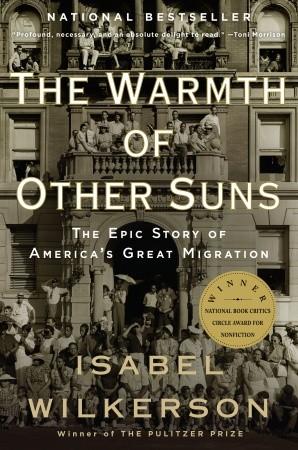
In this epic, beautifully written masterwork, Pulitzer Prize-winning author Isabel Wilkerson chronicles one of the …
This is a big scholarly work written in such a way that the reader can forget how much information is being transmitted. It was quite different from this author's other book, Caste_ The Origins of Our Discontents, which took a more impersonal approach to many of the same issues, more scholarly and less emotional in effect. The migration of millions of American Blacks over the middle decades of the twentieth century transformed both the Jim Crow states and the ones they moved to. It wasn't organized by any one person but came from the life choices of thousands of free Blacks facing lives often only a little better than under slavery when they heard about the opportunities available to them if only they could abandon the place of their birth. They took much of what they knew from the South to inform their new lives and those of their children. …
This is a big scholarly work written in such a way that the reader can forget how much information is being transmitted. It was quite different from this author's other book, Caste_ The Origins of Our Discontents, which took a more impersonal approach to many of the same issues, more scholarly and less emotional in effect. The migration of millions of American Blacks over the middle decades of the twentieth century transformed both the Jim Crow states and the ones they moved to. It wasn't organized by any one person but came from the life choices of thousands of free Blacks facing lives often only a little better than under slavery when they heard about the opportunities available to them if only they could abandon the place of their birth. They took much of what they knew from the South to inform their new lives and those of their children. The racism of the North had rules they had to learn gradually because almost none of it was written down. They had to make new friends and avoid new enemies. And when they couldn't attain all they had dreamt about the disappointment could affect their personality the rest of their life. By learning about their struggles and the experience of many others, the reader gets to know them as well as any fictional character and feels what they felt over decades. By seeing how widely divergent their lives turned out to be one gets a sense of the variety in the millions of unique life journeys during the great migration.
I listened to this as an audiobook narrated by Robin Miles over twenty hours long. some of the passages about brutality were hard to hear and sounded as though they had come from centuries ago, not just decades. By the end I felt as though I gained a greater appreciation of my neighbors and their ancestors.
In this epic, beautifully written masterwork, Pulitzer Prize-winning author Isabel Wilkerson chronicles one of the …
One of the great books of the first quarter of the century
A summer that promises to be eventful turns into something extra special when the four …
This was the third of the Melendy books, in the same country setting of the second one, during World War II. It is a period piece to us today, with the family doing their weekly chores by horse-drawn carriage and grocery purchases subject to rationing. The kids are 90% of the story with a new addition alluded to in the title. This wasn't a baby, which would have been difficult without a mother in the cast, but a local neighbor boy they take in when in one of the two episodes described he finds himself unhoused. The mood of gratitude the boy has for his new home reinforces the cozy, orderly feeling of the books. The rest of the world is far away, intruding only by radio broadcasts and rare long distance telephone calls to Father who spends most of the book away doing Pentagon work. For a week, the …
This was the third of the Melendy books, in the same country setting of the second one, during World War II. It is a period piece to us today, with the family doing their weekly chores by horse-drawn carriage and grocery purchases subject to rationing. The kids are 90% of the story with a new addition alluded to in the title. This wasn't a baby, which would have been difficult without a mother in the cast, but a local neighbor boy they take in when in one of the two episodes described he finds himself unhoused. The mood of gratitude the boy has for his new home reinforces the cozy, orderly feeling of the books. The rest of the world is far away, intruding only by radio broadcasts and rare long distance telephone calls to Father who spends most of the book away doing Pentagon work. For a week, the other adult supervisor, the housekeeper Cuffy, is away to tend to a family matter, so the children are able to live out fantasies of a summer on their own.
The edition I have has an introduction by the author written just after the war about how she came to write about the Melendys. She has a style that borders on sentimentality mixed with gentle humor. The characters spend a lot of time making cute conversation illustrating their various personalities. I wanted to read this book coming off of some harrowing adult fiction, as a light palate cleanser. It would have been easy to re-read it all in one sitting but I don't think it would be as pleasant, like taking too much wartime sugar ration all at once.
These fictional children would be the ones growing up to be the Silent Generation. Raised during trouble times and loyal to an ideal of ordered homogeneous society, accustomed to pinching pennies, I imagine them as being largely skeptical of the changes in the second half of the century. There are no Blacks or immigrants and while there are villains, these are easily identified by the children, and neutralized without much trouble.
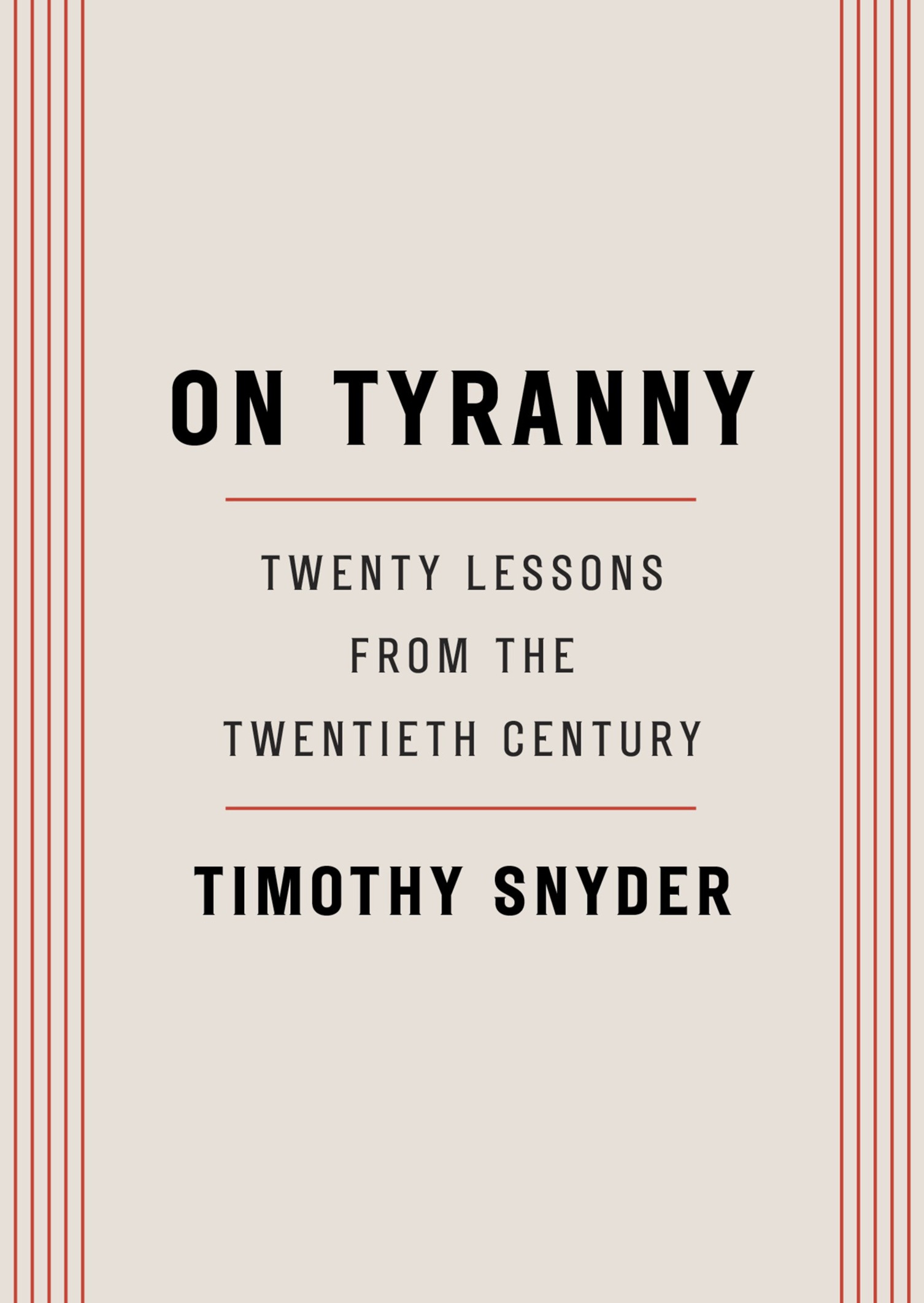
In previous books, Holocaust historian Timothy Snyder dissected the events and values that enabled the …
This short book is having its moment with the dismantling of government institutions in the United States as a backdrop. The pattern of takeover by authoritarian forces happens like the way Mike Campbell describes how his ruin happened in The Sun Also Rises "Two ways. Gradually, then suddenly." There is first an erosion of norms, a bad actor gets a foothold in a place where they can exert influence, then there is a pivotal event like the fire at Germany's Reichstag and then the machinery of free government is taken away. The author organized this book in twenty chapters with titles that encapsulate the whole message. A person alarmed by the threat of state capture can read more context and a justification in the body of each chapter.
At the present time I think the United States hasn't yet blown through the entire process of takeover so I think …
This short book is having its moment with the dismantling of government institutions in the United States as a backdrop. The pattern of takeover by authoritarian forces happens like the way Mike Campbell describes how his ruin happened in The Sun Also Rises "Two ways. Gradually, then suddenly." There is first an erosion of norms, a bad actor gets a foothold in a place where they can exert influence, then there is a pivotal event like the fire at Germany's Reichstag and then the machinery of free government is taken away. The author organized this book in twenty chapters with titles that encapsulate the whole message. A person alarmed by the threat of state capture can read more context and a justification in the body of each chapter.
At the present time I think the United States hasn't yet blown through the entire process of takeover so I think the book might still be of good use. There are multiple countries where citizens' rights are also under attack so it could be a good resource there as well.
In previous books, Holocaust historian Timothy Snyder dissected the events and values that enabled the …
Opportunities for an ordinary person to try making a difference in trying times
In previous books, Holocaust historian Timothy Snyder dissected the events and values that enabled the …
Audiobook on loan from my library

In the third volume of this series the long friendship between the characters of Lenù and Lila is changed as they lead divergent lives in different parts of Italy. There are significantly long sessions where one or the other does not appear but then they reconnect after the tumultuous events, usually by telephone, and it is as though these sections convey the real significance of what just happened. Each manages to reach a certain kind of success but has to navigate stresses in their other relationships and from the larger society. Politics plays a pretty big role in this book, larger than I would expect to see in one by an English speaking writer concentrating on the lives of women in the West. The story is complex with many characters and events from the previous two books impinging on the characters' lives, and I had to work hard more than …
In the third volume of this series the long friendship between the characters of Lenù and Lila is changed as they lead divergent lives in different parts of Italy. There are significantly long sessions where one or the other does not appear but then they reconnect after the tumultuous events, usually by telephone, and it is as though these sections convey the real significance of what just happened. Each manages to reach a certain kind of success but has to navigate stresses in their other relationships and from the larger society. Politics plays a pretty big role in this book, larger than I would expect to see in one by an English speaking writer concentrating on the lives of women in the West. The story is complex with many characters and events from the previous two books impinging on the characters' lives, and I had to work hard more than once to recall just who they were talking about. The writing in English translation is beautiful with long passages here and there with the viewpoint character working out her feelings and coming to surprising insights. There are villains in the course of the plot but even more than that there are ambiguous characters, frequently but not always men, whose actions twist the plot in surprising ways. It is kind of a slow read I took mostly in ten or twenty minute chunks rather than speeding through it all. The settings are more generic than the intense descriptions I remember of Ischia in book two. Really, the only thing distinguishing the new settings was the distance between them which serves to isolate them at critical times. The author is masterful in foreshadowing the hardships that may come to her characters because of their actions and simmering conflicts.
I m going to take a break to ruminate before hitting book four, the last one in the series.
This one had been on my TBR list for a very long time
It took a long time to get through this audiobook, not because of any fault with the writing but because of the harrowing facts dug out of private archives and nationally televised hearings which describe how the bulk of American society has been made irrelevant by organized crime and its friends. The Trumps are in it, of course, but they were covered in the author's previous book so here they just sit on the sidelines, chummy with the likes of Roy Cohn and Senator Joseph McCarthy. There is no hypothesis advanced for why this country is such fertile ground for these conspirators and the ones who advance conspiracy theories, maybe because we don't currently have a good perspective on the immunity other places have had (though not all). The tone of the audiobook is a little breathless as though the burden of telling horrible truths that get ignored, Cassandra-style, is …
It took a long time to get through this audiobook, not because of any fault with the writing but because of the harrowing facts dug out of private archives and nationally televised hearings which describe how the bulk of American society has been made irrelevant by organized crime and its friends. The Trumps are in it, of course, but they were covered in the author's previous book so here they just sit on the sidelines, chummy with the likes of Roy Cohn and Senator Joseph McCarthy. There is no hypothesis advanced for why this country is such fertile ground for these conspirators and the ones who advance conspiracy theories, maybe because we don't currently have a good perspective on the immunity other places have had (though not all). The tone of the audiobook is a little breathless as though the burden of telling horrible truths that get ignored, Cassandra-style, is forcing her to lay it all out there. It is disturbing as hell, and unsettling as it declines to specify a way out of the predicament the country is in. Of course this came out before the 2024 elections but these developments seem of a piece.
Is it an important book? I don't know in the short run, but I wouldn't be surprised if it earns a place in the history of the second Gilded Age when future generations try to piece together why and how this country got to where it is now. Calling out this unhealthy strain as it shows in the past several decades is a public service even if there is no takeaway on what to do about it. I wish there were a champion who had the toughness to take this message out there for people to rally around despite the threats that would almost certainly threaten their safety.
I finished this collection of verified conspiracies at the top in the last century of US politics
Audiobook
The author's message is that there are sicknesses and brokenness that cause people to behave in destructive ways, but in the eyes of God there are no truly bad people, ever. He is not shut away from the real world, either, but has spent his life creating the largest ministry to assist former gang members to try to turn their lives around, and has seen hundreds of his community die from overdose, chronic health problems, or violence. His previous book Tattoos on the Heart is on my list of books to be read. Through a family connection I knew about the work the author was doing before we wrote his two books.
He follows a faith tradition informed by mystic and contemplatives going back hundreds of years at the same time living alongside the kinds of challenges the modern world throws marginalized communities. These include the Covid19 pandemic, extremist …
The author's message is that there are sicknesses and brokenness that cause people to behave in destructive ways, but in the eyes of God there are no truly bad people, ever. He is not shut away from the real world, either, but has spent his life creating the largest ministry to assist former gang members to try to turn their lives around, and has seen hundreds of his community die from overdose, chronic health problems, or violence. His previous book Tattoos on the Heart is on my list of books to be read. Through a family connection I knew about the work the author was doing before we wrote his two books.
He follows a faith tradition informed by mystic and contemplatives going back hundreds of years at the same time living alongside the kinds of challenges the modern world throws marginalized communities. These include the Covid19 pandemic, extremist racism, and a widening wealth gap. I admit I am not myself fully on board with his radical embrace of even the most sadistic and notorious menaces to society but am willing to accept that he must know a lot more about life among people susceptible to gang influence than I could imagine.
At the present time, the enterprise is being run by those it has raised up, and the author is now able to spend most of his time doing national outreach to spread the word about what they have accomplished. Many of the anecdotes involve long distance plane travel by himself with two of the Homeboy community members, who oftentimes have never ventured from the east Los Angeles area where they grew up. He guides them on how to speak in front of a group of strangers who belong to very different cultures, and how to make sense of the way the rest of us deal with the quirks of travel. He doesn't make fun of anyone, but chooses the stories which illuminate what is happening within the hearts of those who have been pulled into gang life but managed to extract themselves with the help of those who cherished them and made them feel that they belonged.
Other stories are set at the Homeboy Industries headquarters where the day-to-day is unlike any other agency I've encountered. We learn what they look for in a prospective trainee making their first steps away from gang life, how they deal with relapses, when they have to tell a trainee that they are not ready to continue. Incarceration and re-entry to the outside world are frequent motifs. The language and details of life on the edge can both get pretty spicy, so if this is a deal-breaker for the reader, this may not be the best book to pick up for them. But if you are looking for an account of life in the shadow of gang violence which isn't sugar-coated, this could be a perfect read.
What the author says is that there are no bad people, full stop. Anyone who commits a heinous act or who expresses hateful opinions or generally makes life worse for people around them is acting contrary to what's in their own best life. For the author, this is a symptom of an inner sickness rather than an evil character, and the best response is to do whatever one can to bring the person back to wellness. This is the function of the Homeboy Industries communities where they live out a message of love to give people who have been raised with hardship a model they can follow. It doesn't mean you never get to feel angry at someone for their behavior or to grieve when they do not live up to your hopes. still, I think to really feel this way in among the residents of the depressed inner city must take some kind of sainthood because of all the cognitive dissonance you have to dispel within yourself. Also, it feels like there can be all sorts of philosophical arguments about what it really means to have no bad people anywhere in the world, as though the term "bad" might simply have been redefined away. Still, I recognize that it can serve a spiritual purpose to live as though the saying were true.
I enjoyed hearing Fr. Greg narrate his own book so he could apply just the right twist to a phrase, or spring one of the many jokes using the gift of timing. And the same goes for the sharpness of the pain that comes across when he recalls a tragedy experienced by one of the Homeboy trainees or their loved ones (he mentions having held nearly 300 funerals in the community over the years). It is an extraordinary account I chose for this year's Advent reading.
It was an extraordinary audiobook which I'll recommend to anyone interested in the subculture served
It was an extraordinary audiobook which I'll recommend to anyone interested in the subculture served