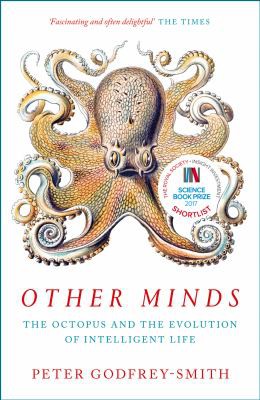
"Peter Godfrey-Smith is a leading philosopher of science. He is also a scuba diver whose underwater videos of warring octopuses have attracted wide notice. In this book, he brings his parallel careers together to tell a bold new story of how nature became aware of itself. Mammals and birds are widely seen as the smartest creatures on earth. But one other branch of the tree of life has also sprouted surprising intelligence: the cephalopods, consisting of the squid, the cuttlefish, and above all the octopus. New research shows that these marvelous creatures display remarkable gifts. What does it mean that intelligence on earth has evolved not once but twice? And that the mind of the octopus is nonetheless so different from our own? Combining science and philosophy with firsthand accounts of his cephalopod encounters, Godfrey-Smith shows how primitive organisms bobbing in the ocean began sending signals to each other and …
"Peter Godfrey-Smith is a leading philosopher of science. He is also a scuba diver whose underwater videos of warring octopuses have attracted wide notice. In this book, he brings his parallel careers together to tell a bold new story of how nature became aware of itself. Mammals and birds are widely seen as the smartest creatures on earth. But one other branch of the tree of life has also sprouted surprising intelligence: the cephalopods, consisting of the squid, the cuttlefish, and above all the octopus. New research shows that these marvelous creatures display remarkable gifts. What does it mean that intelligence on earth has evolved not once but twice? And that the mind of the octopus is nonetheless so different from our own? Combining science and philosophy with firsthand accounts of his cephalopod encounters, Godfrey-Smith shows how primitive organisms bobbing in the ocean began sending signals to each other and how these early forms of communication gave rise to the advanced nervous systems that permit cephalopods to change colors and human beings to speak. By tracing the problem of consciousness back to its roots and comparing the human brain to its most alien and perhaps most remarkable animal relative, Godfrey-Smith's Other Minds sheds new light on one of our most abiding mysteries." -- Goodreads.com summary.
Octopusses and buttlefish - cephalopods in general - are fascinating and inteligent creatures. Overall, a captivating exploration of consciousness focusing on the possibility of its existence in other animals. Scientific inquiry is perfectly blended with philosophical reflection, which takes you on a fascinating journey through the evolution of nervous systems and the emergence of subjective experience.
Good insights into what the definition of intelligence can be, and identifying our own chordate biases when approaching the development of artificial intelligence.
At points, he waxes philosophical, but never very deeply. I'd be more interested in examining how our monolithic human brain biases us when we think about our thoughts, our bodies, or intelligence. Explore the idea that our integrated subjective experience called "consciousness" is largely independent of our body's mechanisms for deciding to lift our arms or move toward food, as measured by neuroscientists who (perhaps wrongly) interpret it as neurological proof of our lack of "free will."
Even speculation into octopus qualia -- what does it feel like to be an octopus with semi-autonomous limbs -- or perhaps some thought experiments drawing analogies between human patients with inactivated brain regions vs an octopus with missing limbs.
Interesting, if a bit unfocused. The news that cephalopods use extensive …
Good insights into what the definition of intelligence can be, and identifying our own chordate biases when approaching the development of artificial intelligence.
At points, he waxes philosophical, but never very deeply. I'd be more interested in examining how our monolithic human brain biases us when we think about our thoughts, our bodies, or intelligence. Explore the idea that our integrated subjective experience called "consciousness" is largely independent of our body's mechanisms for deciding to lift our arms or move toward food, as measured by neuroscientists who (perhaps wrongly) interpret it as neurological proof of our lack of "free will."
Even speculation into octopus qualia -- what does it feel like to be an octopus with semi-autonomous limbs -- or perhaps some thought experiments drawing analogies between human patients with inactivated brain regions vs an octopus with missing limbs.
Interesting, if a bit unfocused. The news that cephalopods use extensive RNA editing to modify their brain structure came out about 4-5 months after this book was published, but I can't help but feeling that the author tilted more toward the side of diving into the water and playing with them to collect fun stories rather than toward the side of studying them in a lab and understanding the underlying physical mechanics. Even Disney in the movie "Finding Dory" spent considerable time writing software to simulate the physics and autonomy of Hank the octopus's limbs.