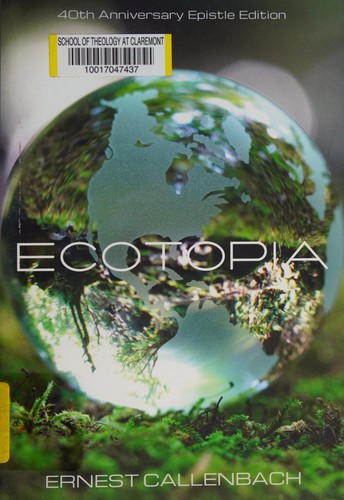
"Twenty years have passed since Northern California, Oregon, and Washington seceded from the United States to create a new nation, Ectopia. Rumors abound of barbaric war games, tree worship, revolutionary politics, sexual extravagance. Now this mysterious country admits its first American visitor: investigative reporter Will Weston, whose dispatches alternate between shock and admiration. But Ectopia gradually unravels everything Weston knows to be true about government and human nature itself, forcing him to choose between two competing views of civilization"--Back cover.
"Twenty years have passed since Northern California, Oregon, and Washington seceded from the United States to create a new nation, Ectopia. Rumors abound of barbaric war games, tree worship, revolutionary politics, sexual extravagance. Now this mysterious country admits its first American visitor: investigative reporter Will Weston, whose dispatches alternate between shock and admiration. But Ectopia gradually unravels everything Weston knows to be true about government and human nature itself, forcing him to choose between two competing views of civilization"--Back cover.
Habe Ökotopia vor gut 40 Jahren gelesen. Auch wenn es literarisch nicht gerade der Bringer ist, hat es mich und meine "bubble" (gab's damals ja eigentlich noch nicht) doch beschäftigt. Zumindest für Jugendliche und junge Erwachsene finde ich das Buch immer noch empfehlenswert.
Habe Ökotopia vor gut 40 Jahren gelesen. Auch wenn es literarisch nicht gerade der Bringer ist, hat es mich und meine "bubble" (gab's damals ja eigentlich noch nicht) doch beschäftigt.
Zumindest für Jugendliche und junge Erwachsene finde ich das Buch immer noch empfehlenswert.
Ein klassischer utopischer Roman. Ein Teil des Landes hat sich von der USA abgespalten um eine alternative Gesellschaft aufzubauen. Diese verwirklicht im weitesten Sinne ökosozialistische Ideen. Ein Reporter aus den USA besucht diese Welt und stellt allerlei interessante Entwicklungen fest. Viele der Ideen, die der Autor in den 70er Jahren des letzten Jahrhunderts formulierte, finden sich heute als Lösungsansätze zum Umgang der der Klimakrise: Weitgehender Verzicht auf fossile Rohstoffe, Nutzung von erneuerbaren Energiequellen, Ausbau des öffentlichen Personenverkehrs usw. Das ist interessant und erfrischend, da der Roman im Grunde die Solarpunk-Utopien vorweggenommen hat. Man möchte nicht allen Ideen von Ökotopia folgen, aber zentral ist ein radikaldemokratisches politisches System und somit sind sämtliche Aspekte ja auch ver- und aushandelbar. Bin der Ideenwelt schon interessant , leider ist die Story ein wenig mau.
Ein klassischer utopischer Roman. Ein Teil des Landes hat sich von der USA abgespalten um eine alternative Gesellschaft aufzubauen. Diese verwirklicht im weitesten Sinne ökosozialistische Ideen. Ein Reporter aus den USA besucht diese Welt und stellt allerlei interessante Entwicklungen fest.
Viele der Ideen, die der Autor in den 70er Jahren des letzten Jahrhunderts formulierte, finden sich heute als Lösungsansätze zum Umgang der der Klimakrise: Weitgehender Verzicht auf fossile Rohstoffe, Nutzung von erneuerbaren Energiequellen, Ausbau des öffentlichen Personenverkehrs usw. Das ist interessant und erfrischend, da der Roman im Grunde die Solarpunk-Utopien vorweggenommen hat.
Man möchte nicht allen Ideen von Ökotopia folgen, aber zentral ist ein radikaldemokratisches politisches System und somit sind sämtliche Aspekte ja auch ver- und aushandelbar. Bin der Ideenwelt schon interessant , leider ist die Story ein wenig mau.
Overall I enjoyed Callenbach's visions of a hopeful future. A few things felt out of place to me though:
The first was the "war games" which just didn't quite fit with the rest of the society, in my mind. It's quite possible I'm just missing something, but I couldn't understand why they were included or what their place in the functioning of the society was supposed to be (as a vent for toxic masculinity to express itself so that it doesn't permeate into every day life, maybe? It seems like this could be done with less injury). They're also part of broader problematic appropriation of indigenous culture by the almost exclusively white cast (more on that in a bit) in the book in a way that feels a bit tropey, which I didn't love.
Similarly, there's a very out-of-place feeling chapter in the middle where he randomly says …
Overall I enjoyed Callenbach's visions of a hopeful future. A few things felt out of place to me though:
The first was the "war games" which just didn't quite fit with the rest of the society, in my mind. It's quite possible I'm just missing something, but I couldn't understand why they were included or what their place in the functioning of the society was supposed to be (as a vent for toxic masculinity to express itself so that it doesn't permeate into every day life, maybe? It seems like this could be done with less injury). They're also part of broader problematic appropriation of indigenous culture by the almost exclusively white cast (more on that in a bit) in the book in a way that feels a bit tropey, which I didn't love.
Similarly, there's a very out-of-place feeling chapter in the middle where he randomly says (paraphrasing): "and of course integration doesn't work, so the black people have their own cities". Whoa, where did that come from? He tries to launder the idea into sounding virtuous by saying (again, paraphrasing) "but they were the ones who chose it for themselves and their cities are also doing well, it's no longer 'separate but equal', there really is a measure of economic justice", and, oddly, by having the (white) American be slightly disappointed by this situation, but again I just couldn't figure out why in the world that would be in there or what purpose it was supposed to have in the society. It really felt like he was trying to justify a personal view that he knew was wrong.
I suppose none of this is surprising from a white man in 1975, it's just so shocking how little it fits with the society he envisions in the rest of the book. Those 10 or so pages just really knocked it down a few notches for me. A brief search didn't turn up him ever having been asked about it, but if he was or if a future book addresses these problems further I'd love to know.