
Review of 'Misreading Scripture With Western Eyes' on 'Goodreads'
3 stars
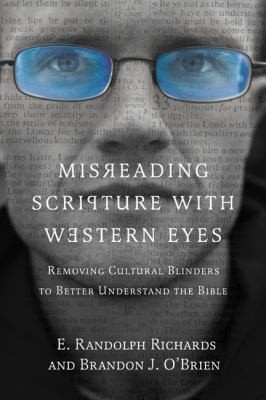
The main message of this book is that a Western reader is all too likely to bring a couple of biases when trying to understand stories from the Bible because of some major differences that contemporary secular culture has compared to those of the cultures of the original authors. The first is a more individualistic way of understanding directives as opposed to a communitarian, tribal-based understanding. One of the two authors brings out numerous examples from his experience in the communitarian cultures of rural Indonesia while on mission, which probably isn't exactly the same as where the biblical authors were coming from but closter to the the pronounced emphasis on the self in Western culture. The examples of incidents in the scripture which transform in meaning when considered as addressing an entire community or nation rather than an isolated reader are quite helpful and lend credence to this topic.
The …
The main message of this book is that a Western reader is all too likely to bring a couple of biases when trying to understand stories from the Bible because of some major differences that contemporary secular culture has compared to those of the cultures of the original authors. The first is a more individualistic way of understanding directives as opposed to a communitarian, tribal-based understanding. One of the two authors brings out numerous examples from his experience in the communitarian cultures of rural Indonesia while on mission, which probably isn't exactly the same as where the biblical authors were coming from but closter to the the pronounced emphasis on the self in Western culture. The examples of incidents in the scripture which transform in meaning when considered as addressing an entire community or nation rather than an isolated reader are quite helpful and lend credence to this topic.
The other is how our idea of private shame and guilt is contrasted with public shaming before the entire community in ancient times, where it was one of the most extreme penalties to be applied to one considered to be a wrongdoer. Again, there are examples with citations which make the point clearer. They do not break down the object of shame too much according to social rank, gender, free vs. slave but it is pretty clear that readers have to be on the lookout for these dimensions as well.
The authors are not strongly in the camp of literal interpretation of Scripture, which I appreciated, or at least it did not come off as strongly Fundamentalist exegisis. My guess is that they are coming from a broadly mainstream mainline US Protestant perspective, but sensitive to a wider audience. The narrator of the audiobook did a decent job of communicating the authors' ideas, distinguishing between the two of them by name where one of them was responsible for a particular observation.