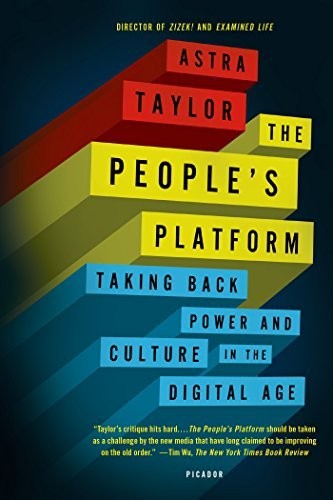
The People's Platform argues that for all our 'sharing', 'up-voting', and 'liking', the Internet reflects real-world inequalities as much as it reduces them. Attention and influence accrue to those who already have plenty of both. Cultural products are primarily valued as opportunities for data collection, while creators receive little or no compensation for their efforts. And we pay for our 'free' access to content and services with our privacy, offering up our personal information to advertisers.
We can do better. Employing a mixture of reportage, research and her own experiences working in a creative field, Astra Taylor not only offers an audacious rebuttal to the current Internet orthodoxy, she also presents viable solutions to our predicament. If we want the Internet to be a people's platfrom, we will have to make so.
The People's Platform argues that for all our 'sharing', 'up-voting', and 'liking', the Internet reflects real-world inequalities as much as it reduces them. Attention and influence accrue to those who already have plenty of both. Cultural products are primarily valued as opportunities for data collection, while creators receive little or no compensation for their efforts. And we pay for our 'free' access to content and services with our privacy, offering up our personal information to advertisers.
We can do better. Employing a mixture of reportage, research and her own experiences working in a creative field, Astra Taylor not only offers an audacious rebuttal to the current Internet orthodoxy, she also presents viable solutions to our predicament. If we want the Internet to be a people's platfrom, we will have to make so.
I love this book and all of Astra Taylor’s writings. She’s a great columnist for the baffler. Totally righteous take On the possibilities the Internet allows and the way they’ve been hijacked by capitalism and social media. A bit dated at this point but still great.
Every major advance in 20th century communications technology brought a promise of mass education, and popular control. Radio was to bring a School of the Air; trade unions owned radio stations to organize and educate on the public airwaves. It wound up being a terrific way to sell soap. Television brought Broadway to the masses, and ended up a vast wasteland. Cable was to bring public access and a low barrier to entry to create new networks dedicated to the public good. We know how that turned out. And now, the Internet.
Astra Taylor does a good job of explaining how the Internet has so much promise to democratize media and give artists, musicians and writers new ways of reaching the public, but wonders what the price of that access will be. When filmmakers like herself are encouraged to distribute their work for free ('it's good exposure," is the cry), …
Every major advance in 20th century communications technology brought a promise of mass education, and popular control. Radio was to bring a School of the Air; trade unions owned radio stations to organize and educate on the public airwaves. It wound up being a terrific way to sell soap. Television brought Broadway to the masses, and ended up a vast wasteland. Cable was to bring public access and a low barrier to entry to create new networks dedicated to the public good. We know how that turned out. And now, the Internet.
Astra Taylor does a good job of explaining how the Internet has so much promise to democratize media and give artists, musicians and writers new ways of reaching the public, but wonders what the price of that access will be. When filmmakers like herself are encouraged to distribute their work for free ('it's good exposure," is the cry), you wonder whether we're creating more starving artists in the new century.
Taylor is solid in describing how the big corporations (old and new media) have again gained the upper hand in the battle for control of the Internet. Where she fails is in her offer as a solution. Her Manifesto for Sustainable Culture is more about allowing creatives the right to make a living (nothing wrong with that, BTW), less about "taking back power." That was disappointing to me