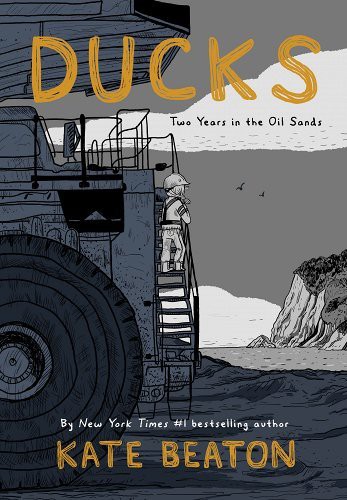

Ducks
4 stars
1) Cape Breton used to export fish, coal, and steel; but in 2005, its main export is people. It's not a unique story in Atlantic Canada. Nor is it a new one. Every Cape Breton family has had its share of empty chairs around the table, for a hundred years. Fathers, siblings, cousins; gone to the "Boston States," gone to Ontario, gone to Alberta—gone to be cheap labour where booming industries demanded it. The only message we got about a better future was that we had to leave home to find one. We did not question it, because this is the have-not region of a have-not province, and it has not boomed here in generations. I need to tell you this—there is no knowing Cape Breton without knowing how deeply ingrained two diametrically opposed experiences are: A deep love for home, and the knowledge of how frequently we have to …
1) Cape Breton used to export fish, coal, and steel; but in 2005, its main export is people. It's not a unique story in Atlantic Canada. Nor is it a new one. Every Cape Breton family has had its share of empty chairs around the table, for a hundred years. Fathers, siblings, cousins; gone to the "Boston States," gone to Ontario, gone to Alberta—gone to be cheap labour where booming industries demanded it. The only message we got about a better future was that we had to leave home to find one. We did not question it, because this is the have-not region of a have-not province, and it has not boomed here in generations. I need to tell you this—there is no knowing Cape Breton without knowing how deeply ingrained two diametrically opposed experiences are: A deep love for home, and the knowledge of how frequently we have to leave it to find work somewhere else.
2) "How's the dead hour treating you?" "It is quiet, why?" "'Course it is. It's the Newfoundland radio hour. Everyone is sitting in their trucks." "No mistaking that, I guess." "Aren't you from there?" "No. Cape Breton." "Same thing." "Excuse me, two different places! They're accordians and codfish, we're fiddles and lobster." "For god's sake."
3) "These young ones! Spending their money like fools." "That's not true now. I works hard for my pay!" "Jesus, got to enjoy life a bit too." "Wife's got the house she wants." "Houses too big, brand new trucks, piles of toys—you're only digging a hole." "Ha. Yeah, a hole that's full of oil for a hundred more years." "The Grand Banks were full too." "Jumpin' dyin' Jesus bah we's on a dory is it! The Grand fuckin' Banks is it!" "All I'm saying is you only knows the good times, don't you. Let me tell you my son, that don't last. You can't make it. It's not up to you." "..." "Ambrose—were you a fisherman, before?" "I'm still a fisherman. I'm just here."
4) "Doug, why are there so many of us here?" "Who?" "From home. Why are there so many of us here. Why here?" "Why not." "Well, people could go anywhere. But we're all here instead." "This is where the jobs are." "I know not just us. Half of Newfoundland is here. The U.K. The Philippines. But still, you could go to Toronto, somewhere else." "Toronto! And what am I going to do in Toronto! Why didn't you go to goddamned Toronto!" "I know. I know! I know I couldn't pay my debt there. I'm just... thinking. Do you think this place makes people better or worse?" "Wha??" "Well, camp's not a normal place, is it? Nobody likes it here. Everyone wishes they were somewhere else." "I've seen worse. Got a bed here, food. And the money." "Do you like it here?" "Doesn't matter." "Doug?" "What." "What did you do before you came here?" "I did it all. I did everything." "Were you a coal miner?" "Jesus, was I a coal miner? Coal, fishing, steel... But that's all gone, isn't it."
5) "You draw comics? You should make a website. Me and my friend have a comics website." "Really? How do I do that?"
6) "Did you hear about those ducks?" "Ducks?" "Yeah. Like three hundred of them got stuck in a tailings pond down by Syncrude or somewhere." "Really? Ugh, I used to work there."