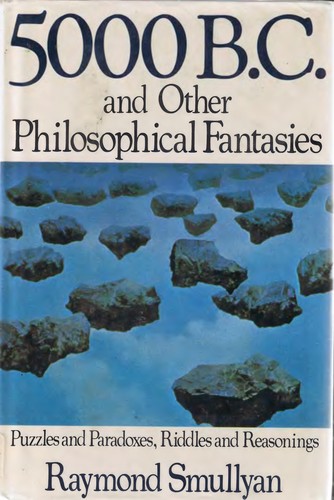

Review of '5000 B.C. and Other Philosophical Fantasies' on 'Storygraph'
3 stars
Due to the nature of its content, this book is much shorter than it seems. Regardless, it is quite good. There are a few puzzles and paradoxes in the miscellany, as one might expect from Smullyan, but most of the text is taken up by dialogues. An assortment of philosophers, epistemologists, moralists, theologians, ontologists, and such are invariably gathered around for whatever reason, and they quarrel over seemingly simple phenomena. I found this terribly amusing all throughout, but then philosophical humor is new to me. The interlocutors often react with a sort of charming bafflement towards each other; it brings to mind a sort of scholarly archetype that I enjoy. A nice benefit of this style is that many interesting views can be expressed quickly and with great clarity. For the first half or so of this book, I was ready to give it five stars and call this my …
Due to the nature of its content, this book is much shorter than it seems. Regardless, it is quite good. There are a few puzzles and paradoxes in the miscellany, as one might expect from Smullyan, but most of the text is taken up by dialogues. An assortment of philosophers, epistemologists, moralists, theologians, ontologists, and such are invariably gathered around for whatever reason, and they quarrel over seemingly simple phenomena. I found this terribly amusing all throughout, but then philosophical humor is new to me. The interlocutors often react with a sort of charming bafflement towards each other; it brings to mind a sort of scholarly archetype that I enjoy. A nice benefit of this style is that many interesting views can be expressed quickly and with great clarity. For the first half or so of this book, I was ready to give it five stars and call this my new favorite genre.
Unfortunately, it quickly became apparent from then on exactly which characters and philosophical standpoints Smullyan himself identifies with. This is not necessarily a bad thing, if from the onset one has some argument to make and has decided to use dialectic methods to go about it. However, as I understood it, that was not the premise of this book. I'm not a huge fan of dialectics because the counter arguments offered by the author's foils rarely predict my own objections. Also, no matter how objective the author really is, I usually cannot escape the impression that these counters are straw men. Consequently, as soon as I realized whose corner Smullyan was in, I could no longer see each character's perspective as independent or equally valid.
I still plan to read more of the author's work, and knowing his true take on things didn't ruin the book. It helps that he is a Taoist, which I find impossible to disagree with (or comprehend) anyway.