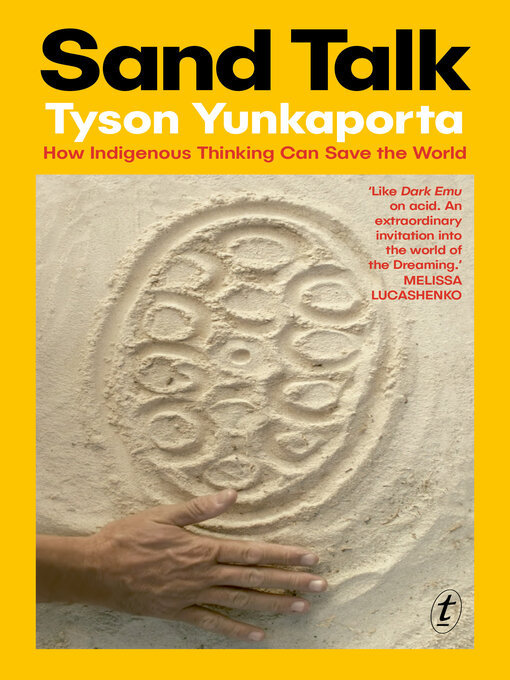
This remarkable book is about everything from echidnas to evolution, cosmology to cooking, sex and science and spirits to Schr dinger's cat. Tyson Yunkaporta looks at global systems from an Indigenous perspective. He asks how contemporary life diverges from the pattern of creation. How does this affect us? How can we do things differently? Sand Talk provides a template for living. It's about how lines and symbols and shapes can help us make sense of the world. It's about how we learn and how we remember. It's about talking to everybody and listening carefully. It's about finding different ways to look at things. Most of all it's about Indigenous thinking, and how it can save the world.
This remarkable book is about everything from echidnas to evolution, cosmology to cooking, sex and science and spirits to Schr dinger's cat. Tyson Yunkaporta looks at global systems from an Indigenous perspective. He asks how contemporary life diverges from the pattern of creation. How does this affect us? How can we do things differently? Sand Talk provides a template for living. It's about how lines and symbols and shapes can help us make sense of the world. It's about how we learn and how we remember. It's about talking to everybody and listening carefully. It's about finding different ways to look at things. Most of all it's about Indigenous thinking, and how it can save the world.
Yarning about the ways of Indigenous knowledge. Insightful, sometimes impenetrable, with a bit of bullshit. The barest exposure, but what next? How to incorporate this into our worldview?
The Bad Does this book live up to its title? Not in the slightest. As others have stated, this book has little to do with indigenous thinking changing the world. Sure, there are moments in which an approach or idea could be useful when applied at scale, but the title overpromises on what are incredibly broad ways of understanding the world. Further, indigenous thinking and culture is by its nature relegated to only small groups of people, and so I see no real place for the non-indigenous majority to adopt any of what is described in the book - you can’t just become indigenous. I doubt that this is the fault of Yunkaporta, however, and was likely some sort of marketing push to sell more copies of an otherwise challenging and pertinent assortment of essays.
The Claims That Don’t Add Up; Or, Overgeneralising the West Yunkaporta …
The Bad Does this book live up to its title? Not in the slightest. As others have stated, this book has little to do with indigenous thinking changing the world. Sure, there are moments in which an approach or idea could be useful when applied at scale, but the title overpromises on what are incredibly broad ways of understanding the world. Further, indigenous thinking and culture is by its nature relegated to only small groups of people, and so I see no real place for the non-indigenous majority to adopt any of what is described in the book - you can’t just become indigenous. I doubt that this is the fault of Yunkaporta, however, and was likely some sort of marketing push to sell more copies of an otherwise challenging and pertinent assortment of essays.
The Claims That Don’t Add Up; Or, Overgeneralising the West Yunkaporta makes claims throughout the book, both about the nature of Western culture and history, and about certain events or processes, that just don’t add up. He generally makes a point of overgeneralising the nature of Western knowledge production, leading to some bizarre conjectures throughout the book. Perhaps this was just to provide a clear contrast to what he perceives his own culture does instead, but I felt it discredited his overall argument against simplistic thinking. Some examples of this include the assertion that vitamin D deficiency due to anti-skin cancer campaigns has killed more people than the cancer would have and that neural changes caused by literacy are abhorrent. Such claims are both bizarre and have no basis in any research that I’ve been able to find. In fact, this book is largely devoid of references, but maybe I’m missing the point of in insisting upon that.
The Things Left Unsaid Certain key issues as far as indigenous cultures and knowledge systems were glossed over, or dismissed without adequate discussion. On the case of domestic abuse and paedophilia in Australian indigenous communities, Yunkaporta fails to truly address the issues of today and instead focuses on potential bad reporting of observers during first contact. He further goes on to essentially explain that paedophilia isn’t an issue because traditionally adolescence was not extended as it now is and that it wasn’t just old men preying on young girls, it was old women praying on young boys too! I guess that makes it ok then?
The Good Making Epistemology Accessible Though I have studied epistemology (theory of knowledge) to some degree before, I think that Yunkaporta’s explanations of ‘ways of knowing’ and ‘indigenous knowledge systems’ as concepts were both effective and accessible. He did a fantastic job (from an outside perspective) of conveying cultural beliefs and practices that usually appear either foreign or quaint to non-indigenous people, and was further able to convey the importance of indigenous knowledge systems far better than anything else I have encountered.
A Compelling Challenge This book will likely challenge things you take advantage of in your worldview, things you didn’t even consider to be part of any worldview at all. Yunkaporta does this in a way that is fascinating and accessible through a melding of art, memoir and analysis (as he calls it: “yarning”.) For this reason alone, this book is a worthy read for anyone vaguely interested in philosophy or world history. I recommend taking this book slowly to try and fully understand it, you’ll get far more out of mulling these ideas over than trying to ram them into your likely very differently wired skull. As with any non-fiction, however, don’t take Yunkaporta’s word for gospel. He readily admits he’s no expert in either Indigenous cultures or the Western cultures he often critiques, so approach any broad claims about either with some respect and skepticism.