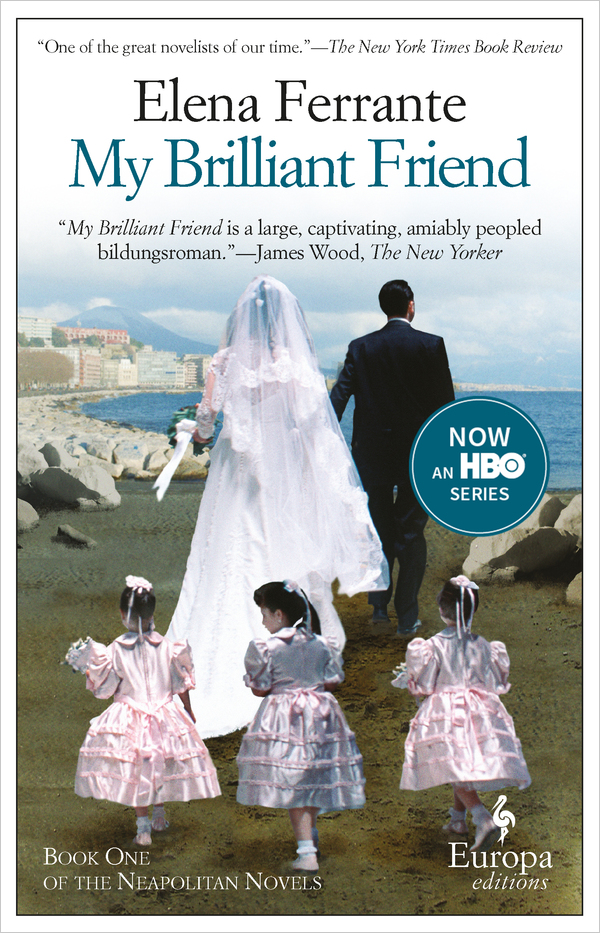
From one of Italy's most acclaimed authors, comes this ravishing and generous-hearted novel about a friendship that lasts a lifetime. The story of Elena and Lila begins in the 1950s in a poor but vibrant neighborhood on the outskirts of Naples. Growing up on these tough streets the two girls learn to rely on each other ahead of anyone or anything else, as their friendship, beautifully and meticulously rendered, becomes a not always perfect shelter from hardship. Ferrante has created a memorable portrait of two women, but My Brilliant Friend is also the story of a nation. Through the lives of Elena and Lila, Ferrante gives her readers the story of a neighborhood, a city, and a country undergoing momentous change. --front flap
From one of Italy's most acclaimed authors, comes this ravishing and generous-hearted novel about a friendship that lasts a lifetime. The story of Elena and Lila begins in the 1950s in a poor but vibrant neighborhood on the outskirts of Naples. Growing up on these tough streets the two girls learn to rely on each other ahead of anyone or anything else, as their friendship, beautifully and meticulously rendered, becomes a not always perfect shelter from hardship. Ferrante has created a memorable portrait of two women, but My Brilliant Friend is also the story of a nation. Through the lives of Elena and Lila, Ferrante gives her readers the story of a neighborhood, a city, and a country undergoing momentous change.
--front flap
I had thought this novel was light (I'm not sure why, the name, the cover?). It definitely is not. It's about dealing with social violence and even psychopathy, all while growing up.
But it's written so well. And the narrator's friend is a character for the ages.
Be ready to read the next in the series; this book ends on what felt to me like an inciting incident of a climax. Not exactly a cliff-hanger, but I need to continue.
I had thought this novel was light (I'm not sure why, the name, the cover?). It definitely is not. It's about dealing with social violence and even psychopathy, all while growing up.
But it's written so well. And the narrator's friend is a character for the ages.
Be ready to read the next in the series; this book ends on what felt to me like an inciting incident of a climax. Not exactly a cliff-hanger, but I need to continue.
I read on Wikipedia that the four volumes of the series constitute a single work, according to the pseudonymous author, and so it is fudging a little to be writing a review of only the first quarter. I do not know how long it will be before I get to those installments, though, and it's convenient to be able to share my impressions so far with anyone thinking of also plunging in at the beginning. It is a thrilling experience to begin to understand why the work has gotten so much attention.
And because of this I am hedging a bit with my Goodreads star rating because I need to leave some room for the successive volumes to surpass the establishing one. I hope that will happen, anyway.
This first book has a large number of large characters surrounding the two girls at the center as they negotiate the passage …
I read on Wikipedia that the four volumes of the series constitute a single work, according to the pseudonymous author, and so it is fudging a little to be writing a review of only the first quarter. I do not know how long it will be before I get to those installments, though, and it's convenient to be able to share my impressions so far with anyone thinking of also plunging in at the beginning. It is a thrilling experience to begin to understand why the work has gotten so much attention.
And because of this I am hedging a bit with my Goodreads star rating because I need to leave some room for the successive volumes to surpass the establishing one. I hope that will happen, anyway.
This first book has a large number of large characters surrounding the two girls at the center as they negotiate the passage from girlhood to womanhood during the 1950s in Italy. There were a few times where I had to concentrate hard to keep straight some of the secondary characters and what they were in relation to the narrator. Her friend Lila is the one whose presence looms most forcefully throughout the story, with her contradictions and her powerful personality, and it was a surprise at one point in the book when it is out of her mouth that she says the words that are the title of this volume, referring to the narrator, instead of the other way around. The contrast between them is not wide as viewed by the reader but feels wider through the subjectivity of the narrator as early teen. It is not so much that this is an unreliable narrator as one whose emotions and judgments are conditioned by her precise situation at the time. While she is studious and feels unattractive, you get the feeling that it is only a little distance to Lila's mental capabilities and innate ability to captivate men's attentions all told. And if Lila is portrayed as reckless and daring, it is the narrator who finds out that she has taken bigger chances with boyfriends and men during the course of the book.
The audiobook narration by Hillary Huber felt like just the right performance to complement the book, warm, mature without prior judgment. I am looking forward to listening to the other volumes in the series presented in her voice. I am guessing that the stakes are going to be raised as the characters navigate their ways through early adulthood, and maybe some changes brought about by national and global changes as they move in to the 1960s and beyond.
The world is a frightening place in this book. The household is no sanctuary for a child, nor is school, and unless a child has the luck of being accepted into some organization that protects its members (the city government, organized crime syndicates, a wealthy ancestry) they are under enormous pressure to clutch after whatever morsels of success come within reach. The narrator found herself talented at school subjects, though not as much out as a natural gift as a willingness to devote long hours after school to her lessons. By contrast, her friend Lila did have a certain instinctual genius in a number of areas, but had the additional handicap of being held back by even more meager family circumstances. When Lila thinks she has found a way out of her predicament by the end of the book, you have a feeling of impending ruin because nothing in the story has suggested that this world would offer up any easy solutions to anyone there. It is all beautifully depicted.
I'm kicking myself because the other books in this series are packed away in boxes somewhere in the Atlantic. I usually have a rule about reading more than one book by an author in a row, but upon finishing this book all I want to do is move on to the next. This is the third Ferrante novel I have read, and all have had the same effect.
I'm kicking myself because the other books in this series are packed away in boxes somewhere in the Atlantic. I usually have a rule about reading more than one book by an author in a row, but upon finishing this book all I want to do is move on to the next. This is the third Ferrante novel I have read, and all have had the same effect.