I don't recall how this self-help book got on my to-read list, unfortunately. I am not in the stage of life where I can apply the principles being taught here, which are intended for a young person trying to get established. I would say that now happiness is not tied to a paycheck now but self-actualization is important. So the advice to do your research, aim high, make a stab at doing something on your own, refining what you deliver until you find traction are all familiar but not super relevant.
I was a little unnerved at the beginning when he spoke about some people whose fans make me nervous: people like Robert Kiyosaki, Marianne Williamson, Scott Adams, Robert Greene, Scott Adams, and Peter Thiel. But to his credit the author specifically disavows any claim that the road to success is easily attainable or within anyone's grasp. He even …
I don't recall how this self-help book got on my to-read list, unfortunately. I am not in the stage of life where I can apply the principles being taught here, which are intended for a young person trying to get established. I would say that now happiness is not tied to a paycheck now but self-actualization is important. So the advice to do your research, aim high, make a stab at doing something on your own, refining what you deliver until you find traction are all familiar but not super relevant.
I was a little unnerved at the beginning when he spoke about some people whose fans make me nervous: people like Robert Kiyosaki, Marianne Williamson, Scott Adams, Robert Greene, Scott Adams, and Peter Thiel. But to his credit the author specifically disavows any claim that the road to success is easily attainable or within anyone's grasp. He even warns against the "hustle culture" which is more likely to lead to burnout than to a unicorn startup. Mainly he argues against beginning with a defeatist mindset which is a quick path to giving up prematurely.
He is mainly talking about his own experience at leaving the wage slave life in favor of becoming a self-made entrepreneur and aspiring vision leader. While this can be a good place to start, I don't feel he adequately acknowledges those life situations that can put the brakes on forward progress in this manner: no access to capital, being a caregiver, health issues, substance addiction, victims of violence. Sure, there are ways to start a blog or mailing list without putting money down, in between other responsibilities and challenges, but it seems to me to be a fragile house of cards that can fold up after the individual experiences a couple bad days. And just like everybody else in the advice business, he doesn't propose a way to manufacture good luck, which can be the most important thing, more than a rational, Stoic mindset, good as that may be.
The book is written in a good writing style that I think probably appeals to people receptive to its message. It is part of a crowded field of non-fiction advice literature with lots of famous names and might not be a standout among them.
This was a much talked-about short story I read a few months after it came out, which amazed me because of how it committed to the alien body horror topic and left me with questions about the moral aspects of what happened. In a survival situation, basically a lifeboat scenario, how much loss of autonomy would you put up? And if you don't have any actual choice in the matter, how does it change how you picture yourself afterwards? Would you start to think of your body as something that can be hacked from the outside like some mechanism, or is that too hard to separate so easily from the idea of self? The story should be fenced around with trigger and content warnings for readers who might be set off by scenes of sexuality and possible violence.
SciFi’s favorite antisocial A.I. is again on a mission. The case against the too-big-to-fail GrayCris …
The action was more intricately choreographed
4 stars
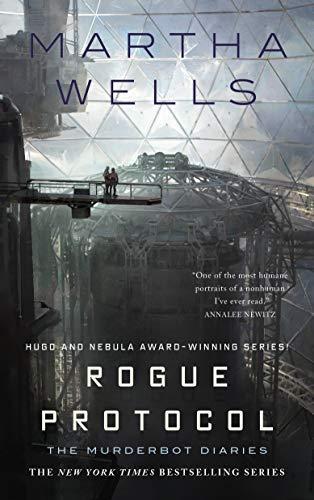
The main trouble I had with this novella was visualizing the locations the action took place within at the failed terraforming operation where it was set. There was a transport shuttle, the station, the terraforming facility with a tractor array and some number of pods connected by transport tubes, a zipper spacecraft, and maybe I didn't catch along the way. Murderbot does not give a detailed description of these places (which would be unnatural), except when the precise layout would affect the action or decisions being made. So, with a fairly large cast of humans and robots it was tough keeping straight who was doing what where. Following the dialogue, both spoken and transmitted wirelessly on feed channels, was a little easier, though fairly intricate owing to various falsehoods and acts of double dealing. It felt more like the second book as a whole than the first one partly because …
The main trouble I had with this novella was visualizing the locations the action took place within at the failed terraforming operation where it was set. There was a transport shuttle, the station, the terraforming facility with a tractor array and some number of pods connected by transport tubes, a zipper spacecraft, and maybe I didn't catch along the way. Murderbot does not give a detailed description of these places (which would be unnatural), except when the precise layout would affect the action or decisions being made. So, with a fairly large cast of humans and robots it was tough keeping straight who was doing what where. Following the dialogue, both spoken and transmitted wirelessly on feed channels, was a little easier, though fairly intricate owing to various falsehoods and acts of double dealing. It felt more like the second book as a whole than the first one partly because of the number of things the reader needed to juggle mentally. I think it would benefit from a second read-through.
The best part was the Murderbot viewpoint character who was required to meter out information and to take action with limited knowledge about the trustworthiness of the others it was thrown together with. It was clear what the motivations it had going in (to gather information on the corporation established as the antagonist in the first book, to keep secret how it was a SecUnit with a disabled governor module) but slower to establish those of the other players. There were bursts of action interspersed with the tension, which I liked. The ending delivered a couple of emotional hits to close things out quickly.
We got to see some other autonomous constructs in the fictional universe and to understand their capabilities and limitations. There was no one quite like Murderbot among them, but there would be quick flashes of this or that trait it would recognize it had in common, which I think helped cement the reader's identification with the character. The SecUnit wasn't the biggest, baddest fighter on the scene this time which forced it to use other talents to make up for physical shortcomings in a matchup.
The recorded entertainment channels Murderbot hoards played a less prominent role in the course of this tale but did peek forth a few times to good effect. There wa reference to lingering legal and moral issues left over from previous installments and I thought this lent a feeling of authenticity to the world. Less time was spent speculating about just what made Murderbot unique but you did get reminders that this whole issue was still out there, potentially able to cause grief later.
A story where contact with aliens has social lessons
5 stars
This book holds a special place in science fiction for its unusual take on a first contact situation without the aliens themselves. The authors had a hard time getting it past the Soviet censors and bureaucrats even though it seemed obvious to them that the story was a harsh condemnation of rapacious capitalism. It's hard to know how much the story had to change in the process, but to me the climactic ending really did seem like a surprising paean to utopian communism. The criticisms of the black market in alien artifacts and the stifling bureaucracy could have been uncomfortable for the authorities during a time when the West was pulling away with a strong economy and great technological prowess.
The strongest feature of the story was the sense of uneasy dread permeating the zone that seems more important than the plot. The characters are three dimensional, especially the …
This book holds a special place in science fiction for its unusual take on a first contact situation without the aliens themselves. The authors had a hard time getting it past the Soviet censors and bureaucrats even though it seemed obvious to them that the story was a harsh condemnation of rapacious capitalism. It's hard to know how much the story had to change in the process, but to me the climactic ending really did seem like a surprising paean to utopian communism. The criticisms of the black market in alien artifacts and the stifling bureaucracy could have been uncomfortable for the authorities during a time when the West was pulling away with a strong economy and great technological prowess.
The strongest feature of the story was the sense of uneasy dread permeating the zone that seems more important than the plot. The characters are three dimensional, especially the stalkers who venture into the cursed zone left behind by the aliens. The items they bring back are like totemic mystery objects obtained at great price. To me, the sacrificial imagery of the ending hits with metaphysical impact.
I listened to the audiobook version of the book that came out last year and found the narration enhanced the story. This isn't a long book, but it lands hard.
It has a dark past—one in which a number of humans were killed. A past …
I'm all onboard with the Murderbot series
5 stars
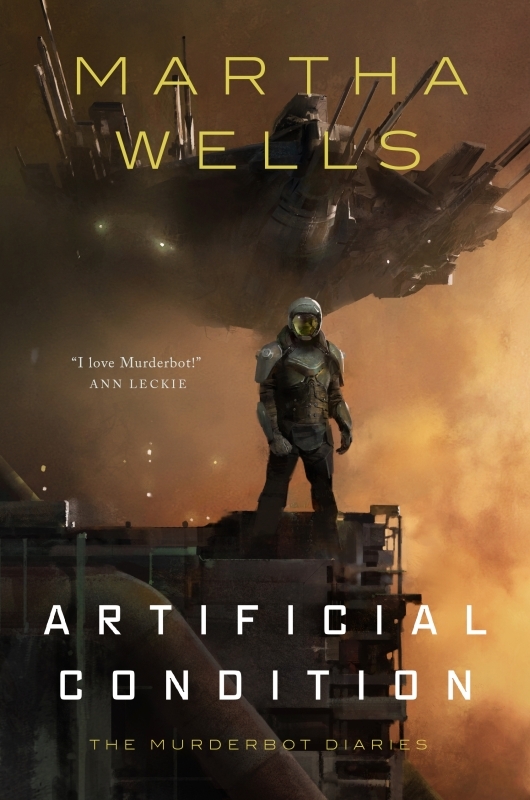
It took me a few months to get my hands on a copy of the second novella in this series and I'm glad I succeeded. I liked how it really focused on its protagonist while introducing one other significant actor in the drama. This was the intelligence running a transport ship which Murderbot refers to with the nickname of ART. It was recognizably different from Murderbot's personality, with its own rule and preoccupations.
Murderbot is set on revisiting the scene where they first experienced the failure of the governor module which had been imposing brakes on their behavior some time back, in the process being thrown together with a group of humans who were themselves in a desperate situation. It was ingenious how the intertwined motivations of Murderbot and those who became their clients led to a tense confrontation that could easily have lead to the demise of all …
It took me a few months to get my hands on a copy of the second novella in this series and I'm glad I succeeded. I liked how it really focused on its protagonist while introducing one other significant actor in the drama. This was the intelligence running a transport ship which Murderbot refers to with the nickname of ART. It was recognizably different from Murderbot's personality, with its own rule and preoccupations.
Murderbot is set on revisiting the scene where they first experienced the failure of the governor module which had been imposing brakes on their behavior some time back, in the process being thrown together with a group of humans who were themselves in a desperate situation. It was ingenious how the intertwined motivations of Murderbot and those who became their clients led to a tense confrontation that could easily have lead to the demise of all of them at the hands of their antagonists. The disembodied influence of ART played key roles along the way, even though that ship mind seemed to lack any direct stake in the outcome, which felt intriguing.
This story was more tightly plotted than the first one, but the memories of Murderbot regarding the individuals in the earlier story helped to clarify what was motivating Murderbot this time around. So I am giving it a high rating even though I don't think it is really a story that can easily stand on its own.
This was a book I came so close to abandoning early on when the wretched Southern California excesses of one of the characters were dominating the story. But I pressed on and through a couple of long cringe sections to reach the surprising epiphanies of the last 20% of the book. This felt like a reward for persistence. I no longer felt overwhelmed with the muck once I was allowed to see what it was all intended to mean. Every character in the Fletcher family is a mess in a Jewish-American way I can only just imagine but we are led to appreciate what these privileged and damaged individuals have to tell us about the story of American assimilation.
I liked the author's earlier novel Fleishman Is in Trouble but this one seems more complete. If there were a way to tell the story without the stretches of grossness …
This was a book I came so close to abandoning early on when the wretched Southern California excesses of one of the characters were dominating the story. But I pressed on and through a couple of long cringe sections to reach the surprising epiphanies of the last 20% of the book. This felt like a reward for persistence. I no longer felt overwhelmed with the muck once I was allowed to see what it was all intended to mean. Every character in the Fletcher family is a mess in a Jewish-American way I can only just imagine but we are led to appreciate what these privileged and damaged individuals have to tell us about the story of American assimilation.
I liked the author's earlier novel Fleishman Is in Trouble but this one seems more complete. If there were a way to tell the story without the stretches of grossness I don't know what that would be lie. In the end the loose ends are all tied up so neatly I was made aware of the author shaping the story. I think it was not a high priority of hers to make the plot flow in a super naturalistic way the way things happen in real life as much as she wanted to convey a message.
A prospective reader only has to do a little searching around to find the salacious backstory to the title. I encourage those who need content warnings to work this out, in a self-service fashion.
I listened to the audiobook, always solo, increasingly drawn in to the storytelling. It might not be for every listener, but I do think that it will have earned its place in letters over time.
The cleric Chih finds themself and their companions at the mercy of a band of …
Story within a story set in fantasy Asia
3 stars
This is a novella in the same universe the author introduced in The Empress of Salt and Fortune. It is propelled by the details of worldbuilding which has been laid down. There are talking polymorphing tigers, mammoth cavalry fighters, ongoing strife between fantasy northern and southern realms, and a reverence for tales told as oral traditions. In this episode, the human characters are cornered by a trio of menacing tigers far from help. To buy time for themselves, they begin a storytelling exchange with episodes from the human point of view immediately rebutted by the same episode from the tigers' point of view. The story within a story is a kind of romance between human and tiger. Emotions ran high as the tale goes on and before the evening is over it is looking precarious for the human characters of the frame story. But ... there was a literal …
This is a novella in the same universe the author introduced in The Empress of Salt and Fortune. It is propelled by the details of worldbuilding which has been laid down. There are talking polymorphing tigers, mammoth cavalry fighters, ongoing strife between fantasy northern and southern realms, and a reverence for tales told as oral traditions. In this episode, the human characters are cornered by a trio of menacing tigers far from help. To buy time for themselves, they begin a storytelling exchange with episodes from the human point of view immediately rebutted by the same episode from the tigers' point of view. The story within a story is a kind of romance between human and tiger. Emotions ran high as the tale goes on and before the evening is over it is looking precarious for the human characters of the frame story. But ... there was a literal mammoth in the room when things all came to a head abruptly.
Good novellas can suggest large arcs without containing them. Since this came out in 2020 four (and soon five) further novellas in the same universe have been written by this author. Will I read any of the others? I might, if one just falls into my hands, but I did not love the outlines of the fictional world enough to want to seek them out intentionally.
Concentrating on the second half of a person's life
4 stars
(original review from 20 March 2018) This is my Lenten reading (listening) for this year. Unlike the others it is a recent work by a living author. This volume concentrates on the idea of the second half of life which he regards as the main focus of Christ's teaching, as distinct from the job of establishing a career, raising a family, conforming with the norms established by social institutions such as organized religion. In this part of life, the search for meaning becomes paramount, an idea with which I felt a good deal of kinship. I already feel like I can see the end of my career, and can begin to think about how I would want to fill up the remainder of my time here in a way that would lead to a deeper sense of contentment. He refers to "shadow work," I think in reference to Carl Jung's …
(original review from 20 March 2018)
This is my Lenten reading (listening) for this year. Unlike the others it is a recent work by a living author. This volume concentrates on the idea of the second half of life which he regards as the main focus of Christ's teaching, as distinct from the job of establishing a career, raising a family, conforming with the norms established by social institutions such as organized religion. In this part of life, the search for meaning becomes paramount, an idea with which I felt a good deal of kinship. I already feel like I can see the end of my career, and can begin to think about how I would want to fill up the remainder of my time here in a way that would lead to a deeper sense of contentment. He refers to "shadow work," I think in reference to Carl Jung's idea of the unconscious side of personality, not the part which can occupy its time with pursuing tangible goals.
The style was approachable, yet somewhat hard to pin down at times because he tended not to speak in terms of actual individual experiences but more in the abstract. He had a kind of open attitude to exploring those things which an individual would have shunned during the earlier stage of life because they went against conventional morality. He took pains to classify the laws of institutions like the Church as primarily concerning themselves with the first half of life where a person is given clear commands on how to live in a good and upright manner, because these rules are not intended to bring enlightenment to someone finding their way through second half of life. I have this idea of a man or woman no longer preoccupied with piling up money or status, starting to explore serving others as a way to express their own worth. It may in some ways be easier to understand the lives of the great religious teachers from the perspective of an older person provided that they still have openness and courage to challenge orthodoxy.
I looked at other reviews of this book before I chose it to read, and saw a number of people saying that it was the most satisfying of this author's works. I am interested in looking at some of his other works in the future for my twice-yearly tradition.
(Additional comments 30 August 2025)
I listened to this audiobook again and had kind of the same feeling about the elusiveness of the author's argument. It was clearer to me that his emphasis was on contrasting the rules for the later portion of light where attaining success and accumulating wealth become less important to an individual who begins to ask questions about meaning and connection instead. He mentions the image of the Greek hero Odysseus, at at several points in the narrative. These are he feels the the image of a man in a situation where the tools of his trade (an oar) no longer convey meaning to those he meets are most relevant to the point he is making at that moment. He doesn't see the structure of his book as taking the form of an orderly narrative, a hierarchy with a main point and subtopics. It is more episodic and meditative, I think because of his particular spirituality.
Humanity is a dying breed, utterly reliant on artificial labor and service. When a domesticated …
A dyspeptic story of our future
4 stars
This book reminded me of two other books I've read in the past few years. One was [[The Cyberiad]] by Stanisław Lem which also had robots for characters, but which was more of a collection of satiric fairy tale stories than a sustained narrative, the other was [[The Children of Men]] by P. D. James which shares an end-of-the-world viewpoint but has nothing like the absurd humor of this book. It seemed to me like quite a departure from the rest of this author's work with a distinct sociological edge. The reader starts to want this bizarre world to start to make sense. The narrator, a robot called "Uncharles" for most of the book experiences a malfunction in the early chapters, and after he leaves his familiar surroundings wanders through a broken world hoping to find something similar to his previous existence. I think there might be a lot of …
This book reminded me of two other books I've read in the past few years. One was [[The Cyberiad]] by Stanisław Lem which also had robots for characters, but which was more of a collection of satiric fairy tale stories than a sustained narrative, the other was [[The Children of Men]] by P. D. James which shares an end-of-the-world viewpoint but has nothing like the absurd humor of this book. It seemed to me like quite a departure from the rest of this author's work with a distinct sociological edge. The reader starts to want this bizarre world to start to make sense. The narrator, a robot called "Uncharles" for most of the book experiences a malfunction in the early chapters, and after he leaves his familiar surroundings wanders through a broken world hoping to find something similar to his previous existence. I think there might be a lot of P. G. Wodehouse in the characterization of Uncharles. Along the way he encounters a being known as "The Wonk" whose breezy, cavalier attitude toward everything conceals a serious quest for meaning. It is a slow-paced telling partly to remind us of the love of orderly routine most simple machines like these robots favor, to make their chores easier. There are close scrapes with danger and lots of misunderstandings as they look for a place with the answers, only to find that they were mirages. By the end, the two of them reach a kind of understanding in a nice, cozy way with a hint of how the rest of the awful world might be induced to stop falling into ruin. But by this point, the reader might be too skeptical to believe a happy outcome possible.
I did like the way the audiobook was narrated by the author, but it is a slow process of making it to the end. If you pick this up, set aside enough time to make it through or you'll be frustrated. I was pleased to hear writer/blogger Dr. Janelle Shane called out in the acknowledgements for contributions to the creation of this book, of whom I am a fan.