Mayobrot commented on Braiding Sweetgrass by Robin Wall Kimmerer
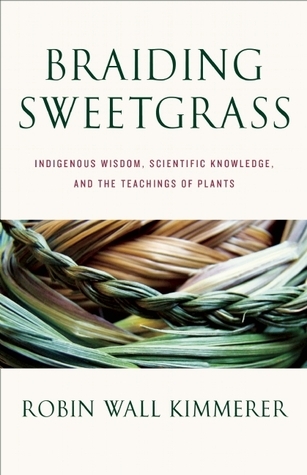
As a botanist, Robin Wall Kimmerer has been trained to ask questions of nature with …
Here, have a mini-essay that summarises the chapter "The grammar of animacy", formatted in org-mode because I'm lazy.
The Indian language Potawatomi has a lot more verbs than English, 70% and 30% respectively of the words are verbs. One reason for this difference is that in Potawatomi words like "bay", "Saturday" or "hill" are verbs: "to be a bay", "to be Saturday" and "to be a hill". This may seem confusing, but the "verb-ness" of words are used to distinguish between animate and inanimate things.
A bay is only a noun if water is dead. When bay is a noun, it is defined by humans, trapped between its shores and contained by the word. But the verb wiikwegamaa---to be a bay---releases the water from bondage and lets it live. "To be a bay" holds the wonder that, for this moment, the living water has decided to shelter itself between these shores, conversing with cedar root and a flock of baby mergansers. Because it could do otherwise---become a stream or an ocean or a waterfall, and there are verbs for that, too. To be a hill, to be a sandy beach, to be a Saturay, are all possible verbs in a world where everything is alive.
Saying "it is cooking food" when talking about your mother is almost hard to imagine because it would be so respectful, it would be to reduce her to a mere object. In English, this is still done about many things, it is classifying trees, animals, and lakes as objects when they could very well be subjects. Potawatomi has a grammar of animacy, a grammar that allows more to be people, to have animacy, to be subjects to consider. We don't necessarily need to speak Potawatomi to have this grammar, we could speak English (and other languages) with a grammar of animacy by using words like he/she/they and "someone" over words like "it" and "something". We could also go the other way; referring to people as "something" is probably still very weird, but some prefer the pronouns it/its which could blur the line between the animate and inanimate.