
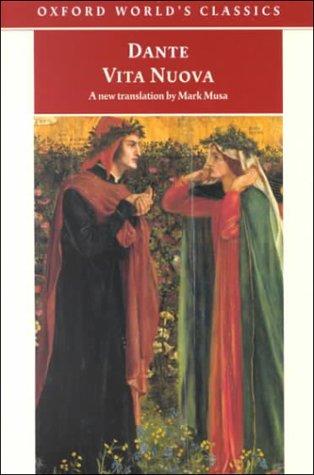
Review of "Vita Nuova (Oxford World's Classics)" on 'Goodreads'
4 stars
So, often times when I read works like this I am asked if I am reading it for school. The inquirer's reasoning faculty is then generally broken once I answer, "No, I'm reading it for fun." My tone, matter of fact, dispels any doubt that this response is not facetious and that I choose to read such works for my own personal enjoyment. Conversation becomes impossible, and the unwelcome interloper is banished leaving me to contemplate the transcedental properities of poetry and its transforming effects on the writer and subject.
In the Vita Nuova, Dante relates the background of his poems that relate to Beatrice. Infatuated with her, Dante uses Beatrice as a symbol for his ever evolving concept of Love (with a capital 'L', so not necesarily romantic love). Eventually, this symbol through Beatrice's death and Dante's grief transcends to a higher sphere where is current skills in the poetic form are sorely lacking in relating. Realizing this, Dante commits himself to intense study to gain the skills necesary to properly present this new concept of Beatrice. At the end of this prose/poetic work, Dante's old life as a merely competent troubadour poet has ended with the hope that through his commitment, it will resurrect into the new life of a poet of the now divine Beatrice.
Vita Nuova is an opportunity to observe the inspiration, drive, and poetic mannerisms of a young Dante. This gives insight into what he thought poetry was, what was worthy subject, and what he hopes his poetry will become. Spoiler alert, it becomes the Divine Comedy.
Poetry often is the manifestation of a poet's soul. Vita Nuova provides a franks glimpse into Dante's own angst ridden soul and provides a framework through which one can view his later work, particularly his magnum opus.