
Orlion reviewed Collected Fictions by Jorge Luis Borges
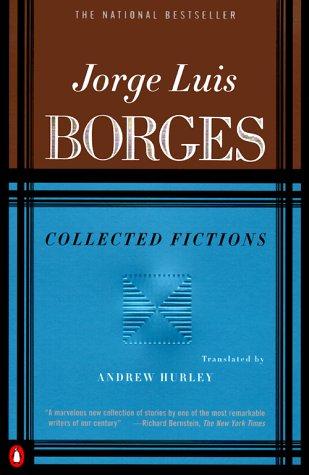
Review of 'Collected Fictions' on 'Goodreads'
5 stars
I was introduced to Jorge Luis Borges through a short story collection edited by Stephen R. Donaldson. The first story in this collection was a fantasy entitled “The Aleph” which told of a poet attempting to write an epic poem that would encompass all time and space. He was able to attempt this because he had stumbled upon a point in his basement where all space and time are located.
Intrigued by this strange dream, I kept my eyes out for anything I could find by Borges. I eventually came upon a dog-eared copy of Ficciones in a used book store. Here, I indulged in speculations of Judas Iscariot as the true Messiah, the invasion of a fictional reality into our universe, and a murder mystery taking place in parallel universes of forking paths.
Around this time, I had to move to another apartment, and fate decreed that my copy of Ficciones would not survive the move. The search for Borges’ fiction would have to continue. This longing would remain unfulfilled, until I stumbled quite by accident on this volume, The Collected Fictions; Translated by Andrew Hurley. Realizing what a treasure I had found, I sacrificed meaner appetites in order to purchase this volume for myself and deny it to some other poor, star struck soul.
Immediately upon purchasing it, rumor began to entangle me in a web of doubts. Rumors had it that this translation did a disservice to the incorruptible author of labyrinths. That this abomination was the doing of his harpy lover that, upon his death, betrayed his blind trust and proceeded to ruin his masterpieces in the English speaking world.
Somewhat discouraged, I recalled the peculiarities of translations. Often, the translation that has introduced us to an otherwise incomprehensible writer holds a special place in our souls. In particular, if that translation should make us fall in love with these babbling authors and their works. Reminicing over Burton Raffel’s translation of Beowulf, I recalled that I have read some of Andrew Hurley’s translation of another poet: Ruben Dario. I have had the pleasure of reading Dario’s prose in the original Castellano and recalled being satisfied with Hurley’s English interpretation.
Satisfied, I plunged into the Fictions of Borges. Throughout his body of prose, Borges often played with the theme of perception. Whether through the falsified accounts of true stories in A Universal History of Iniquity or the more hard-hitting reports in Ficciones and the Aleph, Borges accurately represented how the human mind can trick us into accepting a falsehood as reality. This perception also plays a role in the romanticizing of common, barbaric events. Throughout his prose, Borges recounts several accounts of gauchos and knife fighters that saturated Argentina’s literary culture much like cowboys stride into US culture.
From the middle towards the end of this volume, we get a more subtle Borges. In these writings, reality does not bend or pop like in the earlier prose, mostly because the universe is all ready deformed. His style here is exemplified in his short story ‘The Rose of Paracelsus’. Here, a man who would be Paracelsus’ disciple asks to behold a miracle: that Paracelsus should take a rose, burn it, and bring back the rose from its ashes. Paracelsus tells the man that he should have complete and blind faith, and when the man burns the rose and sees Paracelsus make no move to recover it from the ashes, he leaves a sadder and perhaps wiser man. Left alone, Paracelsus retrieves the ashes and whispers the Word to bring forth the Rose again.
Many will come to this book expecting Borges to do wonderful things with prose. Borges does not care to perform these rumors merely to satisfy the reader. The reader, trusting to his own senses, may attempt to reduce the prose to its base parts through analysis, but without trust, he or she will only leave disappointed, as if they had torn down a god and found broken, futile stone instead. Borges’ prose, however, will continue to withstand these dissections. Through the life breathed into it by the master himself, the prose will continue to blossom forth. Borges only invitation,that “the reader may find in my pages something that merits being remembered; in this world, beauty is so common.”