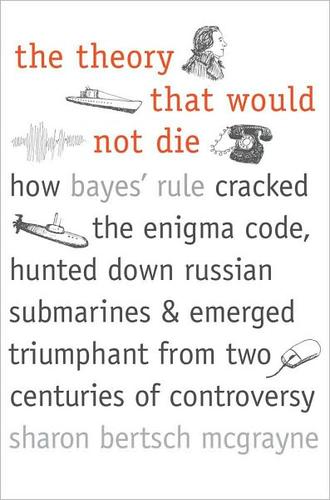

Review of 'The Theory That Would Not Die' on 'Goodreads'
5 stars
One of the most exciting books I've read in years. I'd can't recommend this book highly enough. It's completely approachable to the layperson, but so incredibly interesting. I was astounded at what Bayes' rule has been used for, and just have to learn more. I've loved seeing how it shows up a little bit in my probability and statistics textbook, but am planning to go buy one or several bayesian specific textbooks to learn more.
My only complaint is that I would have loved more and harder example problems. The author only includes a few math problems at the very back, and I would have loved more.
One of the most exciting books I've read in years. I'd can't recommend this book highly enough. It's completely approachable to the layperson, but so incredibly interesting. I was astounded at what Bayes' rule has been used for, and just have to learn more. I've loved seeing how it shows up a little bit in my probability and statistics textbook, but am planning to go buy one or several bayesian specific textbooks to learn more.
My only complaint is that I would have loved more and harder example problems. The author only includes a few math problems at the very back, and I would have loved more.