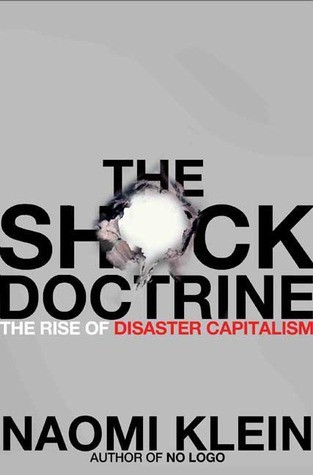
In her ground-breaking reporting from Iraq, Naomi Klein exposed how the trauma of invasion was being exploited to remake the country in the interest of foreign corporations. She called it "disaster capitalism." Covering Sri Lanka in the wake of the tsunami, and New Orleans post-Katrina, she witnessed something remarkably similar. People still reeling from catastrophe were being hit again, this time with economic "shock treatment" losing their land and homes to rapid-fire corporate makeovers. The Shock Doctrine retells the story of the most dominant ideology of our time, Milton Friedman's free market economic revolution. In contrast to the popular myth of this movement's peaceful global victory, Klein shows how it has exploited moments of shock and extreme violence in order to implement its economic policies in so many parts of the world from Latin America and Eastern Europe to South Africa, Russia, and Iraq. At the core of disaster capitalism …
In her ground-breaking reporting from Iraq, Naomi Klein exposed how the trauma of invasion was being exploited to remake the country in the interest of foreign corporations. She called it "disaster capitalism." Covering Sri Lanka in the wake of the tsunami, and New Orleans post-Katrina, she witnessed something remarkably similar. People still reeling from catastrophe were being hit again, this time with economic "shock treatment" losing their land and homes to rapid-fire corporate makeovers. The Shock Doctrine retells the story of the most dominant ideology of our time, Milton Friedman's free market economic revolution. In contrast to the popular myth of this movement's peaceful global victory, Klein shows how it has exploited moments of shock and extreme violence in order to implement its economic policies in so many parts of the world from Latin America and Eastern Europe to South Africa, Russia, and Iraq. At the core of disaster capitalism is the use of cataclysmic events to advance radical privatization combined with the privatization of the disaster response itself. By capitalizing on crises, created by nature or war, Klein argues that the disaster capitalism complex now exists as a booming new economy, and is the violent culmination of a radical economic project that has been incubating for fifty years.
This is an absolutely phenomenal book. Having grown up in a country that has been on the receiving end of the titular shock doctrine, this book gave me the tools to better understand my experience. While I have always been aware of different aspects of the issue, I can now put all of it together and understand the bigger picture.
Naomi Klein has an excellent writing style, explaining her thoughts in very clear and understandable terms. I listened to the audio version, but when I checked out a written copy of the book, I was really impressed by the sheer amount of sources/references she names. That's why I believe that this work is not just a think piece, but a product of actual, serious research.
Overall I would 100% recommend reading The Shock Doctrine, just with a warning that it might make you very, very angry at the …
This is an absolutely phenomenal book. Having grown up in a country that has been on the receiving end of the titular shock doctrine, this book gave me the tools to better understand my experience. While I have always been aware of different aspects of the issue, I can now put all of it together and understand the bigger picture.
Naomi Klein has an excellent writing style, explaining her thoughts in very clear and understandable terms. I listened to the audio version, but when I checked out a written copy of the book, I was really impressed by the sheer amount of sources/references she names. That's why I believe that this work is not just a think piece, but a product of actual, serious research.
Overall I would 100% recommend reading The Shock Doctrine, just with a warning that it might make you very, very angry at the world.
The book about how we let it get this bad. In a strange way, this book feels shallow because of its ambitious scope, but if you want a proper overview of horrific shit that you need to understand to get the current moment, this is probably the place to start unearthing the contents of the memory hole.
This was a very interesting, but incredibly difficult to read, book. On the one hand I'm glad to have become aware of all these hideous crimes US economists have perpetrated - or at least aided and abetted - since the 70s; on the other, I see what the author wrote in 2007 and look at what has happened since, and I still see that the corporations are winning and the people are losing.
This was a very interesting, but incredibly difficult to read, book. On the one hand I'm glad to have become aware of all these hideous crimes US economists have perpetrated - or at least aided and abetted - since the 70s; on the other, I see what the author wrote in 2007 and look at what has happened since, and I still see that the corporations are winning and the people are losing.