
Literally Graphic reviewed Guantánamo Kid by Jérôme Tubiana
2024 Review
5 stars
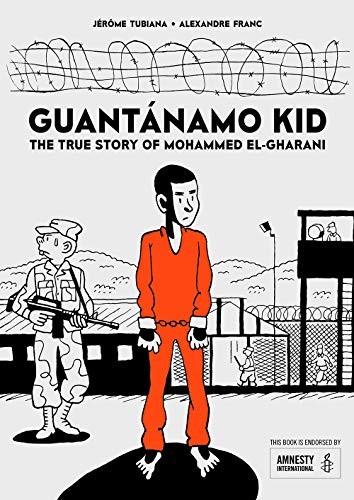
And today’s pick is Guantánamo Kid: The True Story of Mohammed El-Gharani by Jérôme Tubiana and Alexandre Franc. Originally published in 2018 by a French publisher. it was translated to English and published in 2019 by Self Made Hero. Endorsed by Amnesty International.
Content notes for: 9/11, harm to children, lots of torture, n-word, nudity, and suicide.
A heavy read, the torture is described but not shown in detail on the page.
Looking at the creative team we have writer Jérôme Tubiana. Flipping to the back of the book, he is described as an independent journalist and researcher with a focus on “conflicts and migrations in the Sahel and the Horn of Africa”. Online search brings up work with Al Jazeera, The London Review of Books, he’s written reports for the United States Institute of Peace and been an operational advisor for Doctors Without Borders.
And …
And today’s pick is Guantánamo Kid: The True Story of Mohammed El-Gharani by Jérôme Tubiana and Alexandre Franc. Originally published in 2018 by a French publisher. it was translated to English and published in 2019 by Self Made Hero. Endorsed by Amnesty International.
Content notes for: 9/11, harm to children, lots of torture, n-word, nudity, and suicide.
A heavy read, the torture is described but not shown in detail on the page.
Looking at the creative team we have writer Jérôme Tubiana. Flipping to the back of the book, he is described as an independent journalist and researcher with a focus on “conflicts and migrations in the Sahel and the Horn of Africa”. Online search brings up work with Al Jazeera, The London Review of Books, he’s written reports for the United States Institute of Peace and been an operational advisor for Doctors Without Borders.
And we have art by French artist Alexandre Franc. Although work he has illustrated and/or written include Agatha: The Real Story of Agatha Christie, Extinctions: Twilight of the Species, Evolution: Darwin, God and the Horse-People and much more.
What kinds of keywords came to mind: inhumane, anti-state, coming of age, community, faith, shit disturber, and manipulation.
“Saudi Arabia offers few prospects for the bright young Mohammed El-Gharani. With roots in Chad, Mohammed is treated like a second-class citizen. His access to healthcare and education are restricted; nor can he make the most of his entrepreneurial spirit. At the age of 14, having scraped together some money as a street trader, Mohammed seizes an opportunity to study in Pakistan. One Friday in Karachi, Mohammed is detained during a raid on his local mosque. After being beaten and interrogated, he is sold to the American government by the Pakistani forces as a member of Al-Qaida with links to Osama Bin Laden, but Mohammed has heard of neither. The Americans fly him first to Kandahar and then to Guantánamo Bay.”
Starting with the art. I will admit that at first my expectations were not particularly high. The style is lightly cartoonish black and white with fairly straight forward page layouts. As I read through Guantanamo Kid however I became very impressed with the nuance Franc brought to the narrative. Moving the level of cartoonishness up and down to match the ridiculousness of the evil being enacted. There were visual metaphors and symbolism. And the text was nicely spread out and broken down into easy to consume chunks.
Similarly I found the writing to be extremely good in all the ways I could think to test it. Although that certainly is not all encompassing.
To start with, I was struck by how respected and relatable Mohammad felt throughout the book. Not someone to be pitied, not a thin shadow to act as inspiration-porn, or a monstrous other. Mohammad is a young muslim boy whose family moved from the Congo to Medina to be close to this spiritual centre. They are excluded by the state of Saudi Arabia but have family and community.
Moving into his time in Guantanamo Bay, I appreciated how the resistance of Mohammed and his comrades was highlighted in such detail. Obviously this book is nonfiction, but in my media consumption I have come across far too many stories that turned the enslaved, enprisoned and otherwise appressed into passive objects in need of saving. When revolutions, revolts, escapes, and strikes all say otherwise.
I will note that Guantanamo Kid does not do something I generally appreciate in nonfiction. Namely, the author himself is not at all present in the main body of the book and his perspective is not necessarily articulated outright. I do feel like Jerome’s perspective is pretty obvious, although my own personal bias is certainly playing a roll in this because I went into this book agreeing with it. There is also a pretty wide range of reportage on Guantanamo that agree on what we might call the facts of the situation. That said I did really appreciate the final section that was only text and explained further how Jerome and Mohammed crossed paths, the interview process that went into making the book, and updates from Mohammed’s life after the graphic novel concluded.
Looking at the intersections of identitiy I examine in each of my reviews.
Disability actually got a lot of air time. Before Guantanamo Mohammad’s father is disabled while he is fairly young and after Mohammad is forced to smuggle himself into different countries to get medical care to help him recover from torture. While in Guantanamo we also have some insight into how the community took care of each other. Some people were not on the frontline of resistance to the guards because they were more physically fragile.
Race is obviously another important aspect of the narrative alongside dialect, country of origin, citizenship, class and many other ways we divide each other up and make the other more monstrous. In my ignorance I was not aware that any of the detainees were Black. Moving from Mohammad’s detention in Pakistan to Guantanamo we see the death of his naiveté and induction into the American flavor of both anti-Black racism and Black culture. And while Mohammad’s residence is always despite the state, after his release in particular Jerome is sure to dive into all the ways in which Mohammad is displaced and without an easy homeland.
Human sexuality was horribly mostly explored in the ways it was used to humiliate and torture Mohammad and other detainees. Although we do have the briefest mention of polygamy at the end of the epilogue as Mohammad does go on to marry two women.
And finally, gender was again not really a focus of the story beyond the basics unescapables. That said, because it is a thing I like to harp on about, I did appreciate the very clear depiction of not only men working at Guantanamo but also women, as some people suffer under the notion that people who appear to have XY chromosomes are intrinsically nicer.
Wrapping things up. Obviously I generally try and steer away from language that implies that anything is a universal must read. But this time around it is sorely tempting. With 30 people still locked up in Guantanamo it’s still incredibly important for people to be fully aware of the kind of shit that so called america has perpetrated there. And obviously I do feel like there’s stuff to learn here that can impact how we see other things that imperialist powers do. Five stars if you didn’t already guess.