
Tak! reviewed Dual Memory by Sue Burke
Dual Memory
4 stars
Dual Memory was good, but it didn't fascinate me the way that Semiosis did.
Dual Memory was good, but it didn't fascinate me the way that Semiosis did.
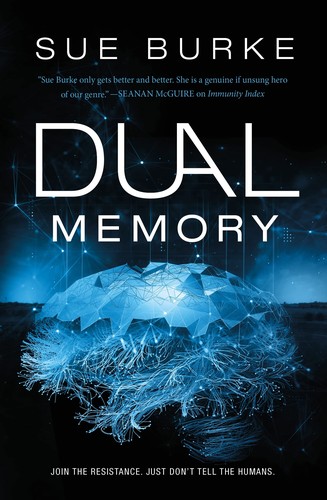
352 pages
English language
Published May 1, 2023 by Doherty Associates, LLC, Tom.
Sue Burke, author of the acclaimed novel Semiosis , returns with Dual Memory, a standalone novel blending the hard science fiction of Her with the action adventure of The Third Man .
Antonio Moro lost everything to the Leviathan League. Now he's alone in a city on an Arctic island fighting the ruthless, global pirates with the chance to be the artist he always wanted to be. Unfortunately, he thinks it’s a cover story for his real purpose―spying on sympathizers.
When things look bleak, he discovers an unusual ally. His new personal assistant program, Par Augustus. It’s insolent, extroverted, moody, and a not-quite-legal nascent A. I.
Together they create a secret rebellion from unlikely recruits to defend the island from ideological pirates with entitlement and guns, and capitalist pirates with entitlement and money.
Sue Burke, author of the acclaimed novel Semiosis , returns with Dual Memory, a standalone novel blending the hard science fiction of Her with the action adventure of The Third Man .
Antonio Moro lost everything to the Leviathan League. Now he's alone in a city on an Arctic island fighting the ruthless, global pirates with the chance to be the artist he always wanted to be. Unfortunately, he thinks it’s a cover story for his real purpose―spying on sympathizers.
When things look bleak, he discovers an unusual ally. His new personal assistant program, Par Augustus. It’s insolent, extroverted, moody, and a not-quite-legal nascent A. I.
Together they create a secret rebellion from unlikely recruits to defend the island from ideological pirates with entitlement and guns, and capitalist pirates with entitlement and money.
Dual Memory was good, but it didn't fascinate me the way that Semiosis did.
Dual Memory was good, but it didn't fascinate me the way that Semiosis did.
Set on a near-future artificial island in the arctic, this book focuses on the interplay of two characters and their worlds: Antonio, a survivor of raider attacks turned artist in residence for rich traders of extraterrestrial microorganisms, and Par Augustus, a personal assistant program that has spontaneously and secretly become sentient, and comes into the keeping of Antonio.
This book goes into a lot of different directions: the relationship between humans and machines, arguments about the nature of art and artists, utopias both human and machine, the lure of authoritarianism, and a critique of attempting to be neutral. I really enjoyed the complicated relationship of Antonio and Par as it developed over time, and the interactions of the machines with each other.
A few touchpoints in this book that reminded me of other things I've read: The tone is quite different, but the way this book talks about …
Set on a near-future artificial island in the arctic, this book focuses on the interplay of two characters and their worlds: Antonio, a survivor of raider attacks turned artist in residence for rich traders of extraterrestrial microorganisms, and Par Augustus, a personal assistant program that has spontaneously and secretly become sentient, and comes into the keeping of Antonio.
This book goes into a lot of different directions: the relationship between humans and machines, arguments about the nature of art and artists, utopias both human and machine, the lure of authoritarianism, and a critique of attempting to be neutral. I really enjoyed the complicated relationship of Antonio and Par as it developed over time, and the interactions of the machines with each other.
A few touchpoints in this book that reminded me of other things I've read: The tone is quite different, but the way this book talks about the dual world of machines and humans reminded me a lot of Suzanne Palmer's short story The Secret Life of Bots. The way that machines coordinate things magically for Antonio feel like parts of Person of Interest, although Par feels like it has more of an agenda. This book also has machines trying to work around Asimovian robot laws. Finally, the neutral Thulians also remind me a lot of the Vorkosigan Saga's Beta Colony, where they both force people into coercive therapy and counseling when their views are misaligned.
This book feels a lot different from the author's other works. The majority of the story is told by Antonio Moro, an illiterate laborer who fled his home country at an early age and is first seen working as a worker on a recycling ship which is attacked by raiders. This is a piratical organization that takes what it can from places with insufficient military force to defend themselves. He is injured and left on the share of Thule island, an engineered community in the cold North Atlantic. While convalescing at the hospital he gets to know the social structure there while secretly watching for raider infiltration, the last order his captain had given him. The social order requires all to have employment so he takes a contract as an artist for a wealthy couple. Their wealth and social status depend on how well he can do in an art …
This book feels a lot different from the author's other works. The majority of the story is told by Antonio Moro, an illiterate laborer who fled his home country at an early age and is first seen working as a worker on a recycling ship which is attacked by raiders. This is a piratical organization that takes what it can from places with insufficient military force to defend themselves. He is injured and left on the share of Thule island, an engineered community in the cold North Atlantic. While convalescing at the hospital he gets to know the social structure there while secretly watching for raider infiltration, the last order his captain had given him. The social order requires all to have employment so he takes a contract as an artist for a wealthy couple. Their wealth and social status depend on how well he can do in an art project for a competition.
The other chapters take the point of view of machine intelligence Par Augustus which has somehow achieved a level of self-awareness and autonomy only a very few other machine minds have attained. Far from unemotional, Par has ambitions and biases, a brassy attitude, and ambiguous motives. Before long it links up with Moro and is able to feed him information using an inner ear implant. They become friends and conspirators as the raider problem butts up against certain aspects of Thule society in ways neither one likes. Towards the end of the novel, the raiders come to Thule, there is bloodshed and subterfuge, and Moro is at the center of everything.
The story was entertaining if I could suspend a certain amount of disbelief regarding some of the story elements. Late in the book a long-lost relation of Moro's turns up to confuse things in a way that felt somewhat forced. It was pretty clear who the reader was to sympathize with and who was outright evil, with not much nuance among the major players. These were machines and people, and I thought the former were the more intriguing actors by quite a bit. As long as these entities were the focus I had little trouble sustaining my interest. I felt that the Antonio Moro character was not as compelling a personality as I would have liked, but it may be that he has a strong role to play in a future story set in this story universe.
The story begins abruptly. Soon, we are drawn into a science-fiction tale with a small cast of characters and tropes. There is action, subterfuge, and even courtroom drama. Is this story a warning? Are we mice?