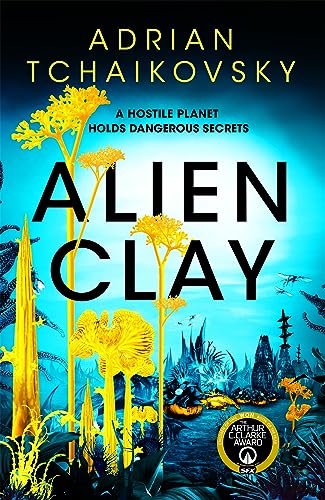
Professor Arton Daghdev has always wanted to study alien life in person. But when his political activism sees him exiled to the planet Kiln, condemned to work under an unfamiliar sky until he dies, his idealistic wish becomes a terrible reality.
Kiln boasts a ravenous, chaotic ecosystem. Its monstrous alien life means Arton will risk death on a daily basis – if the camp’s oppressive regime doesn’t kill him first. But, if he survives, Kiln’s lost civilization holds a wondrous, terrible secret. It will redefine life and intelligence as he knows it – and might just set him free.
I devoured it. Brilliant, surprising, and completely relevant to the world we currently find ourselves in. Bonus points on top because Daghdev has now taken his place among my favorite narrators of all time.
I really loved this book. It felt like the interest and passion in biology that Mikhail Bakunin exhibited in Mutual Aid: A Factor of Evolution but told ask a sci-fi epic@!
analyzing the conditions and contradictions of a human inmate labour camp upon an exoplanet with alien life Tchaikovsky looks at what makes us human, what mutualism and organization mean, and the struggles against domination.
I would liken this to The Dispossessed of Tchaikovsky's catalog and want you all to read it then get coffee with me and talk about the ups and downs.
I really loved this book. It felt like the interest and passion in biology that Mikhail Bakunin exhibited in Mutual Aid: A Factor of Evolution but told ask a sci-fi epic@!
analyzing the conditions and contradictions of a human inmate labour camp upon an exoplanet with alien life Tchaikovsky looks at what makes us human, what mutualism and organization mean, and the struggles against domination.
I would liken this to The Dispossessed of Tchaikovsky's catalog and want you all to read it then get coffee with me and talk about the ups and downs.
I was hooked from the start with Tchaikovsky's description of sending prisoners to Kiln as freeze-dried corpsicles that are reanimated on arrival. Actually doable? Actually money-saving? Hell if I know. Grabbed my attention.
Kiln has life. Not only does it have life, it has monuments built be an intelligent species, but there's no sign of them. That's a secret that was kept from Earth by it's rulers, the Mandate. Arton Daghdev, our protagonist is an unorthodox xenobiologist. A prisoners because of the unorthodoxy. But also he didn't know because it was kept so tightly secret. And the last part of of the premise is that there aren't exactly species on Kiln. The flora and fauna, such as they are, are more agglomerations of species with one purpose each: a stomach and an eye and a leg muscle get together to form a symbiotic creature. But they can all split …
I was hooked from the start with Tchaikovsky's description of sending prisoners to Kiln as freeze-dried corpsicles that are reanimated on arrival. Actually doable? Actually money-saving? Hell if I know. Grabbed my attention.
Kiln has life. Not only does it have life, it has monuments built be an intelligent species, but there's no sign of them. That's a secret that was kept from Earth by it's rulers, the Mandate. Arton Daghdev, our protagonist is an unorthodox xenobiologist. A prisoners because of the unorthodoxy. But also he didn't know because it was kept so tightly secret. And the last part of of the premise is that there aren't exactly species on Kiln. The flora and fauna, such as they are, are more agglomerations of species with one purpose each: a stomach and an eye and a leg muscle get together to form a symbiotic creature. But they can all split up and form other creatures somehow.
So Arton is doing two things: trying to figure out what happened to the builders, and fighting the Mandate as its prisoner. He's got gallows humor in spades. He's also a somewhat unreliable narrator, though it's mostly lies by omission. The story drags in parts. When Arton merits extra punishment, he goes into overlong detail on that punishment. And lastly, the suspicious nature of a subjugated population is hammered home again and again. Yes, I get it that people, especially prisoners, are going to wonder who the snitches are. But by the 5th or 6th time Tchaikovsky and Daghdev go into it I was just wanted to move on.
But Tchaikovsky also ties it all together pretty nicely. The nature of life on Kiln is especially vexing for a totalitarian orthodoxy, and provides some distinct advantages when the conflict between them comes.
Half a star off because it does kind of drag in places.
Oddly, this book reminds me a lot of another nominee, The Tainted Cup. They are both about an alien biology that is a lot more fecund and transformative than ours. But while the world of The Tainted Cup is more controlled, this one is fully uncontrolled alien biology and scientists (and prisoner slaves) have been sent to unravel it while simultaneously needing to justify the political order at home somehow. It is both frustrating and frighteningly plausible given the direction politics in China have gone.
At any rate, a lot of fascinating science, plausible politics and decently well-drawn characters make for a very good read with a lot to think about afterwards. Recommended.
Oddly, this book reminds me a lot of another nominee, The Tainted Cup. They are both about an alien biology that is a lot more fecund and transformative than ours. But while the world of The Tainted Cup is more controlled, this one is fully uncontrolled alien biology and scientists (and prisoner slaves) have been sent to unravel it while simultaneously needing to justify the political order at home somehow. It is both frustrating and frighteningly plausible given the direction politics in China have gone.
At any rate, a lot of fascinating science, plausible politics and decently well-drawn characters make for a very good read with a lot to think about afterwards. Recommended.
A prison novel, and how the novel life on a planet may set the prisoners free.
4 stars
A fascinating book about life on an alien planet and the conflicts between it and the totalitarian human government (the Mandate) that runs the prison colony on the planet known as Kiln. The narrator of the story is Arton Daghdev, a dissident ecologist captured and sent there to help with research on the alien life. He also learns about the discovery of ruins that hints that a civilisation once flourished on Kiln, and speculations about who they might be.
As for the Mandate, it wants to make sure that all findings on Kiln match its world-view on how the universe works (basically, everything works according to the way the Mandate says it does), so Arton has an interest in finding out how life on Kiln is different and how to use it against the Mandate: for he is still a dissident in a prison camp.
The first third …
A fascinating book about life on an alien planet and the conflicts between it and the totalitarian human government (the Mandate) that runs the prison colony on the planet known as Kiln. The narrator of the story is Arton Daghdev, a dissident ecologist captured and sent there to help with research on the alien life. He also learns about the discovery of ruins that hints that a civilisation once flourished on Kiln, and speculations about who they might be.
As for the Mandate, it wants to make sure that all findings on Kiln match its world-view on how the universe works (basically, everything works according to the way the Mandate says it does), so Arton has an interest in finding out how life on Kiln is different and how to use it against the Mandate: for he is still a dissident in a prison camp.
The first third of the story gives an introduction to the camp and bit and pieces of Kiln life, whose biology turns out to be quite weird, but just similar enough to Earth life that it attempts to 'interface' to humans: Arton sees the results of such 'hybrids' and it is not pretty. And that doesn't stop him from joining a prison revolt that goes wrong.
As punishment, he is sent out to help collect Kiln life and find more remnants of the alien civilisation, which gives the reader a closer look at how life on Kiln works. Another disaster befalls Arton, forcing him to trek back to the prison camp. And it is during this trek that things about how Kiln life works, start to join up about and make sense to him. And it may not just help him overthrow the world view of the Mandate, but also possibly free the prisoners of the camp and answer the riddle about how civilisation rose and fell many times on Kiln.
I think I find a jocular first person narrative really irritating. I wish Adrian Tchaikovsky would write fewer books but make them all as good as children of time (not the sequels).
This is now my favorite Adrian Tchaikovsky book. The writing is grippy, the narrator is wry, and I love the way the plotlines of revolution against authoritarianism and academic exploration of alien biology intertwine with each other.
Some extremely minor asides that I appreciated:
The narrator is quite funny and I appreciate the way he sometimes deceives the reader; there are several scenes where you get the surface level view of the scene and then find out shortly afterwards that he's also doing something furtive simultaneously.
I love that the authoritarianism is all about black and white binaries, and the book casually infers that one of the characters fell into political disfavor because they are some flavor of non-binary (without using that word, thank goodness).
This is also somehow the second academic adjacent alien book that I've read recently, with James SA Corey's The Mercy of …
This is now my favorite Adrian Tchaikovsky book. The writing is grippy, the narrator is wry, and I love the way the plotlines of revolution against authoritarianism and academic exploration of alien biology intertwine with each other.
Some extremely minor asides that I appreciated:
The narrator is quite funny and I appreciate the way he sometimes deceives the reader; there are several scenes where you get the surface level view of the scene and then find out shortly afterwards that he's also doing something furtive simultaneously.
I love that the authoritarianism is all about black and white binaries, and the book casually infers that one of the characters fell into political disfavor because they are some flavor of non-binary (without using that word, thank goodness).
This is also somehow the second academic adjacent alien book that I've read recently, with James SA Corey's The Mercy of Gods being the other. The power dynamic contexts are different enough that they end up taking different collaborator vs revolutionary approaches.
Increible fanfiction for Sid Meier's Alpha Centauri
No rating
A deeply interconnected multi-level story diving into structure, communication, and organization from the deep level of biology & chemistry through community and up into society.
You're never going to believe this, but Adrian Tchaikovsky of all people has written a novel about the biology of non-human consciousness & awareness and the implications of that structure for the social structures and creations of such an alien consciousness. This particular novel also engages a little with 20th century authoritarianiam and where that movement might go in the future. That political dimension is connected back as a metaphor for the biology, human connection, & consciousness.
A neat, tight, well-executed novel. Great stuff; lots to consider. Not quite as thought-provoking as Watts' Firefall books which engage with the same material in greater depth. Probably not going to be a perpetual reread for me, but a deeply satisfying read nonetheless.
A deeply interconnected multi-level story diving into structure, communication, and organization from the deep level of biology & chemistry through community and up into society.
You're never going to believe this, but Adrian Tchaikovsky of all people has written a novel about the biology of non-human consciousness & awareness and the implications of that structure for the social structures and creations of such an alien consciousness. This particular novel also engages a little with 20th century authoritarianiam and where that movement might go in the future. That political dimension is connected back as a metaphor for the biology, human connection, & consciousness.
A neat, tight, well-executed novel. Great stuff; lots to consider. Not quite as thought-provoking as Watts' Firefall books which engage with the same material in greater depth. Probably not going to be a perpetual reread for me, but a deeply satisfying read nonetheless.
Another great Tchaikovsky take on the truly alien, this time with added revolutionary fervor. If you like near-to-mid-future scifi rooted in existing social issues and aliens that aren't just humans with weird foreheads, Alien Clay is for you!
Another great Tchaikovsky take on the truly alien, this time with added revolutionary fervor. If you like near-to-mid-future scifi rooted in existing social issues and aliens that aren't just humans with weird foreheads, Alien Clay is for you!