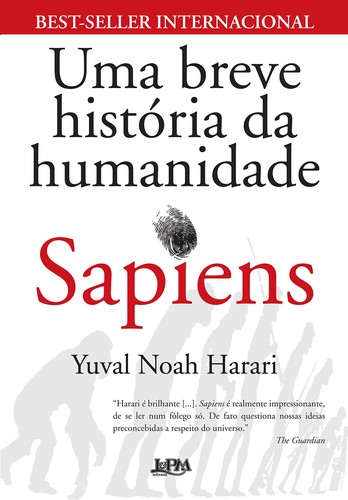
O que possibilitou ao Homo sapiens subjugar as demais espécies? O que nos torna capazes das mais belas obras de arte, dos avanços científicos mais impensáveis e das mais horripilantes guerras? Nossa capacidade imaginativa. Somos a única espécie que acredita em coisas que não existem na natureza, como Estados, dinheiro e direitos humanos. Partindo dessa ideia, Yuval Noah Harari, doutor em história pela Universidade de Oxford, aborda em Sapiens a história da humanidade sob uma perspectiva inovadora. Explica que o capitalismo é a mais bem-sucedida religião, que o imperialismo é o sistema político mais lucrativo, que nós, humanos modernos, embora sejamos muito mais poderosos que nossos ancestrais, provavelmente não somos mais felizes. Um relato eletrizante sobre a aventura de nossa extraordinária espécie ? de primatas insignificantes a senhores do mundo.
Ambitious survey of human development, from our coexistence with neanderthals up to present day and speculations for the future. It's a breezy, colloquial take on a lot of different topics: biology, anthropology, sociology and culture, economics (very breezy here), scientific and industrial revolutions, world history, religion etc. Anecdotes and facts are more established for some of these topics than others -- nevertheless it's all very high level, as you would expect with this sort of scope. A bibliography of further reading would have been nice.
When this came out, most of the buzz seemed to be about his claim that pre-Agricultural revolution homo sapiens (he eschews the word humans for our species) was much better than afterwards. I didn't think this was much in doubt. It's good to realize that not every major change in human development was a net benefit to people overall.
Still, it's a good well written …
Ambitious survey of human development, from our coexistence with neanderthals up to present day and speculations for the future. It's a breezy, colloquial take on a lot of different topics: biology, anthropology, sociology and culture, economics (very breezy here), scientific and industrial revolutions, world history, religion etc. Anecdotes and facts are more established for some of these topics than others -- nevertheless it's all very high level, as you would expect with this sort of scope. A bibliography of further reading would have been nice.
When this came out, most of the buzz seemed to be about his claim that pre-Agricultural revolution homo sapiens (he eschews the word humans for our species) was much better than afterwards. I didn't think this was much in doubt. It's good to realize that not every major change in human development was a net benefit to people overall.
Still, it's a good well written survey with definite opinions that will probably challenge your world-view a bit, even if you're a card-carrying secular scientific type. The author is a bit partial to Buddhism. I'll probably wait on reading his most recent book, as it seems to overlap quite a bit with this one.