
Skeletons in the Swimmin' Hole is a collection of six short horror stories set in Disney World. Three of the stories have been previously published in various magazines, and three are new. The author, Kristi Petersen Schoonover, is an editor of Read Short Fiction (www.readshortfiction.com).
The namesake story is about a woman artist whose specialty is taking photos of dead animals. It speaks well for the quality of writing that such an apparently repugnant brand of art comes across as hauntingly beautiful, in the woman's point of view--so much so that when her husband acquires the ability to sense the last thoughts of the dead, her desperation from having to abandon her art is palpable. When she meets a strange man, one of the avid fans of her art, she cannot help but fall for him, forming an unusual love triangle. But she's soon to discover the dark …
User Profile

An immigrant from Ukraine, now residing near Philadelphia. Software developer by day, science fiction author whenever time allows. PhD in Math from the MIT. Graduate of the Viable Paradise and Futurescapes writing workshops. Author of Pink Noise: A Posthuman Tale.
This link opens in a pop-up window
Leo Korogodski's books
User Activity
RSS feed Back

Review of "Skeletons in the Swimmin' Hole" on 'Goodreads'
4 stars
Skeletons in the Swimmin' Hole is a collection of six short horror stories set in Disney World. Three of the stories have been previously published in various magazines, and three are new. The author, Kristi Petersen Schoonover, is an editor of Read Short Fiction (www.readshortfiction.com).
The namesake story is about a woman artist whose specialty is taking photos of dead animals. It speaks well for the quality of writing that such an apparently repugnant brand of art comes across as hauntingly beautiful, in the woman's point of view--so much so that when her husband acquires the ability to sense the last thoughts of the dead, her desperation from having to abandon her art is palpable. When she meets a strange man, one of the avid fans of her art, she cannot help but fall for him, forming an unusual love triangle. But she's soon to discover the dark side of the fascination with death, darker by far than her own.
Miss Reyna Gets Her Comeuppance on Flash Mountain is a very short story about a young woman who is deathly afraid of rollercoasters yet works for one. Why? It turns out Miss Reyna has reason enough for both in her past. One of the best stories in the collection, it ends in a resolution that's happy and tragic at the same time. The language is hypnotic--again, easing the reader into the main character's decision.
In a striking, but less haunting, parallel, Charlotte's Family Tree also features a woman who's afraid of one particular attraction in Disney World, so much so that she denies her daughter the fun of visiting the place. But when she's finally persuaded by her husband, we discover what had happened between her and her mother at that same attraction when she was a little girl herself. But the darkness is resolved through the main character's daughter--and, surprisingly, her dead grandmother.
In All This Furniture and Nowhere To Sit, the genders are reversed. This time, it's a man whose father, dead by now, didn't let his young son visit Disney World, believing that his son was better off learning the practical things on the farm. Now, the main character's wife suddenly acquires a very expensive obsession collecting relics of the now-dismantled attractions and refashioning them into new furniture for their house. Soon, they end up sleeping in a 1964 Small World boat for the bed. Oddly enough, the relics "whisper" something into the man's mind. This time, though, it's the dead's turn to find atonement.
Perhaps the funniest in the collection, Doing Blue is about a drug-like high inflicted by the Blue Line attraction on a weird group led by a Jesus impersonator (earnestly believing he's the real deal). This gives much opportunity for related humor. But the highlight of the story is the atonement found while "doing blue" by a new member of the group, tormented by her crimes.
On the weirdness end of the spectrum is Romancing the Goat, about a teenage girl having trouble adjusting to her new adopted sister. She does make mistakes. But I wonder whether it was possible to get along with Angelina, the way she's portrayed--for she's no angel. The story is open-ended, with the sense of inevitable horror coming the main character's way. But I felt that the girl acted younger than her age.
With the possible exception of that story, I find atonement to be the overarching theme of the collection. Worth a read.
Leo Korogodski reviewed The human experiment by Jane Poynter

Review of 'The human experiment' on 'Goodreads'
4 stars
Written by a true enthusiast. The author was a long-time member of the Synergias faction that created Biospere 2, but she took the anti-management side in the internal conflict that is well shown in the book. But the jumps from the conflict to the everyday happenings in Biosphere 2 and back again are somewhat jarring.
Leo Korogodski rated Life Under Glass: 3 stars

Life Under Glass
The only account written during the original enclosure, Life Under Glass tells the story of the original crew that lived …
Leo Korogodski rated Rainbows End: 3 stars
Leo Korogodski reviewed Cryptozoica by Mark Ellis
Review of 'Cryptozoica' on 'Goodreads'
5 stars
Adventure done right
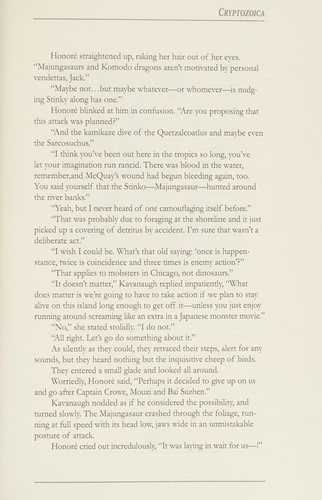
Mark Ellis is a prolific writer, well known for the stories written as James Axler (including the popular Outlanders series) as for those written under his own name. A firm grip on the adventure aspect of storytelling is his forte, and Cryptozoica is a fine example of this. This is an adventure done right. I can easily see it rolling onto the big screen as naturally as a newborn coming out of a womb, already perfect, with hardly a change necessary. Somehow, Mark has managed to marry the Hollywood approach to filmmaking (Indiana Jones crossed with Jurassic Park), that typically makes for much excitement but often falls short for the more sophisticated viewer, with the best traditions of the written genre, capable of pleasing the brainiac science fiction readership. The baby has the best of both. What's more, a lover of Dan Brown may even throw the …
Adventure done right
Mark Ellis is a prolific writer, well known for the stories written as James Axler (including the popular Outlanders series) as for those written under his own name. A firm grip on the adventure aspect of storytelling is his forte, and Cryptozoica is a fine example of this. This is an adventure done right. I can easily see it rolling onto the big screen as naturally as a newborn coming out of a womb, already perfect, with hardly a change necessary. Somehow, Mark has managed to marry the Hollywood approach to filmmaking (Indiana Jones crossed with Jurassic Park), that typically makes for much excitement but often falls short for the more sophisticated viewer, with the best traditions of the written genre, capable of pleasing the brainiac science fiction readership. The baby has the best of both. What's more, a lover of Dan Brown may even throw the parentage into question, claiming that the baby clearly must be a product of secret societies at work--and (s)he'd be right!
Cryptozoica also marks a debut of the Mark & Melissa husband-and-wife team as a small press publisher. This shows in the plethora of small but welcome modifications of the standard book layout. The very first pages contain the portraits of the unlikely crew to brave the Island of Big Tamtung--as all other illustrations in the book (including the cute dinosaurs figures next to the page numbers), drawn by Jeff Slemons. The artist has done a great job. The images are eloquent representations of the characters. Interestingly, "Tombstone" Jack Cavanagh bears some resemblance, in my biased opinion, to the author himself. He, along with Augustus Crowe and a teenage Maori girl Mouzi, make the "two captains and one crew member" team of the Cryptozoica Enterprizes: two former members of the U.S. Air Force and Navy respectively, and an ex-pirate girl who doesn't shy away from cutting a man's throat.
Jack's helicopter and Gus's boat are about the only things remaining of the Cryptozoica Enterprizes, their failed attempt to make money out of their discovery of an island in the Pacific teaming with surviving dinosaurs. Joining them is an unlikely trio of a dwarfish scientist, Aubrey Belleau, led to the island by a suppressed portion of Charles Darwin's diary (suppressed, of course, by his secret society), his enormous bodyguard Oakeshott, a black belt who fights dirty in the to-the-death arenas in Bangkok, and Honore Roxton, a woman paleontologist with the handicap of being the only one clueless at the start of the adventure--but with the advantage of being good-looking, if not in the conventional sense, and smart. As if this were not enough, the Asian organized crime gets involved, as a dashing Chinese swordswoman and an enigmatic Naga dancer Bai Suzhen, the operational leader of the White Snake triad, joins the fray.
There is both beauty and danger aplenty on the Island of Big Tamtung. But it is not the "big-monster" type of dinosaurs that cannot be killed by a machine gun, like a Majungasaurus, that are the most dangerous animals on the island. Although small and vulnerable to a sword, a pack of Deinonychus is far more deadly, not merely thanks to their sharp claws but more so because of their pack tactics; they are smart enough to figure out how to climb onto a monorail! But even more dangerous are other humans. Stranded on the island, the team is torn apart by conflicting goals and loyalties, while also being pursued by the modern-day pirates. Escaping a Majungasaurus on a personal vendetta is nothing next to that.
Nor are the Deinonychus the smartest dinos on the island. Mark has done a great deal of research, and his (or rather, the paleontologist Dale Russell's) speculation that, had they survived to our time, the Troodon species of the warm-blooded dinosaurs may have evolved into an intelligent species is convincing enough. The appearance of this so-called anthroposaur is one of the highlights of the story, and Mark ties it to the numerous legends about the snake-like Naga people of the Asian antiquity.
An astute reader may notice a few text layout problems in the book. But they do not take away from the story. Cryptozoica is not to be missed, and I'm looking forward to the next book coming out of this husband-and-wife team.
Leo Korogodski rated Halting state: 3 stars
Halting state by Charles Stross
In the year 2018, a daring bank robbery has taken place at Hayek Associates. The suspects are a band of …
Leo Korogodski rated Lady of Mazes: 4 stars
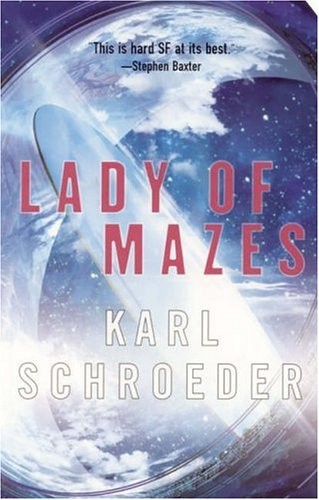
Lady of Mazes by Karl Schroeder
Karl Schroeder is one of the new stars of hard SF. His novels, Ventus and Permanence, have established him as …
Leo Korogodski reviewed Bitter seeds by Ian Tregillis

Review of 'Bitter seeds' on 'Goodreads'
5 stars
It is often said that a story can only have one big "lie." But every rule must have exceptions. In his first novel, Bitter Seeds, Ian Tregillis successfully pits one big lie against another: the outcome of an alternate World War 2 is to be decided by the struggle between the British warlocks and the Nazi supermen.
During the Spanish Civil War, a British secret agent Raybould Marsh is sent to Spain to meet a Nazi defector. But the latter spontaneously erupts into flames, burning to death, and the top-secret documents and film that he has not had time to properly deliver are severely damaged. Later, Marsh meets a young German woman in a harbor, who seems to know him--and she has wires sticking out of her head.
As it turns out, the Germans secretly deployed a team of supermen, using Spain as their training ground. One can fly, another …
It is often said that a story can only have one big "lie." But every rule must have exceptions. In his first novel, Bitter Seeds, Ian Tregillis successfully pits one big lie against another: the outcome of an alternate World War 2 is to be decided by the struggle between the British warlocks and the Nazi supermen.
During the Spanish Civil War, a British secret agent Raybould Marsh is sent to Spain to meet a Nazi defector. But the latter spontaneously erupts into flames, burning to death, and the top-secret documents and film that he has not had time to properly deliver are severely damaged. Later, Marsh meets a young German woman in a harbor, who seems to know him--and she has wires sticking out of her head.
As it turns out, the Germans secretly deployed a team of supermen, using Spain as their training ground. One can fly, another superman can make things burst into flames, one superwoman can turn invisible. An imbecile on a leash can smash things by telekinesis. In order to oppose this, the British turn to a secretive cabal of warlocks.
At first, they think that the German supermen use the same magic in another guise. But they soon discover this is not the case. The supermen are the so-called "Doctor von Westarp's children"--the very few that have miraculously lived through the "good doctor's" experiments. Although the "willenkrafte" (willpower) they use is ill-defined, this comes across as a species of science. Whereas the warlocks use magic--another the book's many polarities.
This magic is powerful, but it is not without a price. Indeed, everyone must pay a price in the story, the von-Westarp's children and the British alike. For the warlocks, this takes the form of "blood price." The Eidolons, the demon-like beings, hate humans with passion and would like nothing better than to erase the humanity entirely from existence. The more the warlocks ask of them, the higher is the price--in blood, at first; but then, in lives. In many lives.
There is a point in the story when neither side is sympathetic; thankfully, it's brief. The slide down the "getting worse before it begins getting better" slope is handled masterfully. The character development arc of another POV character, William Beauclerk, is especially poignant.
Will (interestingly, usually referred to by his nickname in the story, whereas Marsh is called by his last name) is a liaison between the British secret service and the warlocks, and a beginning warlock in his own right. The story begins with him as a witty and gregarious teetotaler, easy to like. Toward the end, the Eidolons' demands of mass killings of his own people drive him almost to the brink of ruin.
On the other side, the Nazi too have likable characters. The third POV in the book belongs to Klaus, one of the supermen. He is a half-Gipsy, and therefore not very much liked by the Nazi (although tolerated for his usefulness). His particular skill is the ability to become incorporeal, going unscathed through walls or through a hail of bullets, even stopping a victim's heart by bare hands.
Yet it is his sister Gretel who is the story's most memorable characters. She is enigma. A girl who can predict future (it is her that Marsh had met in Spain). A lover of poetry and eccentric pursuits, Gretel has the trickster's humor, though with dark edge. But she is insane and has motives of her own, not necessarily coinciding with the goals of the Nazi leadership. As a reader, I wanted nothing more than to find out what she's up to. But, just as it opens with Klaus and Gretel in the prologue, heading toward an unknown future in the von Westarp's mansion, the book closes with them heading toward a very different unknown (though not to her!) future in the next book of the Milkweed triptych--the one I don't intend to miss.
Leo Korogodski rated Queen of Candesce: 5 stars
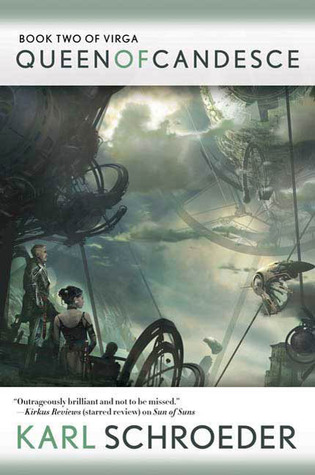
Queen of Candesce by Karl Schroeder (Virga, #2)
Leo Korogodski rated Ventus: 5 stars
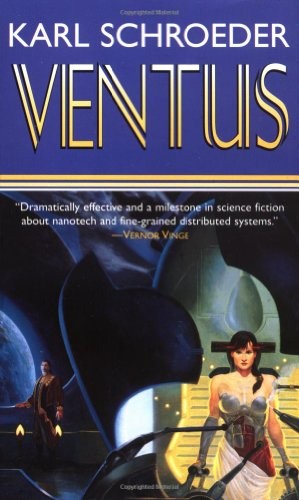
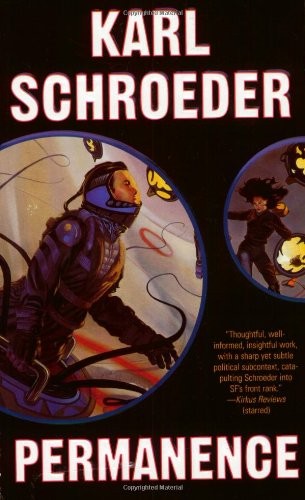
Leo Korogodski rated Permanence: 5 stars
Leo Korogodski rated Pirate Sun: 5 stars
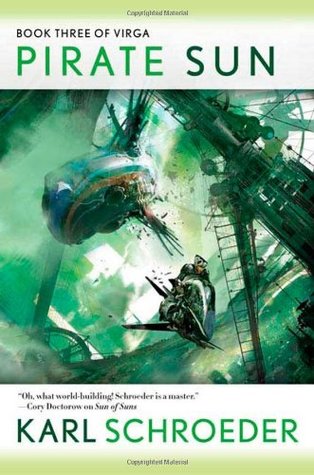
Pirate Sun by Karl Schroeder (Virga, #3)
Leo Korogodski rated The Sunless Countries: 5 stars