That was a comfy read!
4 stars
Hope to get soon a copy of the second book.
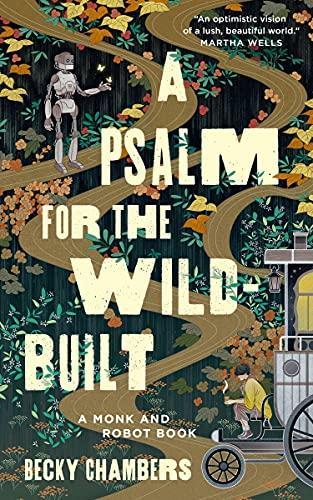
147 pages
English language
Published Nov. 22, 2021
A Psalm for the Wild-Built is a 2021 solarpunk novella written by American author Becky Chambers and was published by Tor.com on July 13, 2021. It is the first book in the Monk & Robot duology, followed by A Prayer for the Crown-Shy, which was released on July 12, 2022. It won the Hugo Award in 2022.
Hope to get soon a copy of the second book.
Content warning Contains some spoiler-ish content. Probably better to read this after the book :)
This is the first book I discovered through Bookwyrm. Its reviews here were overwhelmingly positive, and the spoiler-free comments and reviews were just too intriguing to ignore. I’m glad I took a chance on it, because this was such a joy to read.
What first stood out to me was the tone and diction; they felt oddly familiar. At first I couldn’t shake this peculiar thought that the narration and dialogue sounded like something I would write! It turns out that the author is close to me in age, was raised in LA, and is currently based in Northern California (where I am from). It is kind of a funny coincidence, and an interesting sensation to have on the outset of a novel. Beyond the writing itself, though, there are also numerous philosophical themes woven into this story that overlap significantly with things I have researched and written about somewhat extensively. To say the least, I felt weirdly at home in Dex and Mosscap’s world.
Even though this book is relatively short, it is jam packed with fascinating observations about the human condition, commentaries about social and ethical problems, and thought-provoking insights and wondering out loud about what it means to exist. Looking back on all the passages I highlighted, I am impressed by how well the author gestures toward so many profound topics and themes without smothering them with tedious explanations. For example, when Dex realizes that robots refer to themselves as objects and use “it” as a pronoun, they and Mosscap have this exchange:
“So, it is correct, then? You wouldn’t prefer they or—”
“Oh, no, no, no. Those sorts of words are for people. Robots are not people. We’re machines, and machines are objects. Objects are its.”
“I’d say you’re more than just an object,” Dex said.
The robot looked a touch offended. “I would never call you just an animal, Sibling Dex.” It turned its gaze to the road, head held high. “We don’t have to fall into the same category to be of equal value.”
What I love about this is you are already immersed in this neat world where the main character is (apparently) completely accepted as a non-binary person, and here they are not only learning about identity and personhood from another non-gendered being (a robot), but this episode climaxes in a wonderfully open-ended assertion about the nature of existence in general. The author gives the reader a sign post, but it is up to them to wonder on further. Having space to let my imagination run with these thought-provoking scenarios allowed me to immerse myself further in the story’s world.
The whole book is peppered with these sorts of scenarios. Being the first encounter between humans and robots in an unknown but significantly long period of time, Dex and Mosscap naturally have lots to talk about. Their interactions continually prompt them to re-examine their fundamental ideas about the world and their place in it. For example, contrary to what Dex, and presumably humans generally had assumed, Mosscap and the other robots are, in a sense, surprisingly human-like:
Dex chewed on this for a while as Mosscap continued cooing at birds. “You are nothing like I expected,” Dex said at last. “I mean, I didn’t expect to meet any of you ever, but…” They shook their head. “I wouldn’t have pictured you.”
“Why not?”
“You’re so … flexible. Fluid. You don’t even know how many of you there are, or where you are. You just go with the flow. I figured you’d be all numbers and logic. Structured. Strict, y’know?”
Mosscap looked amused. “What a curious notion.”
“Is it? Like you said, you’re a machine.”
“And?”
“And machines only work because of numbers and logic.”
“That’s how we function, not how we perceive.”
Mosscap struggles with math, and in fact, counts on its fingers. Robots in this world are not just avatars of some super-intelligent hive mind, nor are they glorified Swiss Army knives with an inventory of go-go-gadget-whatevers to save their human counterparts in any given situation. Robots in this world became conscious long ago, for reasons not even they understand, and left the factories and human civilization peacefully to inhabit the wilds undisturbed. What have they been up to out there for all that time? A lot of wondering and wandering: observing insects, watching stalagmites and stalactites form over centuries, cavorting with wolf packs, listening to birdcalls, etc. Y’know, robot stuff.
There is something profoundly moving about the nature of robots in this story that is hard for me to place. In some sense, the robots in this world feel more relatable than the humans, who have a society that is more-or-less everything we could ever dream of for ourselves; a solarpunk paradise, really. They have a society where everyone is cared for, everyone is accepted, computers are built to last forever, nothing is wasted, they value relaxation and leisure but also appreciate work (as opposed to labor). As great as all this sounds, the life of a robot in the wilds is strangely appealing and inspiring. Perhaps it is because they have the time, the patience, and the focus to just deeply immerse themselves in whatever it is that they are doing: even just watching stalactites grow… slowly… painfully slowly! Or, in the case of Mosscap, checking out everything as much as possible:
“So, if Two Foxes is into bird calls, what about you? What’s your thing?”
“Insects!” Mosscap cried. Its voice was jubilant, as if it had spent every second prior waiting for Dex to broach the topic. “Oh, I love them so much. And arachnids, too. All invertebrates, really. Although I do also love mammals. And birds. Amphibians are also very good, as are fungi and mold and—” It paused, catching itself. “You see, this is my problem. Most of my kind have a focus—not as sharply focused as Two Foxes or Black Marbled Rockfrog, necessarily, but they have an area of expertise, at least. Whereas I … I like everything. Everything is interesting. I know about a lot of things, but only a little in each regard.” Mosscap’s posture changed at this. They hunched a bit, lowered their gaze. “It’s not a very studious way to be.”
Being a hyper-sensitive, insatiably curious person myself, I feel like I would get along well with Mosscap. But here it seems to imply that its lack of focus is undesirable. I think the way it states this is significant: “It’s not a very studious way to be.” At the end of the book when Dex is despairing over a feeling that their life lacks purpose, Mosscap explains to them them that its current mission of finding out what humans need is simply something it is doing not its reason for being. This shows us that, like us, Mosscap is imperfect—not some all-wise sage-of-the-woods. Earlier in the book, Mosscap confided that it shares a similar anxiety, but here it is providing insight, encouragement, and support in spite of that fact:
You are not separate or other. You’re an animal. And animals have no purpose. Nothing has a purpose. The world simply is. … You keep asking why your work is not enough, and I don’t know how to answer that, because it is enough to exist in the world and marvel at it. You don’t need to justify that, or earn it. You are allowed to just live. That is all most animals do."
Is Dex just anxious because they are an animal whose existence is impermanent? “[That’s] what scares me. My life is … it. There’s nothing else, on either end of it.” But even if there were something before or after, would that anxiety go away? Or would it just delay the inevitable? The robots, understanding that nothing in nature is permanent, realize that they are not an exception. Rather than rebuilding themselves and sustaining the consciousness of individual robots, they repurpose the parts of older, “dead” robots to build new ones; wild-built robots. Of course, they could just repair existing robots, but not indefinitely. Everything degrades and changes. Rather than delaying the inevitable, robots chose to accept the impermanence of existence. Like humans, like Dex, robots may face the same anxiety about life being meaningless. As Mosscap puts it, there is no point to life, though; it is what it is. It is for its own sake. “‘Then how’ Dex said, ‘how does the idea of maybe being meaningless sit well with you?’” Mosscap responds with what I like to think could be the refrain of the metaphorical psalm for the wild-built: “Because I know that no matter what, I’m wonderful.”
Mosscap isn’t bragging vainly. It’s statement is literal. Mosscap lives in a constant state of wonder. That is all there is to do; the best anything can do:
Dex turned the mug over and over in their hands. “It doesn’t bother you?” Dex said. “The thought that your life might mean nothing in the end?”
“That’s true for all life I’ve observed. Why would it bother me?” Mosscap’s eyes glowed brightly. “Do you not find consciousness alone to be the most exhilarating thing? Here we are, in this incomprehensibly large universe, on this one tiny moon around this one incidental planet, and in all the time this entire scenario has existed, every component has been recycled over and over and over again into infinitely incredible configurations, and sometimes, those configurations are special enough to be able to see the world around them. You and I—we’re just atoms that arranged themselves the right way, and we can understand that about ourselves. Is that not amazing?”
It sure is, Mosscap. Gods around, it is.
and crickets began to sing.
A Psalm for the Wild-Built is a beautiful reminder that technology is not necessarily antagonistic to a better world, and encourages mindfulness of its presence. Becky Chambers paints a hopeful image of what a more humanistic world can look like, while encouraging introspection into how we determine self-worth. This is a must-read for anybody feeling disaffected by technology in the present and struggling to see a path forward.
A Psalm for the Wild-Built is a beautiful reminder that technology is not necessarily antagonistic to a better world, and encourages mindfulness of its presence. Becky Chambers paints a hopeful image of what a more humanistic world can look like, while encouraging introspection into how we determine self-worth. This is a must-read for anybody feeling disaffected by technology in the present and struggling to see a path forward.
This is exactly what I needed to read at this point in my life. It's so beautiful, and I cried my way through the entire second half. Perhaps it isn't anything groundbreaking, but it has the same "vibes" as a Studio Ghibli film or the video game, Celeste. It's no wonder that this book is so loved.
This is exactly what I needed to read at this point in my life. It's so beautiful, and I cried my way through the entire second half. Perhaps it isn't anything groundbreaking, but it has the same "vibes" as a Studio Ghibli film or the video game, Celeste. It's no wonder that this book is so loved.
Thoroughly delightful respite from gloomy books I've been reading lately.
I've enjoyed Becky Chambers' work for years, and I feel she distilled it to perfection in this novella. Length-wise it is just enough to paint a picture of a beautiful solarpunk world, and to give us characterization of Dex, the main protagonist. There is nothing superfluous to it, and there is no rush either; the pace is contemplative and purposeful.
I loved the world building; the slow paced, hopeful world of Panga feels like a perfect place for me. On the other hand, it is a clever backdrop for Dex's angst and struggle to find their own purpose in life. Chambers pulls off a great feat with portrayal of Dex; they feel rich, complex and fully realized human being. Clever too is the contrast of the titular robot to Dex's monk, and the cute, often philosophical exchanges between …
Thoroughly delightful respite from gloomy books I've been reading lately.
I've enjoyed Becky Chambers' work for years, and I feel she distilled it to perfection in this novella. Length-wise it is just enough to paint a picture of a beautiful solarpunk world, and to give us characterization of Dex, the main protagonist. There is nothing superfluous to it, and there is no rush either; the pace is contemplative and purposeful.
I loved the world building; the slow paced, hopeful world of Panga feels like a perfect place for me. On the other hand, it is a clever backdrop for Dex's angst and struggle to find their own purpose in life. Chambers pulls off a great feat with portrayal of Dex; they feel rich, complex and fully realized human being. Clever too is the contrast of the titular robot to Dex's monk, and the cute, often philosophical exchanges between them.
I also liked the book's ending. It might leave things seemingly unresolved, but the story climax presents convincing argument for the value of self discovery over finding the (unattainable) solutions. In its philosophy, its character and world building, and its beauty, this story felt true to me, and that's my favorite thing.
I love novellas and I wish there were more of them in the world. This light read follows a "tea monk" on a spiritual journey where they meet a robot and they learn things. It's cozy, it's quaint, it's a joy to read.
I love novellas and I wish there were more of them in the world. This light read follows a "tea monk" on a spiritual journey where they meet a robot and they learn things. It's cozy, it's quaint, it's a joy to read.
I'm still digesting this one, but I massively enjoyed reading it. The characterization and worldbuilding are top-notch and done with an exceedingly deft hand.
I'm still digesting this one, but I massively enjoyed reading it. The characterization and worldbuilding are top-notch and done with an exceedingly deft hand.
as per title. more stories without the usual american conflicts and cartoony villains. more utopias and less dystopias. more writing that challenges our belief and makes us think, even if shortly, about the possibility of a different world. the relationship between the two characters is beautifully narrated.
as per title. more stories without the usual american conflicts and cartoony villains. more utopias and less dystopias. more writing that challenges our belief and makes us think, even if shortly, about the possibility of a different world. the relationship between the two characters is beautifully narrated.
Kirjan maailmassa ihmiset elävät vehreissä kestävän teknologian kaupungeissa ja puolet planeetasta (tai siis kuusta) on rauhoitettu ihmiskunnalta. Ihmiskunnan muinoin rakentamat ja sitten omille teilleen lähteneet robotit ovat jo melkein unohdettua historiaa. Päähenkilö, kiertävänä "teemunkkina" toimiva Dex, lähtee etsimään merkityksen tunnetta ja törmää robottiin, joka on lähtenyt tutustumaan ihmisten yhteiskuntaan.
Eli siis jonkinlaista tekno-optimistista ja utopistista skifiä on tämä lyhytromaani. Mulle melko uutta "solarpunk"-termiä on myös käytetty teosta kuvaamaan. Ihan kivasti kirjoitettu ja sympaattinen tarina elämän merkityksen etsimisestä, jotenkin liiankin kiva ja mukava. Ehkä kaipaan skifiltäni enemmän konfliktia ja säröä.
Kirjan maailmassa ihmiset elävät vehreissä kestävän teknologian kaupungeissa ja puolet planeetasta (tai siis kuusta) on rauhoitettu ihmiskunnalta. Ihmiskunnan muinoin rakentamat ja sitten omille teilleen lähteneet robotit ovat jo melkein unohdettua historiaa. Päähenkilö, kiertävänä "teemunkkina" toimiva Dex, lähtee etsimään merkityksen tunnetta ja törmää robottiin, joka on lähtenyt tutustumaan ihmisten yhteiskuntaan.
Eli siis jonkinlaista tekno-optimistista ja utopistista skifiä on tämä lyhytromaani. Mulle melko uutta "solarpunk"-termiä on myös käytetty teosta kuvaamaan. Ihan kivasti kirjoitettu ja sympaattinen tarina elämän merkityksen etsimisestä, jotenkin liiankin kiva ja mukava. Ehkä kaipaan skifiltäni enemmän konfliktia ja säröä.
What a joy this book was! It's a fairly light adventure, but with an emotional journey, some relatable characters, and a setting that feels like a relatively positive future with some unspecified dark times in its past.
This was the #SFFBookClub April pick
What a joy this book was! It's a fairly light adventure, but with an emotional journey, some relatable characters, and a setting that feels like a relatively positive future with some unspecified dark times in its past.
This was the #SFFBookClub April pick
I did like this story, but it felt a bit underdeveloped? The interaction between the monk and the robot was charming, and I liked the metaphorical roles of healer and healed, of nature and the created.
I'm not really sure why I did not like it as much as Chambers' longer stories.
One interesting thing was how I tried to figure out the "fact" beyond the gender neutral presentation of the monk. Apparently my mind of so very primed on the woman/man identities when I have to construct an imago in my head of what I read, and then I'm not a very visual reader at all. Intriguing.
I did like this story, but it felt a bit underdeveloped? The interaction between the monk and the robot was charming, and I liked the metaphorical roles of healer and healed, of nature and the created.
I'm not really sure why I did not like it as much as Chambers' longer stories.
One interesting thing was how I tried to figure out the "fact" beyond the gender neutral presentation of the monk. Apparently my mind of so very primed on the woman/man identities when I have to construct an imago in my head of what I read, and then I'm not a very visual reader at all. Intriguing.
Content warning minor spoilers
Having the #SFFBookClub pick this book for this month was a good excuse to read this book for the third time. My bias here is that I have deeply enjoyed everything I've read from Becky Chambers, so take from that what you will.
This is a slow-moving, character-focused novella that is more focused on existential questions and feelings than on plot. It's got some very funny moments, comfy world-building, and has incredibly endearing vibes. I love the idea of Allalae, god of small comforts so so much. (Also, yay non-binary protagonist, you love to see it.)
The short plot summary is that tea monk Sibling Dex struggles with finding satisfaction with their life and takes a jaunt off the beaten path to find it. On the way, they befriend inquisitive robot Mosscap who is trying to learn about how humans are doing and what they need. This novella is definitely the friends you make along the way. In a strict plot sense, the book ends the journey almost as it is getting started (setting up nicely for the next novella), but the emotional arc is amazingly crafted to deliver a gut punch.
In some ways, Sibling Dex feels like a stand-in for the reader themselves where Mosscap the robot as an outsider is positioned to be able to interrogate Dex about humanity itself and its self-perceptions. Mosscap's quest is to ask humans and find out "what they need", and ultimately this is the same question Dex struggles with themself. Dex feels like they need to get out of the city, or listen to crickets, or become a tea monk, or get away from their routine, or or or
I think it could be easy for this story to feel like it's about something very far from our world. Everybody's basic needs are taken care of. Capitalism seems to be in the past. The environment is being respected and rewilded. The autonomy of rebellious robot workers to stop working and fuck off is respected by all of humanity. All together it's a lovely and hopeful worldview that is hard to hold onto these days. But, the fact that Sibling Dex does not have any easy answers to pin their internal dissatisfaction on some obvious material lack makes their existential struggle and their worries about wasting their life that much more poignant.
I think I keep coming back to this book because it's an extremely hopeful view of the future that I want to hold onto, but also because the message is one I very personally need to keep hearing at this point in my life. It hasn't sunk in yet, but maybe on the next reread...
sweet, beautiful, simple and short. this story came to me on the heels of a hard year, which itself was following a couple more hard years. sibling dex and mosscap were precisely the guides i needed to recenter at the end of this year and think about how to bring a little bit of tea monk energy into the next chapters of my life. i'll be rereading this one.
sweet, beautiful, simple and short. this story came to me on the heels of a hard year, which itself was following a couple more hard years. sibling dex and mosscap were precisely the guides i needed to recenter at the end of this year and think about how to bring a little bit of tea monk energy into the next chapters of my life. i'll be rereading this one.
A wonderful, thought-provoking journey of self-discovery and celebration of the simple wonder of being, of existing. Highly recommended.
Delightful, inspires us to quiet community building - so glad the next volume is out