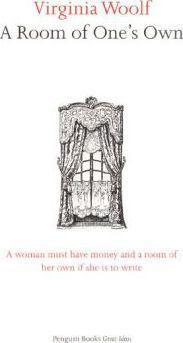
A Room of One's Own is an extended essay by Virginia Woolf. First published on 24 October 1929, the essay was based on a series of lectures she delivered at Newnham College and Girton College, two women's colleges at Cambridge University in October 1928. While this extended essay in fact employs a fictional narrator and narrative to explore women both as writers of and characters in fiction, the manuscript for the delivery of the series of lectures, titled "Women and Fiction", and hence the essay, are considered non-fiction. The essay is generally seen as a feminist text, and is noted in its argument for both a literal and figural space for women writers within a literary tradition dominated by patriarchy.
A Room of One's Own is an extended essay by Virginia Woolf. First published on 24 October 1929, the essay was based on a series of lectures she delivered at Newnham College and Girton College, two women's colleges at Cambridge University in October 1928. While this extended essay in fact employs a fictional narrator and narrative to explore women both as writers of and characters in fiction, the manuscript for the delivery of the series of lectures, titled "Women and Fiction", and hence the essay, are considered non-fiction. The essay is generally seen as a feminist text, and is noted in its argument for both a literal and figural space for women writers within a literary tradition dominated by patriarchy.
A classic that is actually good! An essay on women & fiction (thus, feminism) that rambles along in a relaxed fashion without losing any of its coherency or piercing insight. And damn she can write. Sadly still relevant, nearly 100 years on. (For reference her £500/yr is A$55k/yr today.)
This was my second time reading this. The first time was long ago in school—from which I remembered the general premise, the fact that I liked it, and little else. This time I read it with a reading group. The other members of this group drew my attention to aspects of, and ambiguities in, the book that I might otherwise have missed. It’s a book with a lot of interesting and powerful ideas to ponder. It is also a very entertaining and often funny book. Well worth reading for its place in the history of women’s literature, for its exploration of the history of women in (Western) society, and for its analysis of, and ponderings on, literature in general.
Pour moi ça a été une révélation ! Je l'avais lu plus jeune et relire cette traduction de Marie Darrieussecq m'a fait tout redécouvrir ! C'était génial. Je vais le garder et le relire sûrement plus tard encore et encre...
Pour moi ça a été une révélation ! Je l'avais lu plus jeune et relire cette traduction de Marie Darrieussecq m'a fait tout redécouvrir ! C'était génial. Je vais le garder et le relire sûrement plus tard encore et encre...
De quoi nous parle ce petit bouquin ? De femmes et de fiction. Plus précisément, des femmes romancière et poétesses. Ou plutôt de leur absence. « Beaucoup de livres écrits par des hommes parlent de femmes, mais il y a très peu de femmes qui parlent d'hommes ». On est pas du tout dans une conférence ou un écrit académique (même si l'autrice connaît très bien ses classiques). Woolf nous déroule le fil de ses pensées sur les deux jours précédant la conférence. Il ne s'y passe factuellement pas grand chose: elle marche sur une pelouse, se voit refuser l'accès à la bibliothèque, mange bien le midi et mal le soir. Mais ce qui importe, c'est ce que ces événements suscitent tout un tas de pensées qui éclosent de manière un peu foutraque, comme les bulles d'une eau en train de frémir.
La thèse qu'elle défend parmi tant d'autres …
De quoi nous parle ce petit bouquin ? De femmes et de fiction. Plus précisément, des femmes romancière et poétesses. Ou plutôt de leur absence. « Beaucoup de livres écrits par des hommes parlent de femmes, mais il y a très peu de femmes qui parlent d'hommes ».
On est pas du tout dans une conférence ou un écrit académique (même si l'autrice connaît très bien ses classiques). Woolf nous déroule le fil de ses pensées sur les deux jours précédant la conférence. Il ne s'y passe factuellement pas grand chose: elle marche sur une pelouse, se voit refuser l'accès à la bibliothèque, mange bien le midi et mal le soir. Mais ce qui importe, c'est ce que ces événements suscitent tout un tas de pensées qui éclosent de manière un peu foutraque, comme les bulles d'une eau en train de frémir.
La thèse qu'elle défend parmi tant d'autres est très joliment amenée. Très simplement, écrire demande du temps et un espace où réfléchir et travailler, temps et lieu que les femmes n'avaient tout simplement pas la possibilité d'avoir à cause du patriarcat. Il y a plein d'autres petites choses à picorer: j'y ai appris que le test de Bechdel est en fait inspiré de ce livre !
Le livre est agréable à lire de bout en bout, je ne l'ai pas lâché en trois jours. C'est plutôt bon signe.
Virginia Woolf explores the topic of "Women and Fiction". She describes a fictionalized research into this topic where she entertainingly experiences examples of her talking points during research. This style is very entertaining and makes it a breeze to read through this little essay.
In addition to her funny writing she's also making points that are sadly still relevant today. It's nothing advanced, but I'd say it's one of the best introductory texts into feminism.
Virginia Woolf explores the topic of "Women and Fiction". She describes a fictionalized research into this topic where she entertainingly experiences examples of her talking points during research. This style is very entertaining and makes it a breeze to read through this little essay.
In addition to her funny writing she's also making points that are sadly still relevant today. It's nothing advanced, but I'd say it's one of the best introductory texts into feminism.