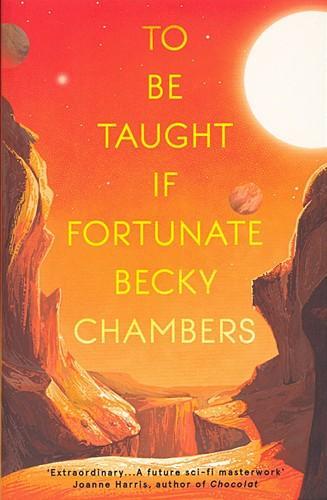
At the turn of the twenty-second century, scientists make a breakthrough in human spaceflight. Through a revolutionary method known as somaforming, astronauts can survive in hostile environments off Earth using synthetic biological supplementations. They can produce antifreeze in sub-zero temperatures, absorb radiation and convert it for food, and conveniently adjust to the pull of different gravitational forces. With the fragility of the body no longer a limiting factor, human beings are at last able to explore neighbouring exoplanets long suspected to harbour life.
Ariadne is one such explorer. On a mission to ecologically survey four habitable worlds fifteen light-years from Earth, she and her fellow crewmates sleep while in transit, and wake each time with different features. But as they shift through both form and time, life back on Earth has also changed. Faced with the possibility of returning to a planet that has forgotten those who have left, …
At the turn of the twenty-second century, scientists make a breakthrough in human spaceflight. Through a revolutionary method known as somaforming, astronauts can survive in hostile environments off Earth using synthetic biological supplementations. They can produce antifreeze in sub-zero temperatures, absorb radiation and convert it for food, and conveniently adjust to the pull of different gravitational forces. With the fragility of the body no longer a limiting factor, human beings are at last able to explore neighbouring exoplanets long suspected to harbour life.
Ariadne is one such explorer. On a mission to ecologically survey four habitable worlds fifteen light-years from Earth, she and her fellow crewmates sleep while in transit, and wake each time with different features. But as they shift through both form and time, life back on Earth has also changed. Faced with the possibility of returning to a planet that has forgotten those who have left, Ariadne begins to chronicle the wonders and dangers of her journey, in the hope that someone back home might still be listening.
An ode to science, discovery and the inherent value of knowledge.
3 stars
A small crew of scientists leave Earth, and their time period, forever to explore life on distant planets. But what will they do when Earth goes silent? An ode to science, discovery and the inherent worth of knowledge. The lack of interpersonal conflict under such trying conditions feels unrealistic.
A short read about space exploration in search of other life forms. Some interesting thoughts about ethical science, and some imaginative world building. But overall it's a bit thin and ends in an unsatisfying way that feels a little forced.
A short read about space exploration in search of other life forms. Some interesting thoughts about ethical science, and some imaginative world building. But overall it's a bit thin and ends in an unsatisfying way that feels a little forced.
Almost leisurely until the not-intensity-but-something-like-it slams into you. Like a mirror rushing towards you but it's a mirror so you don't really see it coming and it hits you and shatters and you're left stunned, looking through broken reflections to the beyond, wondering where to go from here.
The kind of book you need take a long walk after reading, or perhaps a good cry (though you're not really sure why).
Science fiction like only Becky Chambers does it.
Almost leisurely until the not-intensity-but-something-like-it slams into you. Like a mirror rushing towards you but it's a mirror so you don't really see it coming and it hits you and shatters and you're left stunned, looking through broken reflections to the beyond, wondering where to go from here.
The kind of book you need take a long walk after reading, or perhaps a good cry (though you're not really sure why).
It is wonderful. I love the characters and I could really feel the ups and downs with them. The description of the sci-fi science was also very interesting and plausible in my opinion.
One of the books where I'm very sad when it's over and can't stop thinking about it for quite a while.
It is wonderful. I love the characters and I could really feel the ups and downs with them. The description of the sci-fi science was also very interesting and plausible in my opinion.
One of the books where I'm very sad when it's over and can't stop thinking about it for quite a while.
A deeply personal plea for space exploration funding
4 stars
Unlike the super-high-tech far future of her Wayfarers series, Chambers focuses on just the near-future of the human race. Seen from a team of exoplanet explorers surveying alien life, To Be Taught paints a future where governments fail in the mission to space but the human spirit leads ordinary people to crowdfund the mission instead. And when the interstellar mission outlasts human lifespans, government lifespans and even societal lifespans, Chambers leaves us with a deeply personal question, ask from both her perspective and that of the protagonist, chronologically ancient, barely human and too distant to ever return home: how much is space exploration worth?
Unlike the super-high-tech far future of her Wayfarers series, Chambers focuses on just the near-future of the human race. Seen from a team of exoplanet explorers surveying alien life, To Be Taught paints a future where governments fail in the mission to space but the human spirit leads ordinary people to crowdfund the mission instead. And when the interstellar mission outlasts human lifespans, government lifespans and even societal lifespans, Chambers leaves us with a deeply personal question, ask from both her perspective and that of the protagonist, chronologically ancient, barely human and too distant to ever return home: how much is space exploration worth?