

Ahoy 👋 Only listing books I have actually read. My aims in using Bookwyrm are:
1. to enable asynchronous book clubs (i.e. swap read-lists, see if anything has already been read, discuss) and,
2. to prompt me to write reviews, to consolidate learning.
Ratings are for future me, not universal judgements 🕊️ Approximate meanings:
* ★☆☆☆☆ Terrible. I regret taking the the time to read this.
* ★★☆☆☆ Bad. Would rather have been meditating/running.
* ★★⯪☆☆ Pass. Just worth reading, not more.
* ★★★☆☆ Good. Worth reading, even if only once. Not much more to say.
* ★★★⯪☆ Very good. Some notable form or content. Lasting impact, if small.
* ★★★★☆ Excellent. Grateful that someone took the effort to write this, sad to think that certain other people might not read.
* ★★★★⯪ Outstanding. Unlocked new perspectives on life, released new emotions, will re-read or reference in future.
* ★★★★★ — (Not giving this to anything because I'm a Bayesian.)
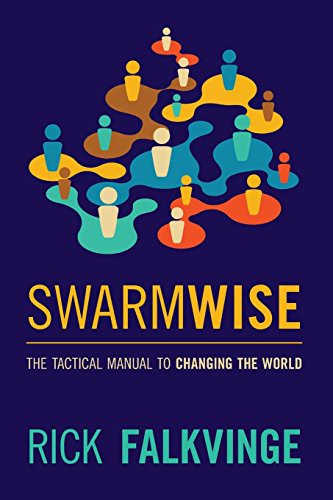
Combining hierarchy & movement to found the Pirate Party and gain a seat at the EU Parliament.
4 stars
(Writing this review from memory almost 10 years after reading!)
Falkvinge writes his personal history of the Swedish Pirate Party, from founding in 2006 (the first Pirate Party) to gaining a seat at the EU elections in 2009.
It is a deeply pragmatic book. The process of founding a Party + Movement is non-trivial, and since it is a mixed strategy, requires compromise. The approach is described as having a centralized "scaffold" (of people in salaried or elected positions) which activists act from. The "3 Pirate" rule was an interesting innovation, where activists could make decisions in the name of the Pirate Party if 2 others agreed with them. This significantly decentralized power and enabled lots of creative actions. Still, the mostly centralized scaffold of party staff were able to make rapid and bold actions of their own, while consulting with activists, not getting held back.
A …
(Writing this review from memory almost 10 years after reading!)
Falkvinge writes his personal history of the Swedish Pirate Party, from founding in 2006 (the first Pirate Party) to gaining a seat at the EU elections in 2009.
It is a deeply pragmatic book. The process of founding a Party + Movement is non-trivial, and since it is a mixed strategy, requires compromise. The approach is described as having a centralized "scaffold" (of people in salaried or elected positions) which activists act from. The "3 Pirate" rule was an interesting innovation, where activists could make decisions in the name of the Pirate Party if 2 others agreed with them. This significantly decentralized power and enabled lots of creative actions. Still, the mostly centralized scaffold of party staff were able to make rapid and bold actions of their own, while consulting with activists, not getting held back.
A good book for people wanting to start, do and lead. (Reminds me of "Blueprint for revolution" by Srdja Popovic which is another movement autobiography or Otpor! in Serbia.)
Well, I made a paper model after reading this one and talked to a bunch of people about it as I was reading it.
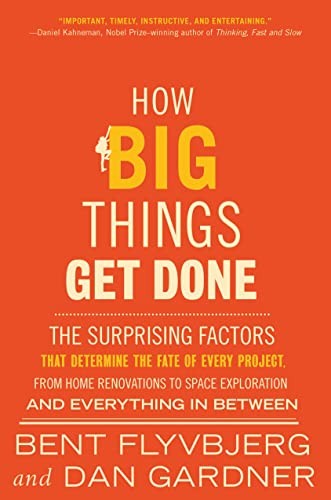
In the subtitle, "the surprising factors that determine the fate of every project", the "surprising" is clickbait. But that's a good thing I guess, maybe means I've learned something over the years. Nevertheless, the book is dramatic, interesting and quite readable.
Flyvbjerg, a professor and consultant for megaproject management, compiled a huge database of megaprojects. This book seems to be the fit-for-public compilation of his research an experience. Packed with fascinating stories of great success (Empire State building, Guggenheim Bilbao) and hard(ly) success (Sydney Opera House, Heaven's Gate), interviews with Edwin Catmull, Franck Gehry and Daniel Kahnemann.
I think the practical point that stood out most for me is that the most accurate forecasting method is to refer to other completed projects of …
Well, I made a paper model after reading this one and talked to a bunch of people about it as I was reading it.
In the subtitle, "the surprising factors that determine the fate of every project", the "surprising" is clickbait. But that's a good thing I guess, maybe means I've learned something over the years. Nevertheless, the book is dramatic, interesting and quite readable.
Flyvbjerg, a professor and consultant for megaproject management, compiled a huge database of megaprojects. This book seems to be the fit-for-public compilation of his research an experience. Packed with fascinating stories of great success (Empire State building, Guggenheim Bilbao) and hard(ly) success (Sydney Opera House, Heaven's Gate), interviews with Edwin Catmull, Franck Gehry and Daniel Kahnemann.
I think the practical point that stood out most for me is that the most accurate forecasting method is to refer to other completed projects of the same class, the more the better. This helps account for unknown unknowns & black swans which we otherwise don't factor in due to latent human optimism.
So read about how the Sydney Opera house went 14 times over budget and the architect was forced out half way, leaving Australia never to return. Read about how Pixar films go through ~8 iterations of feature-length, hand-drawn slide shows before being developed. And how solar and wind are the most reliably on budget of all project classes.
(And this is definitely an engineering book. While conscious of climate change, it goes on to suggest carbon capture and storage as a serious technology. And one of the examples of success is the expansion of Heathrom terminal 5... it is steeped in Capitalism Realism. Still valid and useful and helpful for doing stuff, just don't come for your critical theory.)
Whether you work in business or schools, volunteer in neighborhoods or church organizations, or are …
"When only the most productive hens were selected to breed, egg productivity declined over the course of five generations. Why? The most productive hens in each group achieved their productivity by bullying the other hens, a heritable behavior in chickens."
Whether you work in business or schools, volunteer in neighborhoods or church organizations, or are …
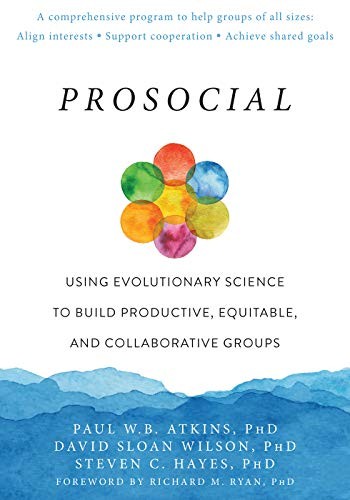
Commons theory + evolutionary theory + mindfulness
4 stars
This is a book about working in groups, and while the target audience seem to be companies most of the content is transferrable to non-profits or anti-profits.
The 3 co-authors are all guys with PhDs, psychologists. Hayes seems to be one of the main people behind Acceptance and Commitment Therapy, which seems to be the Cognitive Behavioural Therapy + Mindfulness.
The theoretical basis of the book is multi level selection (evolutionary) theory (MLS)+ commons theory. MLS expands Darwin's model of genetic & epigenetic variability, heritability and fitness to include learning & culture. They claim this expanded model accounts for social innovations and that the 'fitness' of humans really can't be accounted for if learning and culture are ignored. Apparently MLS is the mainstream evolutionary theory, so we can all stop straw-manning "hard geneticists" and their "selfish gene".
I skimmed the chapter on commons theory, but I think …
This is a book about working in groups, and while the target audience seem to be companies most of the content is transferrable to non-profits or anti-profits.
The 3 co-authors are all guys with PhDs, psychologists. Hayes seems to be one of the main people behind Acceptance and Commitment Therapy, which seems to be the Cognitive Behavioural Therapy + Mindfulness.
The theoretical basis of the book is multi level selection (evolutionary) theory (MLS)+ commons theory. MLS expands Darwin's model of genetic & epigenetic variability, heritability and fitness to include learning & culture. They claim this expanded model accounts for social innovations and that the 'fitness' of humans really can't be accounted for if learning and culture are ignored. Apparently MLS is the mainstream evolutionary theory, so we can all stop straw-manning "hard geneticists" and their "selfish gene".
I skimmed the chapter on commons theory, but I think they did a good job for people new to it. They reformulated Ostrom's 8 principles in a convincing and accessible way.
The chapter on the evolution of learning was quite interesting from habituation, to classical condition, to social learning (e.g. mimicry), to operant conditioning, to symbolic learning. Not very detailed, but stands out as being the clearest I've heard the differences being described.
The second part of the book, the larger half, was less interesting. Here the authors go through their reformulations of the commons principles and how they apply to groups. The anecdotes and experiences are interesting, and there are some practical tips in there. However it's pretty dry... professional I guess. It feels steeped in Capitalist Realism — see book of same name by Mark Fisher. And they have this 4-quadrant matrix thing that they claim solves everything, and refer to the Prosocial method a lot ("Prosocial" appears over 300 times in the book!) which gives a strong taste of trying to establish a brand.
I recommend the first part (4 chapters on theory) but can't really recommend the second part.