Jessica reviewed What Moves the Dead by T. Kingfisher
None
3 stars
Entertaining, but thoroughly predictable. I definitely liked the ternary gender system.
English language
Published July 10, 2022 by Doherty Associates, LLC, Tom.
Entertaining, but thoroughly predictable. I definitely liked the ternary gender system.
This is a novella based on Edgar Allan Poe’s The Fall of the House of Usher. In the 1890s; Easton, a former soldier of the Gallacia, visits kan old friend Madeline Usher at her family’s ancestral seat on the news that she may be dying. The house is decaying and covered in fungus; only a few servants remain (Madeline’s maid jumped from the roof a few months prior) while her nervous wreck of a brother has only an American doctor to rely on who is baffled by Madeline’s ailment. As Easton attempts to help the family, ka uncovers a mystery around the glowing lake and unsettling wildlife that just won't die.
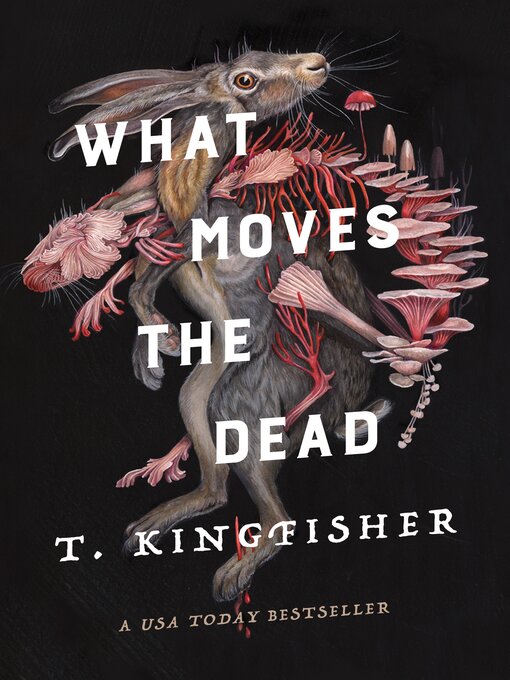
If you’re up for some gothic horror, mycelial zombie hares, a soldier whose gender/pronouns are simply “soldier”, and regular English jibes at Americans then this is worth picking up. I enjoyed the characters a lot, especially Easton and …
This is a novella based on Edgar Allan Poe’s The Fall of the House of Usher. In the 1890s; Easton, a former soldier of the Gallacia, visits kan old friend Madeline Usher at her family’s ancestral seat on the news that she may be dying. The house is decaying and covered in fungus; only a few servants remain (Madeline’s maid jumped from the roof a few months prior) while her nervous wreck of a brother has only an American doctor to rely on who is baffled by Madeline’s ailment. As Easton attempts to help the family, ka uncovers a mystery around the glowing lake and unsettling wildlife that just won't die.
If you’re up for some gothic horror, mycelial zombie hares, a soldier whose gender/pronouns are simply “soldier”, and regular English jibes at Americans then this is worth picking up. I enjoyed the characters a lot, especially Easton and the English lady providing the mushroom nerdery, and I’m always here for fungal horror vibes. It gives it a blend of old and modern horror.
I have never read The Fall of the House of Usher, so I cannot comment on references to the original.
I read Mexican Gothic last year and saw people comparing it with this one, so I was not surprised to see the similarities, or to see in the authors note that they were inspired by MG. I did however find this to be more enjoyable. It felt more streamlined and didn't drag on in any areas. I'm looking forward to reading the sequel to see where it goes.
I have never read The Fall of the House of Usher, so I cannot comment on references to the original.
I read Mexican Gothic last year and saw people comparing it with this one, so I was not surprised to see the similarities, or to see in the authors note that they were inspired by MG. I did however find this to be more enjoyable. It felt more streamlined and didn't drag on in any areas. I'm looking forward to reading the sequel to see where it goes.
Great retelling of the classic Poe story, with some actual horrific moments. While some elements were pretty obvious, it was still gripping and Kingfisher managed to keep it not too long, while also extending the original store which was actually too short!
So, it's not very scary or anything. It also has soldiers, which often makes me dislike stories. But ah. This one is exactly right for me. It has the right kind of mushrooms and queerness and feminism and I enjoyed so many little details in it.
So, it's not very scary or anything. It also has soldiers, which often makes me dislike stories. But ah. This one is exactly right for me. It has the right kind of mushrooms and queerness and feminism and I enjoyed so many little details in it.
I enjoyed this from start to finish. I really liked the characters and connected with Alex Easton immediately. The remote location constrained the setting and I felt immersed in it. The contemporary treatment of gender was interesting, relevant to the story and understated. And the story was as creepy as heck.
Oh my gosh, I was really really enjoying this book up until maybe the last three chapters. Incredible how it pivoted so hard. I couldn't help but compare this to Mexican Gothic, a book I was a fan of. But this improved on that story in so many ways. The creepiness factor was really dialed up, and I found myself to be legitimately freaked out at times. I loved the body horror and almost alien, incomprehensible horror that they were trying to uncover. However all of that went downhill when Madeline, quite predictably, arose from the dead, being controlled by the fungus. That in and of itself wasn't an issue. I thought that was creepy. But having possessed a human, it gave voice to the fungus, which was apparently semi-conscious, had motivations, and was like a child wanting to learn more. There was a comically bad scene of Madeline moaning …
Oh my gosh, I was really really enjoying this book up until maybe the last three chapters. Incredible how it pivoted so hard. I couldn't help but compare this to Mexican Gothic, a book I was a fan of. But this improved on that story in so many ways. The creepiness factor was really dialed up, and I found myself to be legitimately freaked out at times. I loved the body horror and almost alien, incomprehensible horror that they were trying to uncover. However all of that went downhill when Madeline, quite predictably, arose from the dead, being controlled by the fungus. That in and of itself wasn't an issue. I thought that was creepy. But having possessed a human, it gave voice to the fungus, which was apparently semi-conscious, had motivations, and was like a child wanting to learn more. There was a comically bad scene of Madeline moaning like a zombie, pleading with the main character to help the fungus learn and grow. It instantly dashed the scariest part of the book, which was that this was a horrific, inescapable thing that happens because fungus doesn't have motivations, and it is a horrific thought that something without motivation can do such terrible things to living beings for seemingly no other reason than to propagate. A hard truth in nature. But making the fungus sentient just ruined it for me, honestly. I want to give the book credit for how gripped it was the majority of the time, but boy was this a disappointing ending.
Merged review:
Oh my gosh, I was really really enjoying this book up until maybe the last three chapters. Incredible how it pivoted so hard. I couldn't help but compare this to Mexican Gothic, a book I was a fan of. But this improved on that story in so many ways. The creepiness factor was really dialed up, and I found myself to be legitimately freaked out at times. I loved the body horror and almost alien, incomprehensible horror that they were trying to uncover. However all of that went downhill when Madeline, quite predictably, arose from the dead, being controlled by the fungus. That in and of itself wasn't an issue. I thought that was creepy. But having possessed a human, it gave voice to the fungus, which was apparently semi-conscious, had motivations, and was like a child wanting to learn more. There was a comically bad scene of Madeline moaning like a zombie, pleading with the main character to help the fungus learn and grow. It instantly dashed the scariest part of the book, which was that this was a horrific, inescapable thing that happens because fungus doesn't have motivations, and it is a horrific thought that something without motivation can do such terrible things to living beings for seemingly no other reason than to propagate. A hard truth in nature. But making the fungus sentient just ruined it for me, honestly. I want to give the book credit for how gripped it was the majority of the time, but boy was this a disappointing ending.
Content warning spoilers for the whole book and the original
If the original Fall of the House of Usher is a gloomy campfire tale, then I'd characterize the retelling as body horror with gender vibes. Vernon's version fleshes out both the characters and the world itself. It's set in a fictional Galacia, the narrator gets a batman, Madeline and the doctor get a lot more page time, and also introduces the delightful Eugenia Potter.
I reread the original[*] before I started, which was added a lot to my enjoyment of this version. Apart from the main plot parallels, having read the original made me appreciate a lot of the word choices too (e.g. sedges, tarn), and notice details (like the fungus digressions, or the single sentence mention of a doctor, who I suspect is the source of Denton in this version).
The gender angle (of course, for me) was a delight. I like the idea of an occupation being a gender in and of itself that can transcend bodies or other signifiers, and can be worn either temporarily or forever. It was fun worldbuilding, but only tied (loosely, in my opinion) into the plot.
On that note, I enjoyed all of the pieces going on here, but I am not convinced they all worked together in a way that supported each other. Galacia and its uniquely gendered army were fun to read about, and the war trauma worked well in the context of a horror story. However, I couldn't help but feel like it was an entire second story inserted here that was working a little at odds with the main thrust of the first story.
I was also a little sad about some details of the ending itself (which Vernon also expressed in the author's note at the end), but overall I admit that it is hard to see a retelling of the House of Usher end any way but the House of Usher sinking into the tarn.
I'm sure I read The Fall of the House of Usher at some point, but I didn't retain enough that I had any particular expectations for the direction of the plot, etc.
However, I did read Mexican Gothic relatively recently, so I spent a good deal of What Moves the Dead, once the overall shape of the story became apparent, nodding along and waiting for the characters to catch up - it gave me a chuckle to see the reference to Mexican Gothic in the author's note.
Great writing, an intriguing reimagination of the classic.
I'm sure I read The Fall of the House of Usher at some point, but I didn't retain enough that I had any particular expectations for the direction of the plot, etc.
However, I did read Mexican Gothic relatively recently, so I spent a good deal of What Moves the Dead, once the overall shape of the story became apparent, nodding along and waiting for the characters to catch up - it gave me a chuckle to see the reference to Mexican Gothic in the author's note.
Great writing, an intriguing reimagination of the classic.
Content warning mild spoilers for the whole book
I found The Fall Of The House Of Usher intriguing but ultimately frustrating, and judging by the author's note at the end of this book, so did Ursula Vernon. Her reworking does a great job of keeping the atmosphere of the original while filling it out to be much more of a satisfying story, with clearer reasons behind what happens and much more compelling characters.
I love how the narrator has so much of their own story, and it's mostly made relevant to the core story of the book. And the mystery aspect is very well done, with that tantalising sense that we as readers are just slightly ahead of Easton & Denton in figuring out what's going on and what will have to happen. I also appreciated how Roderick gets to be more of an actor in this telling rather than a pure victim, and I'm intrigued by the ambiguity of whether Madeline also is one or whether we're purely hearing from the fungus towards the end of the book. It must be tempting when writing a story that fills in so many gaps from the original to fill in every gap, and I think stopping short of doing that was a very good move.
I found The Fall Of The House Of Usher intriguing but ultimately frustrating, and judging by the author's note at the end of this book, so did Ursula Vernon. Her reworking does a great job of keeping the atmosphere of the original while filling it out to be much more of a satisfying story, with clearer reasons behind what happens and much more compelling characters.
I love how the narrator has so much of their own story, and it's mostly made relevant to the core story of the book. And the mystery aspect is very well done, with that tantalising sense that we as readers are just slightly ahead of Easton & Denton in figuring out what's going on and what will have to happen. I also appreciated how Roderick gets to be more of an actor in this telling rather than a pure victim, and I'm intrigued by …
I found The Fall Of The House Of Usher intriguing but ultimately frustrating, and judging by the author's note at the end of this book, so did Ursula Vernon. Her reworking does a great job of keeping the atmosphere of the original while filling it out to be much more of a satisfying story, with clearer reasons behind what happens and much more compelling characters.
I love how the narrator has so much of their own story, and it's mostly made relevant to the core story of the book. And the mystery aspect is very well done, with that tantalising sense that we as readers are just slightly ahead of Easton & Denton in figuring out what's going on and what will have to happen. I also appreciated how Roderick gets to be more of an actor in this telling rather than a pure victim, and I'm intrigued by the ambiguity of whether Madeline also is one or whether we're purely hearing from the fungus towards the end of the book. It must be tempting when writing a story that fills in so many gaps from the original to fill in every gap, and I think stopping short of doing that was a very good move.
This novella retells Poe's "The Fall of the House Usher" as a sci-fi body horror while retaining the gothic flavor with some delightful humor in the mix. What made this truly outstanding was the the recasting of the narrator as non-binary in a way that the transcended simple inclusion and allowed the language to add more layers of meaning. This was a very rewarding read.
This novella retells Poe's "The Fall of the House Usher" as a sci-fi body horror while retaining the gothic flavor with some delightful humor in the mix. What made this truly outstanding was the the recasting of the narrator as non-binary in a way that the transcended simple inclusion and allowed the language to add more layers of meaning. This was a very rewarding read.