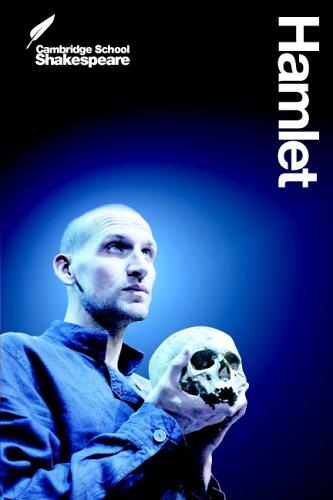
The Tragedy of Hamlet, Prince of Denmark, often shortened to Hamlet , is a tragedy written by William Shakespeare sometime between 1599 and 1601. It is Shakespeare's longest play, with 29,551 words. Set in Denmark, the play depicts Prince Hamlet and his revenge against his uncle, Claudius, who has murdered Hamlet's father in order to seize his throne and marry Hamlet's mother. Hamlet is considered among the most powerful and influential works of world literature, with a story capable of "seemingly endless retelling and adaptation by others". It was one of Shakespeare's most popular works during his lifetime and still ranks among his most performed, topping the performance list of the Royal Shakespeare Company and its predecessors in Stratford-upon-Avon since 1879. It has inspired many other writers—from Johann Wolfgang von Goethe and Charles Dickens to James Joyce and Iris Murdoch—and has been described as "the world's most filmed story after …
The Tragedy of Hamlet, Prince of Denmark, often shortened to Hamlet , is a tragedy written by William Shakespeare sometime between 1599 and 1601. It is Shakespeare's longest play, with 29,551 words. Set in Denmark, the play depicts Prince Hamlet and his revenge against his uncle, Claudius, who has murdered Hamlet's father in order to seize his throne and marry Hamlet's mother.
Hamlet is considered among the most powerful and influential works of world literature, with a story capable of "seemingly endless retelling and adaptation by others". It was one of Shakespeare's most popular works during his lifetime and still ranks among his most performed, topping the performance list of the Royal Shakespeare Company and its predecessors in Stratford-upon-Avon since 1879. It has inspired many other writers—from Johann Wolfgang von Goethe and Charles Dickens to James Joyce and Iris Murdoch—and has been described as "the world's most filmed story after Cinderella".The story of Shakespeare's Hamlet was derived from the legend of Amleth, preserved by 13th-century chronicler Saxo Grammaticus in his Gesta Danorum, as subsequently retold by the 16th-century scholar François de Belleforest. Shakespeare may also have drawn on an earlier Elizabethan play known today as the Ur-Hamlet, though some scholars believe Shakespeare wrote the Ur-Hamlet, later revising it to create the version of Hamlet that exists today. He almost certainly wrote his version of the title role for his fellow actor, Richard Burbage, the leading tragedian of Shakespeare's time. In the 400 years since its inception, the role has been performed by numerous highly acclaimed actors in each successive century.
Three different early versions of the play are extant: the First Quarto (Q1, 1603); the Second Quarto (Q2, 1604); and the First Folio (F1, 1623). Each version includes lines and entire scenes missing from the others. The play's structure and depth of characterisation have inspired much critical scrutiny. One such example is the centuries-old debate about Hamlet's hesitation to kill his uncle, which some see as merely a plot device to prolong the action but which others argue is a dramatisation of the complex philosophical and ethical issues that surround cold-blooded murder, calculated revenge, and thwarted desire. More recently, psychoanalytic critics have examined Hamlet's unconscious desires, while feminist critics have re-evaluated and attempted to rehabilitate the often-maligned characters of Ophelia and Gertrude.
It is hard to read Hamlet for what it is, because so many of our sayings and our literature have been shaped by it. And it really is for that reason that any English speaker should read Hamlet at least once.
Now I know that reviewing Shakespeare is kind of strange, I mean, he's the GOAT right? But, I'm just your average person who doesn't appreciate hardcore literature unless someone explains why it's good. And even after someone explaining why it's good I have some serious issues with this book (mostly just one big one,) and there are definitely some things that need to be unpacked. Antiquity, of course, should never be the decider as to whether or not something deserves critique. Let's start off with the positives.... THE DRAMA IS TANGIBLE The interaction of political and overwhelmingly personal relationships creates both an emotional and action-filled plot, right down to the end. If I didn't have to …
In short, while I enjoyed the overall plot, I do think that the end is a complete cop out. It's like the book equivalent to the final episode of Lost.
Now I know that reviewing Shakespeare is kind of strange, I mean, he's the GOAT right? But, I'm just your average person who doesn't appreciate hardcore literature unless someone explains why it's good. And even after someone explaining why it's good I have some serious issues with this book (mostly just one big one,) and there are definitely some things that need to be unpacked. Antiquity, of course, should never be the decider as to whether or not something deserves critique. Let's start off with the positives.... THE DRAMA IS TANGIBLE The interaction of political and overwhelmingly personal relationships creates both an emotional and action-filled plot, right down to the end. If I didn't have to concentrate so damn hard to understand Middle English I probably would have finished this in one sitting. You can actually feel Hamlet's heartache as his mother and uncle dad get down to some shady business.
THE CHARACTER DEVELOPMENT IS AWESOME Though I do find the amount the characters talk to themselves incredibly strange, it allows for the unicorn of character development to cha cha slide up in this. The plays' namesake goes from grief stricken to crazy town, but through his soliloquy's Hamlet's true issues are revealed.
TO THAT ENDING... Now my main issue with this novel (as previously mentioned,) is it's ending. I honestly think it's about as lazy as the "it was all a dream" trope. Rather than come up with a creative ending, and actually wrap up the plot and character development, Shakespeare chose to just kill off all the characters. Yes, it was dramatic. And yes, it was effective. But seriously??? Could you imagine if J.K. Rowling had just ended Harry Potter by nuclear bombing Hogwarts and killing everyone except Malfoy?
Overall I did find this classic pretty entertaining, especially after acting it out in class (I was Polonius.)