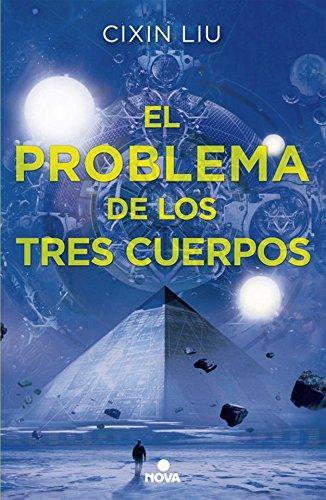

The Three-Body Problem (Chinese: 三体; lit. 'Three-Body'; pinyin: sān tǐ) is a science fiction novel by the Chinese writer Liu Cixin. The title refers to the three-body problem in orbital mechanics. It is the first novel of the Remembrance of Earth's Past (Chinese: 地球往事) trilogy, but Chinese readers generally call the whole series The Three-Body Problem. The trilogy's second and third novels are The Dark Forest and Death's End. The Three-Body Problem was serialized in Science Fiction World in 2006 and published as a book in 2008. It became one of the most popular science fiction novels in China. It received the Chinese Science Fiction Yinhe ("Galaxy") Award in 2006. A Chinese film adaptation of the same name was in production by 2015, but halted soon after. The English translation by Ken Liu was published by Tor Books in 2014. Thereafter, it became the first Asian novel ever to win …
The Three-Body Problem (Chinese: 三体; lit. 'Three-Body'; pinyin: sān tǐ) is a science fiction novel by the Chinese writer Liu Cixin. The title refers to the three-body problem in orbital mechanics. It is the first novel of the Remembrance of Earth's Past (Chinese: 地球往事) trilogy, but Chinese readers generally call the whole series The Three-Body Problem. The trilogy's second and third novels are The Dark Forest and Death's End.
The Three-Body Problem was serialized in Science Fiction World in 2006 and published as a book in 2008. It became one of the most popular science fiction novels in China. It received the Chinese Science Fiction Yinhe ("Galaxy") Award in 2006. A Chinese film adaptation of the same name was in production by 2015, but halted soon after.
The English translation by Ken Liu was published by Tor Books in 2014. Thereafter, it became the first Asian novel ever to win a Hugo Award for Best Novel, and was nominated for the Nebula Award for Best Novel.The series portrays a future where, in the first book, the Earth is awaiting an invasion from the closest star system, which in this universe consists of three solar-type stars orbiting each other in an unstable three-body system, with a single Earth-like planet unhappily being passed among them and suffering extremes of heat and cold, as well as the repeated destruction of its intelligent civilizations.
Es el primero de una trilogía. Me ha gustado, aunque hay algunas cosas "científicas" que me han parecido muy simplonas. De cualquier forma, estoy leyendo el segundo, y creo que también leeré el tercero. Lo recomiendo.
Es el primero de una trilogía. Me ha gustado, aunque hay algunas cosas "científicas" que me han parecido muy simplonas.
De cualquier forma, estoy leyendo el segundo, y creo que también leeré el tercero.
Lo recomiendo.
Much of the novel assumes a tone of gossamer fantasy, still with the heft of a folktale. Think of fabric draping a central space into being, over a solid floor.
There is video gaming (along with rally and militarism) as theatre, perhaps most overtly, but the whole story is almost palpably sited within in staging containers — which mostly stretch or are transcended rather gently, in contrast to the claustrophobic violence possessing and constricting the gap in the crowd, the logged woods, the cramped room, the retina, the battered biosphere, the rigid formation, the traumatic shared memory, the laden canal, the proton.
For its themes, The Three-Body Problem is a very comfortable read. The “hard sci‐fi” elements are good fun, silly (or playful and open) without committing to ridiculous abandon. Although, on occasion, explanatory dialogue felt condescendingly conspicuous, on the whole, Liu’s devices moved smoothly enough. There are …
Much of the novel assumes a tone of gossamer fantasy, still with the heft of a folktale. Think of fabric draping a central space into being, over a solid floor.
There is video gaming (along with rally and militarism) as theatre, perhaps most overtly, but the whole story is almost palpably sited within in staging containers — which mostly stretch or are transcended rather gently, in contrast to the claustrophobic violence possessing and constricting the gap in the crowd, the logged woods, the cramped room, the retina, the battered biosphere, the rigid formation, the traumatic shared memory, the laden canal, the proton.
For its themes, The Three-Body Problem is a very comfortable read. The “hard sci‐fi” elements are good fun, silly (or playful and open) without committing to ridiculous abandon. Although, on occasion, explanatory dialogue felt condescendingly conspicuous, on the whole, Liu’s devices moved smoothly enough. There are some beautiful scenes. The storytelling is both generous and measured; hospitable.
Hmm, the bits about the scientist and the cop were good, but the computer game stuff and the Trisolaris stuff was a bit silly. Although I did like the "dehydration" aspect. Not read anything like this before!
I was surprised to read a Chinese sci-fi novel, but it's an interesting perspective on it. At first I thought this is going to be all about China, being for or against the CCP regime and a bit of sci-fi sprinkled on it, but it was the opposite!
The parts that were leaning on it being in China were great, it's a different view on how to write sci-fi, which is usually VERY centered on the US. I hope for more non-US authors in the sci-fi world, there's a lot to explore here.
The ending surprised me, because I read through it much faster than I thought. This should be a good thing, but I only noticed how far in I was, because I couldn't believe that this is how it's gonna end. It was a bit disappointing, but it's a trilogy, so and it felt very much …
I was surprised to read a Chinese sci-fi novel, but it's an interesting perspective on it. At first I thought this is going to be all about China, being for or against the CCP regime and a bit of sci-fi sprinkled on it, but it was the opposite!
The parts that were leaning on it being in China were great, it's a different view on how to write sci-fi, which is usually VERY centered on the US. I hope for more non-US authors in the sci-fi world, there's a lot to explore here.
The ending surprised me, because I read through it much faster than I thought. This should be a good thing, but I only noticed how far in I was, because I couldn't believe that this is how it's gonna end. It was a bit disappointing, but it's a trilogy, so and it felt very much written in such a way to build upon.
I'm not sure if I will read the rest, but I'd say it's okay. I'm not sure why people are into this story so much, it read a bit wooden at times, but that could be owing to it being a translation. Maybe people are just eager to read something non-US, which I totally get.
Review of 'El problema de los tres cuerpos' on 'Goodreads'
3 stars
Empecé con muchas ganas este ganador del Premio Hugo de 2015. Ciencia ficción "hard", de una cultura un tanto exótica para mí como la china, y con aplauso unánime de la crítica, prometía mucho. Y no es que sea una mala lectura ni mucho menos, pero me ha acabado decepcionando bastante.
Se dice que el autor está muy influido por Asimov, Clarke y similares, y la verdad es que sí: la trama contiene muchos elementos que podían haber sido originales en los años 60, pero que desde luego hoy en día no lo son, al menos en Occidente. El personaje principal es bastante plano; los secundarios, que tenían mimbres para ser interesantes, acaban resultando estereotípicos; el hecho de que la novela acabe en un "continuará" (es el primer libro de una trilogía) no ayuda tampoco a la redondez de la trama.
En otros aspectos donde se ven influencias de otros …
Empecé con muchas ganas este ganador del Premio Hugo de 2015. Ciencia ficción "hard", de una cultura un tanto exótica para mí como la china, y con aplauso unánime de la crítica, prometía mucho. Y no es que sea una mala lectura ni mucho menos, pero me ha acabado decepcionando bastante.
Se dice que el autor está muy influido por Asimov, Clarke y similares, y la verdad es que sí: la trama contiene muchos elementos que podían haber sido originales en los años 60, pero que desde luego hoy en día no lo son, al menos en Occidente. El personaje principal es bastante plano; los secundarios, que tenían mimbres para ser interesantes, acaban resultando estereotípicos; el hecho de que la novela acabe en un "continuará" (es el primer libro de una trilogía) no ayuda tampoco a la redondez de la trama.
En otros aspectos donde se ven influencias de otros autores, los extraterrestres, lejanos y enigmáticos pero a la vez muy humanos, me recuerdan poderosamente a los de Los Propios Dioses; el juego de realidad virtual no puede menos de sonarnos a Ender... Pero todo ello con menos fuerza que las referencias originales.
Curiosamente, donde me parece que el libro se vuelve más vivo y brillante es en sus regresiones sobre China, la Revolución Cultural y su evolución posterior. Quizás es simplemente por mi desconocimiento sobre el tema, pero los capítulos centrados en ese tema se me hicieron mucho más interesantes.
El libro se lee bien, entretiene y es de lectura ágil, pero esperaba algo más. No sé si continuaré con los otros dos libros de la trilogía, tocará pensarlo.
Although this book is really physics-inspired (just look at the name), it is not actually intended for physicists, and more for the general public (which is good! Just not expected). Let me explain:
I just finished my B.A. in physics, and although I'm in no means an expert, I do have certain knowledge in the field. This caused an unexpected problem for me.
The physicists in the book (except Ye Wenji maybe) aren't believable. They lack basic knowledge that all physicists have, or understand the situation far slower than expected.
For example, let's look at the 3body game. As a non-expert with limited knowledge, I was able to understand the mechanics of the game within the first chapter of it. For Wang, en expert with years more of experience it took 3 another several chapters.
Of course, this is not a problem for most people (I guess), since most people …
Although this book is really physics-inspired (just look at the name), it is not actually intended for physicists, and more for the general public (which is good! Just not expected). Let me explain:
I just finished my B.A. in physics, and although I'm in no means an expert, I do have certain knowledge in the field. This caused an unexpected problem for me.
The physicists in the book (except Ye Wenji maybe) aren't believable. They lack basic knowledge that all physicists have, or understand the situation far slower than expected.
For example, let's look at the 3body game. As a non-expert with limited knowledge, I was able to understand the mechanics of the game within the first chapter of it. For Wang, en expert with years more of experience it took 3 another several chapters.
Of course, this is not a problem for most people (I guess), since most people didn't a whole course named "Chaos Theory" last semester. Therefore of course the reader would have to introduce those concepts at a slower pace. But it is a problem for the people who did, and so we get to my earlier statement:
This is a great physics-inspired sci fi book for the general public. But if you have physics knowledge, don't expect to be surprised too much.
Really intriguing premise, but not well-written. I really struggled to finish this -- the writing (or the translation, I don't know) was very stiff, and I found it very hard to care about or sympathize with the characters.
Cixin Liu is a different voice in sci-fi - for someone brought up on western stories, Liu's story structure and background are odd, which makes it very refreshing to read. I had one minor problem with believability in the book, but otherwise I'm looking forward to reading the English translation of the next two books.
The tale is a sweeping one, filled with good sci-fi ideas and nothing less than the fate of humanity at stake. Like John Wright's Count to the Eschaton series, the fate of humanity rests in the hands of a few who know what's going on. Unlike anything else I've read, this book faces that challenge with the background of the Chinese Cultural Revolution driving the protagonists actions, and - here's where the refreshing part comes in - coloring the thoughts of alien minds as well.
If you've ever read the Night Watch books by Lukyanenko, …
Cixin Liu is a different voice in sci-fi - for someone brought up on western stories, Liu's story structure and background are odd, which makes it very refreshing to read. I had one minor problem with believability in the book, but otherwise I'm looking forward to reading the English translation of the next two books.
The tale is a sweeping one, filled with good sci-fi ideas and nothing less than the fate of humanity at stake. Like John Wright's Count to the Eschaton series, the fate of humanity rests in the hands of a few who know what's going on. Unlike anything else I've read, this book faces that challenge with the background of the Chinese Cultural Revolution driving the protagonists actions, and - here's where the refreshing part comes in - coloring the thoughts of alien minds as well.
If you've ever read the Night Watch books by Lukyanenko, or anything by Stanislaw Lem, after having been brought up on a steady diet of Asimov, Herbert, Clarke, and Niven, you'll understand the subtle and refreshing shift of perspective Liu's background brings. Really looking forward to the last book being translated, so I can take the rest of the series in at one go.
The best unexpected part of this book is all the perspective shifts. The presentation of miracles, and their explanations were satisfying, and the historical descriptions of the Chinese Cultural Revolution were tantalizing peeks into what the original Chinese language version of the story was like in structure.
It's a pessimistic view of what encountering extraterrestrial life would be like, without applying the same fear and dread to the emergence of strong AI, so while it's food for thought, it's not a perspective I feel I will ever share.
The best unexpected part of this book is all the perspective shifts. The presentation of miracles, and their explanations were satisfying, and the historical descriptions of the Chinese Cultural Revolution were tantalizing peeks into what the original Chinese language version of the story was like in structure.
It's a pessimistic view of what encountering extraterrestrial life would be like, without applying the same fear and dread to the emergence of strong AI, so while it's food for thought, it's not a perspective I feel I will ever share.
Man, this was a conceptually thick book. I can't vouch for most of the science as presented, but I can say that the effort expended in incorporating that much science into a story of an impending apocalypse was impressive. I didn't love it, but I enjoyed it.
I didn't know what to expect when picking this up. I added it to my "to read"list after hearing an interview with the translator, who was talking about his own writing. Overall, I liked it. It has a lot in common with classic science fiction in style, written in a very straightforward matter and with an eye not so much on the robots and gadgets as the effect of these things. It deals with the psychological and social issues involved with technology and our attempts to find others like us in the universe. The characters are fleshed out enough to make them relatable, but this isn't the kind of writing where the character spends paragraphs contemplating fire or mooning over a love interest. It is set on the backdrop of the Cultural Revolution in China which makes the story feel authentic, and would attract anyone interested in history. I will …
I didn't know what to expect when picking this up. I added it to my "to read"list after hearing an interview with the translator, who was talking about his own writing. Overall, I liked it. It has a lot in common with classic science fiction in style, written in a very straightforward matter and with an eye not so much on the robots and gadgets as the effect of these things. It deals with the psychological and social issues involved with technology and our attempts to find others like us in the universe. The characters are fleshed out enough to make them relatable, but this isn't the kind of writing where the character spends paragraphs contemplating fire or mooning over a love interest. It is set on the backdrop of the Cultural Revolution in China which makes the story feel authentic, and would attract anyone interested in history. I will most likely pick up the sequel once translated, just to see how far the story goes, if anything.