Nook&Cranny reviewed All Systems Red by Martha Wells (The Murderbot Diaries, #1)
Entertaining and quick read
5 stars
Watched the Apple TV series a while ago and knew I wanted to read the books. The first one was great and fun to read.
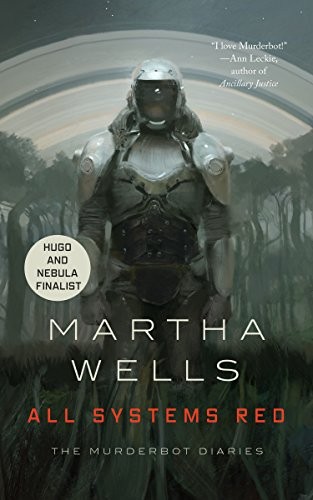
eBook, 156 pages
English language
Published Dec. 13, 2017 by Tor.com.
"As a heartless killing machine, I was a complete failure."
In a corporate-dominated spacefaring future, planetary missions must be approved and supplied by the Company. Exploratory teams are accompanied by Company-supplied security androids, for their own safety.
But in a society where contracts are awarded to the lowest bidder, safety isn’t a primary concern.
On a distant planet, a team of scientists are conducting surface tests, shadowed by their Company-supplied ‘droid — a self-aware SecUnit that has hacked its own governor module, and refers to itself (though never out loud) as “Murderbot.” Scornful of humans, all it really wants is to be left alone long enough to figure out who it is.
But when a neighboring mission goes dark, it's up to the scientists and their Murderbot to get to the truth.
"As a heartless killing machine, I was a complete failure."
In a corporate-dominated spacefaring future, planetary missions must be approved and supplied by the Company. Exploratory teams are accompanied by Company-supplied security androids, for their own safety.
But in a society where contracts are awarded to the lowest bidder, safety isn’t a primary concern.
On a distant planet, a team of scientists are conducting surface tests, shadowed by their Company-supplied ‘droid — a self-aware SecUnit that has hacked its own governor module, and refers to itself (though never out loud) as “Murderbot.” Scornful of humans, all it really wants is to be left alone long enough to figure out who it is.
But when a neighboring mission goes dark, it's up to the scientists and their Murderbot to get to the truth.
Watched the Apple TV series a while ago and knew I wanted to read the books. The first one was great and fun to read.
Content warning spoilers; 3rd reading
2026-02-07: reread for same work bookclub. Didn't remember this wonderful moment: [in response to revealing "murderbot" name: Harsh glare—"That was private". Chef's kiss.
2020-03-27: 5 stars; reread for my new work bookclub.
2018-02-03: 5 stars; read with a cool bookclub at Volume Books in Chicago.
Lighthearted, fun, and quick!
Im Vergleich zur Fernsehadaption etwas ernster, aber dafür noch besser.
I have not watched the TV show, but this first instance of this series of novellas was captivating fun. Looking forward to reading the other books.
Loved the tight little plot. A great intro to the cast of characters and conceits of the series. Murderbot's intense interiority is such a great idea. It feels in a way like an autistic insert into this interesting universe of corporations and free worlds. Despite that, the story is kept very very local and immediate-stakes, and resists explicit worldbuilding.
IMO a masterpiece.
Loved the tight little plot. A great intro to the cast of characters and conceits of the series. Murderbot's intense interiority is such a great idea. It feels in a way like an autistic insert into this interesting universe of corporations and free worlds. Despite that, the story is kept very very local and immediate-stakes, and resists explicit worldbuilding.
IMO a masterpiece.
Loved the tight little plot. A great intro to the cast of characters and conceits of the series. Murderbot's intense interiority is such a great idea. It feels in a way like an autistic insert into this interesting universe of corporations and free worlds. Despite that, the story is kept very very local and immediate-stakes, and resists explicit worldbuilding.
IMO a masterpiece.
Loved the tight little plot. A great intro to the cast of characters and conceits of the series. Murderbot's intense interiority is such a great idea. It feels in a way like an autistic insert into this interesting universe of corporations and free worlds. Despite that, the story is kept very very local and immediate-stakes, and resists explicit worldbuilding.
IMO a masterpiece.
After finishing the show (which has been renewed for a second season!) I thought I'd go back and check out the original to recall exactly what changes they made for the screen.
There weren't many — the show is pretty darn close to the novella. I guess having such tight clean source material means there isn't as much you need to cut. A lot of it was pretty streamlined — a couple of characters were merged, human thoughts and feelings get more screen time, making it more of an ensemble piece, and the addition of Leebeebee to make Murderbot more visually scary for us.
There's less detail to the tech/interface/hacking/hub system interactions. I don't think I've ever seen a hacking scene I really liked which both felt genuine and was visually interesting. (If you're wondering, the two best onscreen hacks are: 1. Trinity's use of nmap and the …
After finishing the show (which has been renewed for a second season!) I thought I'd go back and check out the original to recall exactly what changes they made for the screen.
There weren't many — the show is pretty darn close to the novella. I guess having such tight clean source material means there isn't as much you need to cut. A lot of it was pretty streamlined — a couple of characters were merged, human thoughts and feelings get more screen time, making it more of an ensemble piece, and the addition of Leebeebee to make Murderbot more visually scary for us.
There's less detail to the tech/interface/hacking/hub system interactions. I don't think I've ever seen a hacking scene I really liked which both felt genuine and was visually interesting. (If you're wondering, the two best onscreen hacks are: 1. Trinity's use of nmap and the SSH1 CRC32 exploit in Matrix Reloaded, which is realistic but visually mundane and only appears on screen for a few moments, making it more of an easter egg than anything else, and 2. Hugh Jackman assembling a hacking cube from an ancient server in Swordfish, none of which has any relationship to reality, but which is very flashy on screen and includes Hugh Jackman.
The biggest thing which felt different to me was the absence of Murderbot's ubiquitous use of micro drones and remote cameras as extensions of its sensorium. In the novella, I really felt like Murderbot was deeply connected to the feed and that looking through a remote camera or accessing a database was was as natural for it as reaching out a hand or looking in a particular direction is for us. There were definitely nods to this — it wasn't exactly forgotten — but it was considerably less ubiquitous and visceral than in the novella.
And I think this contributed to making it more of an ensemble piece. In the novellas, the reader doesn't have any senses: we're not watching or listening. We are reading an account composed by someone whose sensorium & perception are comprehensible but alien to us — like reading a cuttlefish talk about light polarization and how it's using chromatophores. And in fact I think that this is one of the deep strengths of the series. Murderbot is a killing machine with guns in its arms who experiences the world through drones & feeds and minimal fear of pain or death. But also, it's an autistic nerd treated as less than a person in a corporate dystopia and just wants to be left alone to watch its shows, just like the reader.
Anyway, this novella continues to delight. If you enjoyed the show and like to read, check it out. The books are very short and easy to get into, which makes it very easy to start and equally disappointing when you run out.
I've been watching the recent tv show and thought I'd give the books a reread so I could ground myself in the text again. Also brains have been bad, and Murderbot is such short grippy comfort fiction. I think what makes me come back to this (personally) is my empathy for Murderbot's exhaustion and horror around being asked to be a person.
Murderbot also epitomizes the mortifying ordeal of being known (but simultaneously the even more mortifying ordeal of being loved). There's so much joy for me in the grumpiness of the internal monologue. If I had to come up with a one sentence emotional arc for each book, this one would be Murderbot moving past apathy and learning that it does in fact want to protect (some) humans.
Confession time: I don’t actually know where we are
On a reread, I had also forgotten …
I've been watching the recent tv show and thought I'd give the books a reread so I could ground myself in the text again. Also brains have been bad, and Murderbot is such short grippy comfort fiction. I think what makes me come back to this (personally) is my empathy for Murderbot's exhaustion and horror around being asked to be a person.
Murderbot also epitomizes the mortifying ordeal of being known (but simultaneously the even more mortifying ordeal of being loved). There's so much joy for me in the grumpiness of the internal monologue. If I had to come up with a one sentence emotional arc for each book, this one would be Murderbot moving past apathy and learning that it does in fact want to protect (some) humans.
Confession time: I don’t actually know where we are
On a reread, I had also forgotten the level of indifference that Murderbot has, in terms of not even knowing what planet they're on. It's an aspect that comes through so much stronger in the original text.
I think the big appeal of this Hugo award winning novella was the care spent building the character of the viewpoint character. The author succeeded in giving Murderbot a convincingly non-human personality and interior life. I think of this as something distinct from worldbuilding, because that would be more a matter of fleshing out the natural and social structures the characters are placed in, which is there but I think as occupying definitely a second place in the concerns of the story. At the same time, there is a well managed increase in the level of suspense until the main action scene is complete, followed by a denouement where Murderbot does something both unexpected and in character which motivates the other stories in the series.
There is violent action in the story, but the graphic nature is blunted by the viewpoint of a SecBot who is accustomed to being …
I think the big appeal of this Hugo award winning novella was the care spent building the character of the viewpoint character. The author succeeded in giving Murderbot a convincingly non-human personality and interior life. I think of this as something distinct from worldbuilding, because that would be more a matter of fleshing out the natural and social structures the characters are placed in, which is there but I think as occupying definitely a second place in the concerns of the story. At the same time, there is a well managed increase in the level of suspense until the main action scene is complete, followed by a denouement where Murderbot does something both unexpected and in character which motivates the other stories in the series.
There is violent action in the story, but the graphic nature is blunted by the viewpoint of a SecBot who is accustomed to being repaired from a point of non-functionality over and over again. It understands that the humans it has been charged with to protect do not have this capability, and so logically places itself forward at the point of greatest peril on more than one occasion. It is interesting to see the the way human team interprets this as loyalty, altruism, and maybe courage even though Murderbot does not think any of those terms truly apply.
I like concentrated stories in the novella format which provides enough room to explore a number of different aspects to a character while still paying attention to a narrative drive much faster than a full-length novel. Not every novella-length story I have read can do that, but it is clear that well-versed in craft from her years producing well-regarded science fiction and fantasy.
(Reposting this now that this has been adapted into a miniseries on Apple+ TV)
"I could have become a mass murderer after I hacked my governor module, but then I realized I could access the combined feed of entertainment channels carried on the company satellites.[...]. As a heartless killing machine, I was a terrible failure.
That was a nice little entertainment. SecBot is a nice (but not new) mixture of laziness, virtues and superhuman skills and reminds me of Kvothe in the kingskiller chronicles. Thanks @reading tofu for the recommendation!
"I could have become a mass murderer after I hacked my governor module, but then I realized I could access the combined feed of entertainment channels carried on the company satellites.[...]. As a heartless killing machine, I was a terrible failure.
That was a nice little entertainment. SecBot is a nice (but not new) mixture of laziness, virtues and superhuman skills and reminds me of Kvothe in the kingskiller chronicles. Thanks @reading tofu for the recommendation!
The first three chapters take too much time to establish the protagonist as a metaphor for neurodiversity (especially AuDHD) but after that, the story evolves nicely and reads really fast.
short, fast-paced, funny. i too love muderbot. it's so endearing.
short, fast-paced, funny. i too love muderbot. it's so endearing.
Murderbot is a really compelling character. The story was a little thin, but it served mostly to introduce the character.
Murderbot's clearly depressed and has social anxiety, but deals with it the best they can. I loved the ending, but wonder if we'll see the Preservation crew again.
Freedom is a pure idea. It arises spontaneously, without instruction.
Murderbot is a really compelling character. The story was a little thin, but it served mostly to introduce the character.
Murderbot's clearly depressed and has social anxiety, but deals with it the best they can. I loved the ending, but wonder if we'll see the Preservation crew again.
Freedom is a pure idea. It arises spontaneously, without instruction.
I am reminded of one comment I read some time ago from somebody talking about machine intelligence - tehy weren't so much interested in what art a machine would make for humans, but what they would make for one another. To some extent, this series explores that.
I am reminded of one comment I read some time ago from somebody talking about machine intelligence - tehy weren't so much interested in what art a machine would make for humans, but what they would make for one another. To some extent, this series explores that.

































Purchasable
Purchasable
Purchasable
Purchasable
https://www.ebook.de/de/product/28297712/martha_wells_all_systems_red.html.https://www.ebook.de/de/product/28297712/martha_wells_all_systems_red.html.https://www.ebook.de/de/product/28297712/martha_wells_all_systems_red.html.https://www.ebook.de/de/product/28297712/martha_wells_all_systems_red.html.