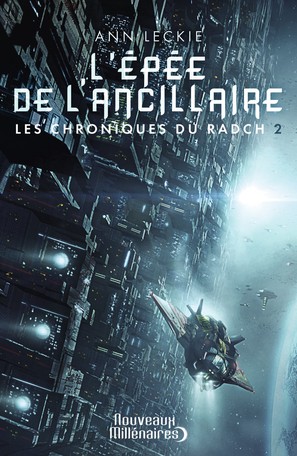

Breq is a soldier who used to be a warship. Once a weapon of conquest controlling thousands of minds, now she only has a single body and serves the emperor she swore to destroy. Given a new ship and a troublesome crew, Breq is ordered to the only place in the galaxy she will agree to go: to Athoek station, to protect the family of a lieutenant she once knew - a lieutenant she murdered in cold blood.
The Imperial Radch trilogy begins with Ancillary Justice, continues in Ancillary Swordand concludes with Ancillary Mercy. Also available now: Provenance is a stunning standalone adventure set in the same world as Ancillary Justice. NPR calls it 'A fitting addition to the Ancillary world'.
Breq is a soldier who used to be a warship. Once a weapon of conquest controlling thousands of minds, now she only has a single body and serves the emperor she swore to destroy.
Given a new ship and a troublesome crew, Breq is ordered to the only place in the galaxy she will agree to go: to Athoek station, to protect the family of a lieutenant she once knew - a lieutenant she murdered in cold blood.
The Imperial Radch trilogy begins with Ancillary Justice, continues in Ancillary Swordand concludes with Ancillary Mercy.
Also available now: Provenance is a stunning standalone adventure set in the same world as Ancillary Justice. NPR calls it 'A fitting addition to the Ancillary world'.
This book was really enjoyable, it hit very well in what I needed from a book right now, and it's continued adventures with people that we know and love :) Really a nice read.
It's always hard for me to separate what happens in Ancillary Sword and what happens in its sequel. Both books are set on the same station, deal with the same themes, and this book would feel incomplete without its sequel.
“I know that Ship appreciates it when you act for it, and your ancillary façade lets you feel safe and invisible. But being an ancillary isn’t something to play at.”
“No, sir. I can see that, sir. But like you said, Ship appreciates it. And Ship takes care of us, sir. Sometimes it feels like it’s us and Ship against everyone else.” Self-conscious. Embarrassed.
It's funny to me to turn to military scifi for feelings of found family, but what endears me to this book is the relationships between Ship and Breq and its crew. The human crew acts like ancillaries, which previously was a …
It's always hard for me to separate what happens in Ancillary Sword and what happens in its sequel. Both books are set on the same station, deal with the same themes, and this book would feel incomplete without its sequel.
“I know that Ship appreciates it when you act for it, and your ancillary façade lets you feel safe and invisible. But being an ancillary isn’t something to play at.”
“No, sir. I can see that, sir. But like you said, Ship appreciates it. And Ship takes care of us, sir. Sometimes it feels like it’s us and Ship against everyone else.” Self-conscious. Embarrassed.
It's funny to me to turn to military scifi for feelings of found family, but what endears me to this book is the relationships between Ship and Breq and its crew. The human crew acts like ancillaries, which previously was a way of dealing with a jerk captain but also is a way for the Ship to cope with no longer having ancillaries itself. Ship helps Breq deal with her own losses by sending her images and data from the ship and crew as if she were still one of many ancillaries herself.
Really, I love the way that the omniscient nature of Ship here allows the reader to see into the hidden emotional state of characters and to show moments that are "off camera" from the main narrative.
While Ancillary Justice gave us a sense of the world-spanning scale of of the Radch, Ancillary Sword brings things down to a single system and explores both Radchaai culture and the consequences of having been "civilised" by the Radch. Colonialism and corruption both play a big part in this story, which manages to be utterly engrossing throughout.
The only gripe is that this is very much the middle book of a trilogy and several threads are set up which will not be resolved until the next installment. As a consequence, the ending didn't deliver quite as much as I had hoped.
That said, Ancillary Sword is an excellent second installment and I shall be reading Ancillary Mercy just as soon as I lay my hands on it.
While Ancillary Justice gave us a sense of the world-spanning scale of of the Radch, Ancillary Sword brings things down to a single system and explores both Radchaai culture and the consequences of having been "civilised" by the Radch. Colonialism and corruption both play a big part in this story, which manages to be utterly engrossing throughout.
The only gripe is that this is very much the middle book of a trilogy and several threads are set up which will not be resolved until the next installment. As a consequence, the ending didn't deliver quite as much as I had hoped.
That said, Ancillary Sword is an excellent second installment and I shall be reading Ancillary Mercy just as soon as I lay my hands on it.
Different than Ancillary Justice, which is good - she didn't have to explain the Radch anymore, so could show us a corner of the Radch. I was struck with the how much I kept comparing the Radch to the Roman Empire - the way the religions of the conquered were made part of the Radch religion, the focus on citizenship of the conquered, the rituals and stress of propriety, all remind me of ancient Roman culture. This book moved along at a quick pace, and didn't waste a lot of time, but the Sword of Inil thread was lost on the way. I'm definitely looking forward to the last one...
Even better than the first book. For those frustrated by the flashback sequences of Ancillary Justice, there is none of that here. A few amazing twists that kept me on my toes. The book doesn't really end--yes, some major issues are resolved, but mostly the story just kinda peters out. I'm assuming this is because it's the middle book, and there wasn't an easy way to tidy things up without ruining plot scheduled for the last book. Looking forward to it!
Great book. I'm really into this universe. It is interesting and alien but... the emotions are detached but... like the first book there seemed to be no story. And then the action ramps up and realize what Ann Leckie was showing you, and how it was important. All those little details added up to something was, as usual, very interesting and new.